November, 1558
The year had not yet worn out its grief for Oliver Cromwell when the denizens of Garraway’s Coffee House set themselves to the work of deciding England’s future. Already a fixture for anyone with a penny for a cup and an hour of idle time, this was the place to gauge the thoughts of the people.
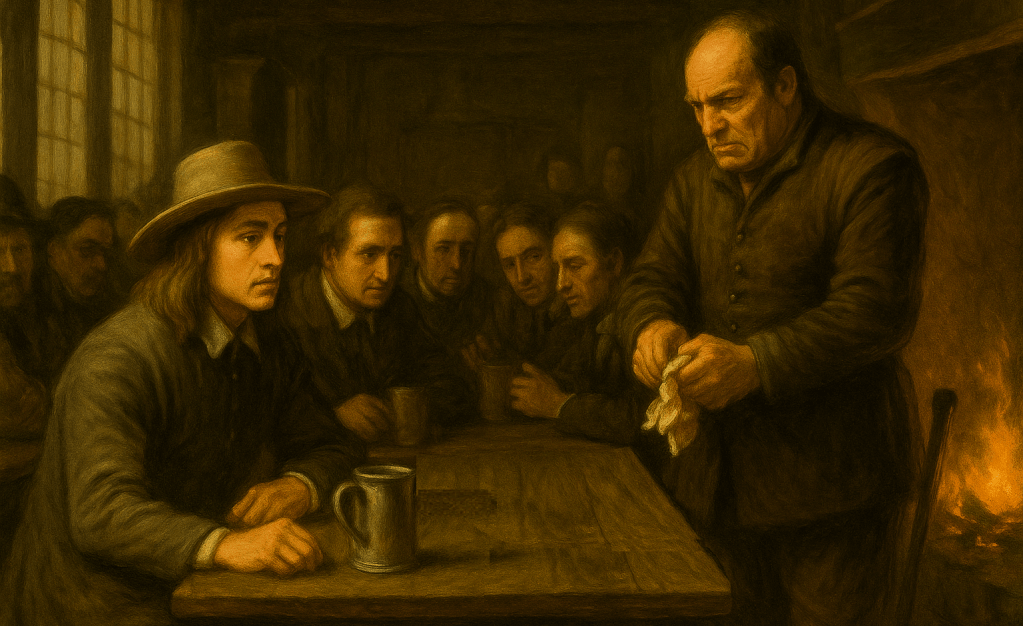
The room still carried the scent of its first year; the resinous sweetness of new oak beams and boards rising above the sharper aroma of fresh-ground coffee, all wrapped in a haze of tobacco—for clay pipes were an integral part of coffee house fashion. Light from tall, un-shuttered windows fell through the smoke across two long trestle tables, each flanked by plain benches where merchant, mariner, and messenger might sit beside landed gentry or even a former royal bold enough to make an appearance.
Humanity being what it is, the seating had sorted itself as it always does. At the fire’s end clustered the high-wigged sons of the wealthy, alongside the more powerful merchants, politicians, and guild leaders; their ledgers spread beside steaming cups. Nearer the door, messengers and small tradesmen bent over shared news-sheets, their fingers still scented of ink or tallow. Between these two poles ran the overlapping hum of gossip and Parliament talk, undercut by the metallic scrape of spoons in pewter mugs. As George Whitehead entered, a merchant’s laugh rang too loud, only to be swallowed at once by the low, serious murmur of political debate.
The brim of his hat low over uncut and unwigged locks, and his grey coat plain as stone, the twenty-one year old drew glances as inevitably as a candle draws moths. He neither slowed nor quickened his step, moving with the steady purpose of one intent upon his business. Under his arm he carried a folded broadsheet, the outer page belying a spatter of street mud. Hidden beneath it, pressed flat, was a small stack of Stephen Crisp’s pamphlets—ink still sharp on thin pages with words that had weight enough to bring trouble.
He crossed the creaking floorboards toward the far wall where the day’s news was spread over a long shelf, already littered with handbills, letters, and dog-eared pamphlets that had passed from hand to hand. These carried the ideas of every party—Royalist squibs, Republican declarations, and anonymous slanders of men dead and living alike.
With no pause, no furtive glance toward the door, he set the bundle down with a studied nonchalance, letting the broadsheet’s folds conceal what lay beneath. A half-second longer than necessary, he straightened the pile—just enough to make it appear part of the general disorder—before stepping away. The pamphlets were now part of a natural confusion of paper in a room where information changed hands as quickly as coin.
Moving toward the coffee booth, George passed a table where men leaned forward in earnest debate. One of them, a burly fellow with a coalman’s shoulders, stood and gestured toward the space he’d just vacated. “Friend,” he murmured, tapping the table with his knuckle. George nodded once and made his way to the counter.
That edifice was crowded with men in every cut of coat—apprentices with ink on their sleeves, merchants smelling faintly of pepper and salt, a thin barrister in his worn periwig. The keeper of the house, busy pouring a dark stream into a tin pot, gave George a curt nod.
The coffee was black and hot, the steam carrying an earthy bitterness that clung to his throat. Cup in hand, he threaded his way back, boots scuffing over sand strewn to catch the wet from customers’ shoes.
At the table, the men he’d seen continued deep in talk with heads bent close, voices pitched low.
“…Richard is not his father,” said one man in a plain shirt, beautifully woven. His thumb rubbed idly at the handle of his mug. “He has not the iron hand nor the—”
“—nor the sense to know when the game’s up,” said another who looked from face and fashion to be his son, a young man about George’s age. “It was folly to think the army would stomach his rule when they barely endured the first Lord Protector.”
“Barely endured, Robert?” The father’s eyebrows rose. “You’re too young to remember how they called him Deliverer at the start.” He glanced around the table and conceded, “Though by the end—” He hesitated as the door opened and two finely dressed lawyers entered, carrying leather packets stuffed with official-looking papers.
A well-appointed man sitting on a stool at the end of the table leaned in, “Aye, Bob, I ain’t afraid to say it. By the end, even the Republicans said his reign was naught but tyranny and ruin.” He tapped the table for emphasis. “The Republicans!”
The two lawyers, who were at the shelf looking half-heartedly across the collection of pages turned briefly though they could only see the man’s back.
“Peter,” Bob said, giving him a concerned shake of the head.
As George settled in, one nudged another and they turned to him. The coalman had come back with a few of the pamphlets, passing them secretively around the table. In a low voice he spoke for all. “We’ve longed for your opinion, Friend Whitehead…” he folded his copy of the pamphlet carefully, placing it in his coat. “And the truth about what they done to James Parnell.”
George sipped his coffee, letting its heat wash through him before he spoke. “The truth you have there, all of it. As to Oliver Cromwell, there is one thing that can be said,” he remarked, his tone even. “His concern was only with disorder. He did not trouble himself with the petty ruin of men for what they believed, so long as they kept the peace. This was a grace for us.”
A small silence followed—though young Robert scoffed. “Some grace that saw so many in prison.”
Others expressed agreement unspoken but felt.
The coalman nodded slowly. “No, it is true in some aspects,” he said. “And here we are, watching his son clutch after power with neither the fear of God nor the fear of the mob to guide him. If things have been bad for us already, are they about to become worse by his hand?”
“Aye, Mick, we are all afeared of the same thing.” This was Silas the glass merchant, his voice nasal with contempt. “It was folly for young Richard to think the name alone would hold the Council together. A boy raised in the shadow of the Protector thinks the shadow itself will serve in place of substance.”
Peter disagreed. “What’s he done about our wretched economy? His father’s Navigation Acts what was supposed to cut out the Dutch and make us rich puts the shipping cost up high fer me coats and blankets. I’m in wool, as some of ye know, and our guild don’t want new tariffs on either side. My goods can’t compete.”
“Aye, Peter, we linen men stand the same,” Bob said. “The Navigation Acts weren’t good for nothing but getting us into another expensive war and this time with our friends.” He looked toward George, then nodded to his son. “His mother’s Dutch.” All nodded as he continued, “Now Cromwell’s son inherits a crown what ain’t a crown, and naught to show but enemies on every side. And he don’t know enough politics to put an end to the harm.”
Whitehead listened in silence. His hands closed around the warm cup, fingers absorbing what heat they could. He had no love for Richard Cromwell’s government—nor for the last years of Oliver’s—but this was not a house for his voice to lead the discourse.
Leaning forward again, Peter spoke with lowered voice, still legible if the room hadn’t been buzzing already. “There’s talk of the old king’s son waiting in Breda. Some think to send for him. We Merchants of the Staple agree.”
A murmur passed among the group, for Wool had been the loudest voice before the end of the crown, and even with Cromwell’s eyes on war and unrest, Wool must be heard, for Wool not only clothed the country, but fed it as well.
Robert beheld the table in dismay. “You’d see the bishops back? The Book of Common Prayer? Star Chamber’s lash?” The elder men shook their heads and studied their cups. “Look to the future!” As his voice rose his father reached over and placed his hand on his arm.
Mollified, he concluded, “We must find a new way forward.”
After a moment of thought Bob opined, “I’d see an end to confusion.” Here he looked apologetically at his boy. “If it comes wearing a crown, so be it. A people may tire of liberty as of anything else, when liberty gives them nothing but quarrel and want.”
Within his own silence, Whitehead sipped, letting the bitter liquid burn his tongue. Silas was holding his pamphlet down on the table close to his chest where it could be hidden easily, reading a few lines visible at the top and shaking his head.
George’s eyes followed the motion but his face remained unreadable. The others bethought themselves to either look without seeming to or following Mick’s example, folding it away into their coats for later perusal.
From the warmer side of the room a voice called over: “Is that the Quaker?”
George did not turn his head, but the array of glances told him the question was for the benefit of more than one listener.
Another voice answered dryly, “Can you not tell by his dress? He’s “the prophet of drab.”
Chuckles rippled down the benches, rising with delight. Some unleashed long-smothered commentary about Quakers causing unrest. One of the two lawyers who now stood by the hearth quipped, “Is it the ‘Spirit’ or the coffee that moves him?”
A loud raucous laughter set in. There was no sting in the words for George; the sting lay in the readiness of others to hear them without protest. Their source of amusement kept his gaze on the dark swirl of diminishing coffee in his mug.
The door opened again, letting in a draft that carried the stink of horse dung from the street. Constable Jenkins entered—a lumbering man of more than six feet, his leather jerkin beaded with rain. In his right hand he carried a heavy oak staff, its knotted head darkened by years of use. Drawn by the noise, which diminished immediately, he stepped into the salon and paused just past the threshold, the staff’s butt resting on the floor as his eyes moved slowly over the room, measuring each face. His gaze found George without effort.
The men nearby fell silent, following the constable with furtive glances. One tapped his fingertips lightly on the wood; another cleared his throat as though to remind himself of his own voice.
Jenkins shifted the staff into his left hand and smacked its head into his palm—a slow, deliberate sound that seemed to carry more promise than warning. He walked behind Peter’s back, the reek of wet leather and cold iron drifting in his wake. Each step was measured, his boots striking the floorboards with a weight that made the sand strewn there crunch audibly. The merchant closed his eyes as the furious presence passed behind him, like a tide that might at any moment turn and break upon the table.
George did not turn his head. He counted the beats of his own pulse, his hand wrapped around the little pot’s warm rim, aware that Jenkins had both the strength and the sanction to bring that staff down on any man he chose..
Passing beyond the benches, his boots heavy on the boards, Jenkins made for the news shelf.
There were no contraband pamphlets in sight. Or rather, none to the unpracticed eye.
He lifted the broadsheet George had placed earlier, flipping it open with the practiced motion of a man who knew where mischief liked to hide. Beneath, two of the pamphlets still lay, the top one bearing in bold type the title, “The Lamb’s Defence Against Lies and Calumny.”
Jenkins plucked it up, mouthing with disgust, “The lamb.” His lips tightened as he scanned the first lines.
The room watched without watching—eyes on mugs, hands fidgeting, ears tuned to the rustle of the paper the great man held in his grasp.
He turned. With the pages pinched between thumb and forefinger as if he beheld a stinking rag, he turned and stalked the length of the room, his oak staff striking the floor in slow, deliberate beats that echoed dangerously. Past the counter with its giant pot of coffee, to the hearth where the lawyers quickly made room, he came to a halt. He paused for effect, resting the staff against the mantel and staring into the low orange glow of the coals. Then, with both meaty hands, he crushed the pamphlets into a tight ball and tossed it into the fire.
The fire seized it greedily; there was a rush of light as the paper curled and blackened, the ink bubbling in little blisters. A sudden updraft made the burning ball lift and slowly spin, floating upward for a long moment before collapsing into ash, the white center shrinking into nothing.
The constable brushed his hands together as if ridding himself of dust, then turned and walked across the room through its out into the street.
Only after the door shut did the voices return—quieter now, edged with unease.
George’s table was quiet. Mick let out a slow breath.
“And so it goes,” he murmured.
George’s coffee had gone lukewarm. He drank it anyway, the bitterness sharper now, and thought of the pamphlets still hidden at his lodging. There would be other mornings, other shelves, other fires. He set down his cup, the returning volume of the room giving him leave to speak. “Where there is no governance, every man with a little power acts on his own prejudices,” he said.
There was no argument from any side, just the distant crackle from the hearth, and the clerk again pouring coffees for customers, the smell of it filling the room like a stubborn reminder that some things could not be dispensed with so easily.
 Friends of Freedom