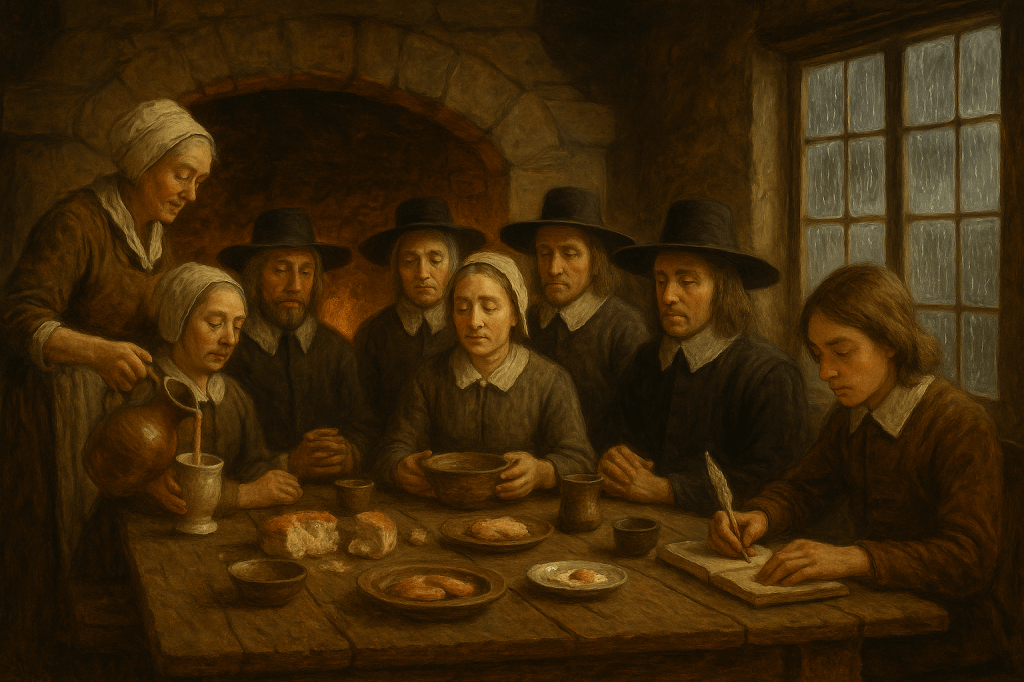
I happened upon this story while researching my family tree in Ancestry. Although my efforts proved I am probably not related to Thomas Lightfoot, there are two very interesting pieces of evidence that when combined create a remarkable scenario.
First, we turn to a compilation of journal entries and remembrances by the noted Quaker George Whitehead, prepared just before his death. In this lengthy tome, he names many of those who were part of the early movement, as well as some who were decidedly not Friends. Early on, he briefly recounts a time when he was 17 years old, and how Thomas Whitehead had accompanied him in one of his first missionary journeys, how he had to compel an innkeeper to give them a place to sleep though it was snowing outside, and how their tiny garret was woefully exposed to the bitter cold.1
What caught my attention is that the entry is brief and lacks the detail or the ire that would have come from a 17-year-old who writes well. It could be based on a fuller rant or a dim memory that comes up as a nod to the Thomas Lightfoot who is quite well-documented and was well-loved and respected both in Pennsylvania and Ireland, and active in communications with London when the book was published.2
In fact, the funeral of this Thomas Lightfoot was noted by a Friend this way:
“In the Ninth month, 1725, I was at the funeral of our worthy ancient Friend, Thomas Lightfoot. He was buried at Darby; the meeting was the largest that I have ever seen at that place. Our dear Friend was greatly beloved for his piety and virtue, his sweet disposition and lively ministry. The Lord was with him in his life and death, and with us at his burial.”
So without a statement in the remembrance that the Thomas Lightfoot who accompanied George Whitehood as a teen was not in fact the Thomas Lightfoot known and loved by all, it seems likely to me that these are indeed one and the same persons. One historical society guesses the man of the early movement could have been Lightfoot’s father by the same name, but in such case the published narrative would surely have referred to him as Thomas Lightfoot the elder.
The second fact that becomes downright astonishing is that in the year following this missionary journey, the Book of Sufferings by Joseph Besse records that a Thomas Lightfoot was sent to jail for stating “Jesus is the Word of God, not the Bible” even though he was basically quoting John 1:1. And he made this statement before the High Professors at Cambridge University, where Quaker activists (who like today’s activists were mainly in their twenties) had taken up the practice of interrupting lectures and challenging the very theologians responsible for training the clergy in the way they should go. Besse goes on to say that there were some who wanted Thomas killed.3
I can well imagine this scenario, having read a few other stories mainly by Whitehead of how clergymen had tried to put him in prison and he was able to debate himself free. In fact, Whitehead was intelligent enough to gain meetings with several heads of state, in particular the brilliant Charles II (he who created the three-piece suit just to spite France).
Let us imagine you are a frustrated professor who has heard complaints from clerics far and wide about these Quakers who want to end tithing, the economic force that keeps the theocracy in power. And yet you can’t seem to make headway against Fox, Whitehead and others like him. Having an unlearned sort pipe up with a bit of nonsense he barely understands would have been like an answer to prayer. Take this puny mascot and make an example of him. Anyone who has had a teacher who amused themselves by picking on the weakest person in the classroom would understand what I mean.
And this leads us to the most remarkable part of the story. Because the well-known Thomas Lightfoot’s year of birth was “about 1645.” The fact that the year isn’t certain is testament to the Ancestry data that makes him motherless at four and an orphan by the age of eight, leaving him without a family to keep and remember his year of birth. All of which means that when 17-year-old George Whitehead went on that early mission, Thomas Lightfoot would have been an orphan of about nine years old.
Now you have a story worth telling.
- The Christian Progress of That Ancient Servant and Minister of Jesus Christ George Whitehead, by George Whitehead, pub. 1725, p. 236 ↩︎
- https://www.wikitree.com/wiki/Lightfoot-54#_note-TheFriend ↩︎
- A Collection of the Sufferings of the People called Quakers Vol I by Joseph Besse, pub. 1753, pp 85-86 ↩︎
 Friends of Freedom
Leave a comment