November, 1658
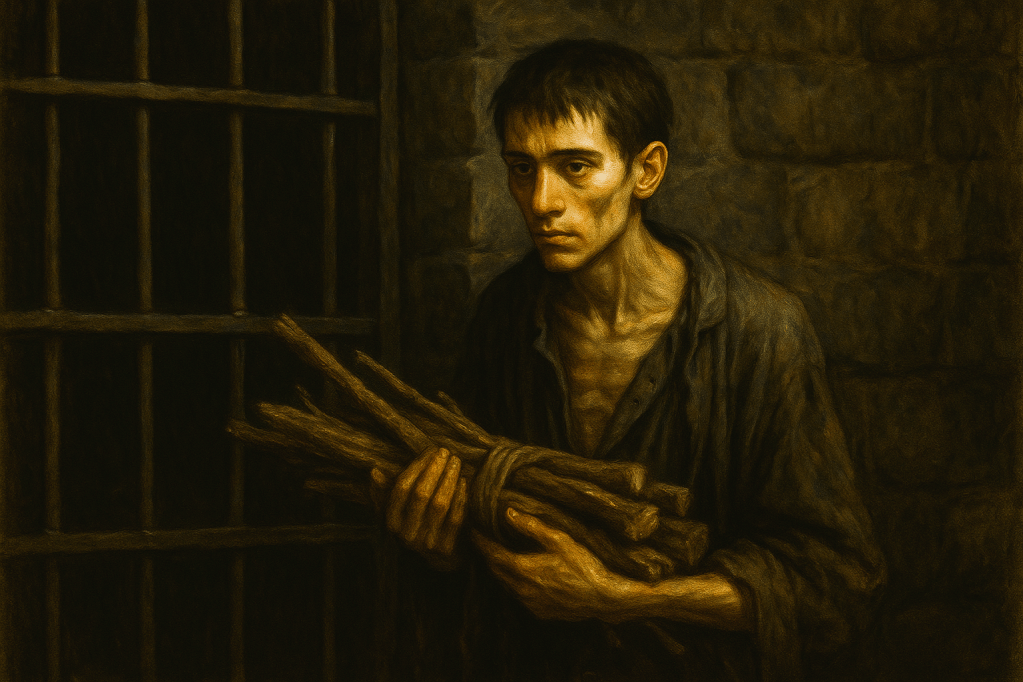
A year had come and gone since Tom had seen Duffy and learned of the tragedies beyond the walls of the Cambridge House of Correction. Weeks and months passed in agonizing slowness, the seasons turning as a wheel turns, slow and inexorable, bringing Tom into his fourteenth year. Now a prisoner for three years of his short life—nearly two at Castle Hill, the rest as a debtor in Vexler’s prison. The boy who had come in small, quick, and fairly well-fed was gone; in his place stood a bony youth whose limbs had yet thickened with labor, whose voice had deepened without ceremony into the rough, uneven baritone of a young man.
Men were made in this place through the simplest method: by wearing boys away. Tom’s days began in the cold, when the fire was only embers and the noises of his fellow sleepers hung in the dim air. Each morning he hauled himself from his straw pallet and commenced to his work at the woodpile, hands stiff from the night.
It was the kind of work no man would envy, yet no man could shirk: hauling green wood and offcuts delivered from carpenter’s yard that had been dumped in heaps at the bottom of the stone stairs. They were damp to the touch, smelling of sap and rain, their bark slick with moss where they had been left too long in the yard. Down in the basement, the air clung to the lungs like a cellar’s breath—damp, moldy, and cold even in the height of summer.
An older prisoner, a thin-shouldered man with a face like dry leather, sorted the pieces on a low bench, setting aside the straight-grained lengths to be split upstairs. Tom took these in armloads, trudging up the narrow uneven steps to the upper room where the heat was stifling, the air thick with the steam of wet wood drying too fast beside the great stove. Here sat Hugh, the man who punched in his sleep, though in the day he was a blissful cloud of calm. With rhythmic movements he would wedge the billets and split them, the blows ringing like dull hammers in Tom’s skull. These Tom would carry down again, his shirt plastered to his back with sweat that chilled him each time he reentered the basement.
It was an endless cycle—up to heat, down to chill—like the eternal punishment of some forgotten Greek hero whose crime no one remembered. It made his muscles harden and his hands roughen until the skin cracked, yet it also narrowed his world to the few steps between cold and heat, darkness and light.
In those hours, he climbed through the grief of losing Bess and James, who in such a short time had become like family to him. Grief was a journey Tom knew too well, and he was well-acquainted with the desire to rewrite his history, imagining a home he might come to where his parents still lived, and might greet the Friends now departed.
Eventually his thoughts turned to Duffy, and then one day in the silence of the stairs he realized his situation was not far different from the years in the heretic’s cell, except that now there were others about him at night, even if none were allowed to speak to him until he renounced his Quaker beliefs. Yet he was glad of the company, and the bodies nearby. And equally so he was glad of the exhaustion of the exercise which only an active young person who was prohibited from exercising for such a long period might understand.
And still later, remembering his talks with George Whitehead and the sore knowledge of how blisters felt now, and what his mentor’s feet must have felt like after a journey from York and then again to Norwich. And then in a flash—when the older man was bent over his sorting, pointing wordlessly to the faggots the boy must carry—Tom realized that there was One who was not silent, and who had not withheld words from him. And then the greater realization that he could speak back to that One and take part in the battle his dear friends were fighting all across England. He could pray. For the Georges, for the Blakelings and all his friends in Norwich…and for Duffy.
This last struck him mightily. Had Duffy abandoned him…or had he with nothing but time and emptiness of thought abandoned the one person who had found a way to visit him here in Vexler’s domain? And so began Tom’s prayers for Duffy. Not the short, dutiful prayers of a schoolboy, but long, steady petitions that strength would come to him and that his grief would not be the end of him.
One day he as he slowly gathered up bits of hedgerow branches that stung when he wasn’t careful, he felt the urgent need to pray. Pray now, that the Almighty might send His angels to minister to Duffy. And so he quickly piled the branches together in his arms, heedless of thorns, and nearly ran up the first flight of stairs to the moldy middle section that had in his first days caused him greatest anxiety. But now these steps were the place of vacancy, as others shunned them for the surer flight on the outside of the building. But there he prayed, deeply and in earnest that God might send his angels to minister to his friend. He imagined in his mind that perhaps, in that very hour, heavenly angels from on high were at work—guiding Duffy’s steps out of this dark season of grief.
He could not have known that this day—All Hallow’s Eve—was the very one that Duffy had felt the call to return to Cambridge. Nor that in the same moment, his friends of late who had purchased their way out of debtor’s prison by benefit of Tom’s carvings and who appeared to have disappeared from his life, had just decided to celebrate the evening as they had not done in ages—with a puppet show for those who did not fear the new Cromwellian government which lacked so many teeth, some thought they could use false ones.
But Tom could not know anything but that he’d had an impulse to pray, and that it disappeared like a door suddenly closing even as he stepped nearer the hearth room. He thought of it again in the night, and thought also to pray silently for his “gratitudes” and Bess used to call them. He was grateful for having her in his life, and all his Quaker friends. He thought of his feet, that had been so blistered his work took him twice as long. And how Cress, all impatience to have him carving in his evening hours, had appeared one day with the shoes he now owned. His first pair of shoes as a man might wear.
They were sturdy leather, cracked at the toe but solid in the sole. Too big for him, but the cooper stuffed the toes with wool. “Last you longer that way,” Cress muttered, handing them over as if it were contraband. Tom never knew where they came from, though he suspected a dead man’s feet. He did not ask for fear of finding his suspicions to be well-founded. Instead he only nodded and said, “Thank thee,” for he had seen in this jail that gratitude was best spoken plain and short, with no room for promises of a debt owed.
When they returned from their work one day in new clothes and a small bag of sweetmeats for him, he had thought joyfully that their plan to sell the little pile of dice he’d carved had worked, and it would be a turning point for all of them. They even spoke of bringing him clothes and better shoes. He would have been happy to receive food. But once they paid their debt to a suspicious Vexler, on the pretext of “inheriting sommat from an old uncle,” they never returned.
At first he missed them bitterly. It was Lark who had shown him the trick of turning pain into a story, and Cress who had made him laugh when the cold gnawed too deep. But as the months passed, Tom began to think on their absence in another way. They were not like Bess and Duffy who cared for him as adults do their children. Rather, they were like uncles who come for a feast with wild stories and glad cheer. He’d had such an uncle once, his mother’s brother. When she died he had come with great anger, and hardly the wake was started but that his anger overflowed. Later still his father said the plague had claimed him too. Such were uncles, and such were Lark and Cress.
In early November when the cold of the cellar began to run cruel, a new prayer came to him. In his mind he said, “God, I do not know where Duffy is. I do not know if he be in health, or in chains, or in the ground. But Thou knowest. And I pray Thee, make him a way to come see me, as Thou didst for our Lord. Make him a way, Father, and help me to be a help to him as he always was to me.”
He continued climbing, up to the hearth room. It was unchanged—the same glowing light in the dimness of morning, but he sensed the thing he asked was already in motion and he should put his mind to the latter part of his prayer, and ask for words of comfort for his dear friend.
In the midst of it the memory intruded, the game of Deadman’s Chance, the night he rolled a six, and the question that had followed—what would he undo? His answer had been the same then as it would be now: he would undo his own failure, the moment that had led to his imprisonment. The guilt was a constant thing, like a weight he carried under his coat. He knew now that he had been obstinate and querulous in his thinking. The Biblical Word was God’s word, and while Jesus embodied it, he now realized that Jesus had made a study of it all his life, as he’d seen George Whitehead do.
Yet there was a maturity in his thought process as well, as if in lacking counsel of any kind, there was yet the counsel of the Spirit. And this same Spirit of God showed him that he was a child and spake like a child. And now he was becoming a man and it was his responsibility to learn and speak as a man of God. Also that he was forgiven and must forgive himself. This thought dawned on him as he trod the stairs, and lifted him with hope. This was the message he must give to his friend Duffy should he ever see him again.
And then the miracle happened. In the hearth room he heard men arguing. Vexler’s voice he knew, but the other…oh it was a voice his memory welcomed. Hardly daring to hope, he delivered his bundle far more carefully than usual. And rather than turn quickly back to the stairs before Hugh might catch his eye and direct him to clear up the sticks beyond his reach—for Tom had realized the prohibition against speaking to him held some benefit—he looked the man directly in the eye, as if asking, “Who’s here?”
Hugh nearly whispered something before catching himself, then pointed at the bits of wood and bark near the opening to the hall and a broom close to hand. Tom quickly set to work, sweeping the bark while remaining out of Vexler’s sight, yet attempting to catch a glimpse, to be sure his memory of this particular voice was correct.
“Ye carnt come ‘ere demanding naught, ye old drunkard. Fer I heard of yer laziness and filth. We don’t want none o’ that ‘ere. Got filth enough in the prison below.”
“Do I appear to be drunk, man? Am I drunk even now? For I’ve even had a bath, Vexler. And a man don’t do that for nothin’, does he.”
With a sniff Vexler scowled. “Ye could ha’ washed them clothes a bit finer, eh? But what need have I of the likes o’ you?”
“But one year ago I was here, as ye remember, to walk the corridors in place of the night watch. And what did I find? Dice gaming in secret. The two sneaks who now walk the streets boldly—”
This got the jailer’s attention. “Cress and Lark! What they done? How’d they come by such coin as they had, eh? Inheritance by Saint Swithun’s nose. Tell me what they done and I’ll see what I can do for ye.”
It occurred to Tom that this discussion might put an end to his carving as he carefully swept the tiniest bits of bark and leaves into the woodpile. He hazarded a look up and his eyes met Duffy’s—and though the man looked quickly away, there was a moment of recognition. In his mind Tom gave a war whoop, and he glanced back at Hugh, who nearly laughed at the boy’s agitation. Yet the big man also quickly moved his eyes away, lest they both suffer for their joy.
Duffy responded carefully, as he’d a plan which required the use of the two vagrants even as he used them to make his way into Vexler’s confidence. “Side work. The kind what brings a fat purse, and which paid nothing out to you, the keeper of their…” he gestured into the depths of the building, “your house here.”
“What kind o’work, eh? How’s they finding it? For I know everything there is to know about this place.”
“trafficking in goods from abroad. A lucky find. They sold fine-carved dice as from the Indies, under yer very nose, Vexler. And a handsome profit they made, as I heard.” At this Vexler studied his hands, his lips pressed together. Duffy took the opportunity to wink at Tom, who returned him a wide grin.
“I’ll be blowed.” The man thought, and took a heavy breath the inmates recognized as often leading to a storm of fury, but with another breath he straight at Duffy, for all the world like the man had a map to a missing fortune. “This here’s my arrangement, take it or leave it. I carnt says as I’m employin’ ye, as I haint got a vacancy, but ye can be my overseer. Ye find all the means by which these here are makin’ money—and if ye find none then make some, for if they can work nights they will. I’ll give ye 10% for the trouble.”
Duffy made no sound, but all knew the look and remembered him as a dangerous man not so very long ago. “I do ye a favor and this is the greeting I get. Half, Vexler. Else why would I bother?”
“It’s hardly work, Duffy. And I heard as ye have nowhere’s to go. Winter’s nigh and colder every year. I remember when I was a boy, a November’s day like this warn’t near as cold.”
Duffy was unmoved. Tom clutched the broom for fear the entire episode was only God’s plan to show him the man’s face without actually speaking to him again. And while he submitted to the thought, he prayed for more. He prayed that Duffy might really live here, in the correction house, with him.
As if the former turnkey could hear the boy’s appeal, he relaxed his jaw and offered, “I’ll give ye 60% and I get me own room, no sharing with the night watch.”
“What? The night watch sleeps days, Duffy. Ye can share a cot.” Again the two seemed to be in a standoff, but eventually his greed for imagined profits won him out. “Ye win, Duffy. A room of yer own if ye don’t mind the lower level, and I get 70%. Don’t ask for nothin’ else!”
With a grudging nod, the new overseer held out his hand to shake on it, and the two now entered the bowels of the stone building as brothers in arms. Duffy had already thought of ways the workers might generate profit for themselves and their master, with a few coins besides for himself. He didn’t need much, he reasoned, whereas that starving young man he’d just seen needed everything.
Tom watched them, straining to catch every word until he felt a hard switch upon his legs. He looked back at Hugh, who pointed to the stairs. And with that the teenager gathered the bits for bundling and headed back down the steps, heartily wishing for a thicker pair of breeches.
***
Later that night on the north end of Bridge Street, Duffy followed a slatternly woman down a dismal hall that smelled of stale beer and tallow smoke. With dramatic effect she stopped at a particular door, pointed to it and then quietly slipped a key into the lock to open it. Duffy held up a finger and whispered, “Hold.” She stepped back and waited with delight.
In a heartbeat, Duffy flung the door wide, slamming it against the wall so hard the clap echoed like a musket-shot in the narrow stairwell. Behind him the landlady gasped, hardly daring to peek around the corner at Lark and Cress, whose rent was far past due. She muttered, “Only mind ye don’t break aught, for mercy’s sake.”
The now-sober jailer’s assistant stepped inside. His boots ground the grit and splinters scattered over the uneven floorboards of a low-ceilinged room that stank faintly of unwashed bodies and damp wool. His voice was low, but it carried a dangerous edge:
“You two magpies been pickin’ the meat off the boy while he rots, and now he’s naught but bone.”
Cress took a step back into a shadowed corner where a cudgel leaned ready, though he tried to cover his unease with a soft laugh. Lark, caught mid-slouch on a rickety chair, stiffened.
The wily cooper spoke in a coaxing tone. “He could leave any day, if he’d the mind. Only needs to bend the knee, take proper communion, say the prayer they put in his mouth. But he won’t. Says the Spirit within forbids it.”
Lark, with mock solemnity, added, “Quaker ways. We can’t speak to him—not proper—save to slip a crust with his stub of candle when no one’s watching.”
Duffy took another step forward. “Give me coin for food. I’ll see he eats.” The pair glanced at each other but did not move.
“NOW!” he barked, seizing Lark by the shoulder and shaking him so the chair legs scraped hard against the floor. “Or I’ll carve the lesson into you.”
Cress shook his head with a forced chuckle, though his knuckles whitened on the cudgel. “You know as well as I, Duffy—he can’t take much. A bit o’ cheese at most, or you’ll do him harm. Belly’s no bigger than a walnut now.”
“I’ll portion it out proper,” Duffy said, his jaw tight. “I’ve been in the trade of death, but I’m done with it.”
The minstrel, fingers resting on the neck of a well-polished lute, tried his own persuasion. “You can’t get near him, and if by some devil’s chance you did—it takes but one word to Master Vexler, and your game’s ended.”
“Mischief!” Duffy roared. “You’ve done naught but mischief. And enough words with the lad to set him carving for you this past year.” His gaze flicked to Cress, who shifted his cudgel as though weighing it. “You left him for dead, but he ain’t—and profit’s still to be had, even for scourges such as yourselves.”
That pricked their interest. Lark set his lute aside with care while Cress eased his weapon. “How mean you?”
“I’ve moved into the House of Corrections as overseer. And as such Vexler’ll take his share when you sell wares for him, not wasting the coin on your own bellies.”
Lark righted the chair and sat, a grin spreading. “So the gaoler makes his bargain with thieves. Thought you’d turned holy, Duffy.”
“I’m a man who keeps his own alive. Don’t mistake me for a priest.” He held out his hand and waited, breathing slow and heavy. Cress shrugged and dropped a few pennies into his palm.
“And the rents. Lady’s waiting.”
With a shake of the head Lark opined, “Oh, I wouldn’t call her a—”
“Here it is, Missus,” called Cress, handing another coin to Duffy, who stepped back and pressed it into the waiting hand. The landlady peered at it in the dim rushlight, bit it with her teeth, and tucked it into her bodice. She yet lingered another moment just out of sight.
“That’s for the last month. I’ll need this one now I know you’re flush,” she trilled.
Cress leaned past the bedstead so he could see her. “If ye don’t mind a moment while we finish our business with this gentleman…”
She looked around the room suspiciously before giving a grunt and tottering away. “Only a moment, then, to finish your business.”
Duffy paused in the doorway, watching them as they suddenly set to packing their things in canvas sacks. “I’m off then, and will see you down to pub on the morrow. Mind,” he bent close and hissed in Lark’s ear, “if ye cross me, I’ll nail yer bones to the wall for coat-pegs.”
***
Within a few days, Tom stepped onto the prison cart for the first time since his arrival. Duffy announced to Vexler he was taking the “wood boy” to take up scrap, as he wasn’t allowing the carpenter to pick and choose what came from the yard. This satisfied the jailer’s avarice and he returned to his ledger without another thought.
Duffy set the old mare moving and she grudgingly obliged, pulling the cart along with gentle ease. As soon as they passed out of sight, he produced a crust for the boy’s hand. Tom shook his head, “I’m not hungry, honest. I had my bit at breakfast.”
“Nay, ye’ll eat when I say. Yer no good to me as a sack o’bones.” His young charge looked askance at himself, but shrugged and tried to nibble a bit as they moved through the streets.
It was one of those raw afternoons when the clouds hung low over the chimneys and the streets were wiped clean for a short time. The yard lay beyond the older colleges, in a quarter where the cobbles were uneven and the air carried the sour tang of sawdust and glue. Tom liked the place immediately; the stacks of planks leaned like mute walls, the saw-pits gaped like graves, and the carpenters working with a rhythm that was all muscle and breath, no talk.
Duffy had a walk about the place. He noticed the prison’s kindling allotment came in the form of unceremonious cartloads—knots and split ends from the joiners’ yard, chunks too warped for furniture, damp branches from the fen country still smelling of sap. He had an eye to see what else they might make use of for the inmates to buy their way free.
From a bin under the eaves, he drew out lengths of bent iron nails, rust already biting them. “These’ll fetch summat if the smith’s in want.” Tom found a shallow crate of offcut dowels and thin slats — too short for chairs but good for pegs, knitting needles, or a warming fire. In another heap lay boards with one sound end and the rest gnawed by damp; Duffy had the yard man saw them down to the good wood and stack them crosswise for the cart. “Fer a good cause, mate,” he winked.
The boy’s fingers found a length of ash shaved smooth on one side, the beginnings of some fine thing abandoned mid-work. “Keep it,” Duffy said, low. “Ye’ll whittle that in the yard o’ an evening.”
By the time the mare stamped her impatience, the cart brimmed with uneven bounty: the makings of stools, tinder, mending pegs, and a few sticks of proper kindling thrown in with the rest. Duffy took the reins again. The cold made the leather stiff, and the horse’s breath billowed in quick clouds.
On their return, in the narrow way by the Market Hill, they happened upon a knot of townsmen moving with animation, their shouts bursting through the wind’s monotone. In the center of their circle, a man in a plain, untrimmed coat stood with his hat on, even as a constable’s staff struck him across the shoulder. Another blow followed, and another, and still the man said nothing. His lips moved—perhaps in prayer, perhaps in challenge—but the crowd jeered loud enough to drown it.
Tom felt the start in his own throat before he spoke, but Duffy’s hand was already on his arm, heavy and warning. “Eyes front,” he muttered, “finish yer crust.” The cart jolted forward.
The boy twisted for one long look. He saw the man bend but not fall, the dark cloth of his coat flaring as another blow landed. Then the corner took them, the scene vanished, and only the noise lingered — until even that was lost under the clatter of wheels on the frost-hardened stones. What small appetite Tom might have had was lost, and he quietly dropped his bit of bread into the mud.
 Friends of Freedom