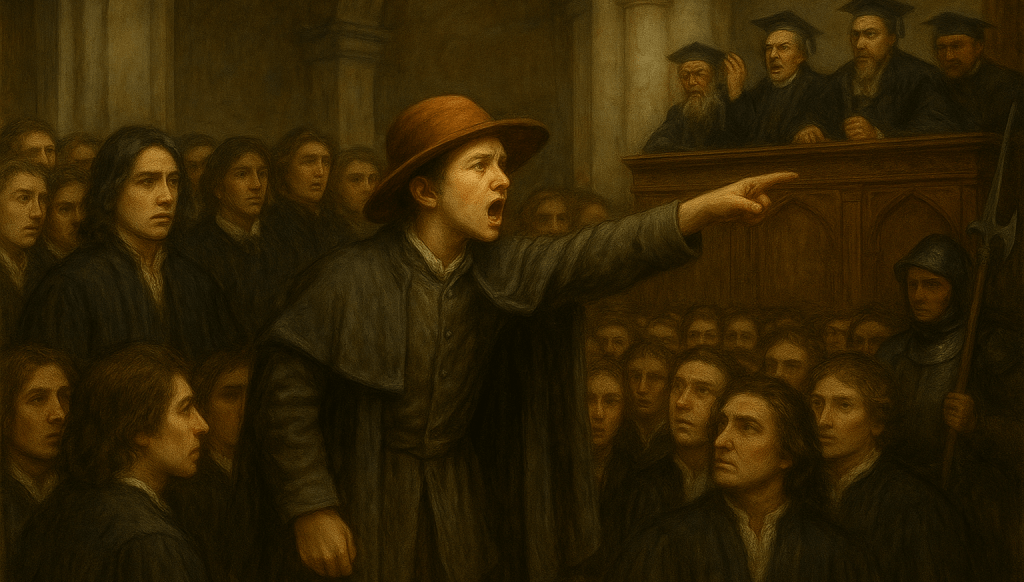
Spring, 1655
A long season of icy rain had passed over England, but at last, spring found its way back, bright with buds on hedgerow branches and a promise of relief from all that stung and chafed. The nation still bore the scars of war—bruised laws, trembling consciences, and a Parliament whose edges frayed with each new rumor of rebellion. Amid this uneasy calm, the Quaker movement flowered, carried by the feet of a thousand young missionaries eager to publish their message of a kingdom without kings, a faith without masters.
They were no soldiers—yet in their spirit there rang the high call of a revolution deeper than any sword could carve, as if an invisible line of Light advanced across the land, shining on every injustice it found.
It was a fair day in Bury St. Edmunds, the green buds just breaking open on the ancient oaks ringing the square. In the back room of a kindly Friend’s house, George Whitehead sat at a heavy desk sandwiched between two long benches. He leaned forward, hands steepled before him. Around him the air smelled of lamp oil, new rushes, and a faint whiff of fresh bread from the next room.
George glanced from face to face—believers, simple men and women whose eyes still flinched when a bootstep fell heavy outside the door. This was, after all, no lark to pass a pleasant afternoon. Richard Hubberthorn had only just had his case heard at the Court of Assizes, which met in spring and again in late summer. The Friends had watched as the case against him for exhortations to a steeple-house congregation after the sermon ended was dropped. But even as he stood to receive this judgement he was charged with Contempt of Authority and recommitted to prison under that pretense. He yet languished at Norwich Castle.
Now at George’s right hand sat a broad-shouldered youth of about sixteen, dark-haired and restless as a jackdaw in spring. This was George Fox the Younger, so called because he bore that oft-used name, without the benefit of relation. However, his fervor and quick tongue often brought to mind a certain resemblance to the older Fox’s fire.
At George’s left perched James Parnell, now eighteen, still a small young man but belying an intellectual confidence that warns those who behold him, here is one who knows whereof he speaks. A born pamphleteer, a bundle of broadsheets lay beside him exuding the musty yet metallic smell of wet ink.
“And Cambridge,” James was saying, tapping one finger on the stack, “is ripe for a shaking. The professors there are no better than king’s men, teaching their students to make merchandise of souls and worse yet, to throw stones and dirt upon us. They know the slightest instigation leads to much worse than a few stones. My Declaration should land among them like a spark on flax.”
Fox the Younger nodded, eyes bright. “Aye, their doctrine is stale as last winter’s bread. What they fear is a witness who trembles at the Word, instead of bowing to a stipend.”
Whitehead smiled faintly, but did not contradict them. He had learned the wisdom of letting the younger Friends carry a leading where it pulled them.
It was then that Thomas Lightfoot ducked through the doorway, removing a soft gray knitted cap made special for him by the lady of the house. He’d sprouted up since Wymondham with good healthy food regularly pressed upon him in spite of the Quaker preference for smaller meals. He seemed to be a project for the women who regularly remarked that he was still as thin as a rail.
“Tom,” George greeted him warmly, “it is good to see thee again.”
As usual the boy flushed under the attention, but he remained before them, clutching his cap and shifting from foot to foot. The young men waited to see what it was he needed to tell them.
“Bess sent a message,” he blurted, “asking if I’d forgot her. Worried after me, she was.” He held the letter forward.
George reached for it, pleased that his efforts to arrange a simple education for the boy had blossomed into an actual correspondence. He was equally pleased to see that the tattered missive was scratched in Bess’ own hand, a quiet testimony to Eleanor Blakeling’s support of the same in her household.
James raised an eyebrow. “The woman of the almond tarts?”
George laughed. “We all remember Bess, for her hand is well guided in the kitchen.”
Tom brightened a moment. “Aye. And she worries. Maybe I should look in on her.”
George exchanged a knowing look with James. “It so happens,” he began carefully, “Friend James is for Cambridge, this very day. And he needs a porter for this abundance of pamphlets.”
Young Fox, concerned for the lightness of the boy’s oratory abilities, stepped in. “Ye must be careful. Do not take this decision lightly. The Mayor of that cursed city had two men whipped not long back, just on word of their being Friends.”
This revelation brought pause, but the Spirit would not be denied. It seemed now that the idea of the two journeying toward such an adventure was now writ large before them.
James leaned forward with sincerity. “A companion would be no harm, if you can keep your wits, Tom.”
The boy straightened, pride and fear warring in his eyes. “I can keep my wits,” he insisted.
“Then it is settled,” George said gently, glancing a stay at Fox. “James shall carry his testimony to Cambridge, and Thomas with him, to speak if led, to serve if needed—and to see Bess, of course.”
Tom smiled shyly, and for a moment the room felt lighter, as if the sun had blessed their mission.
Fox the Younger sat back, looking between the two travelers with some thought. “Only take care,” he warned. “The professors on high will defend their towers with sharper tongues than any sword.”
James smiled and shook his head. “We’ll manage. The Lord is with us, or else we would never go.”
George closed the moment with prayer, his voice calm and certain, reaching out to the Spirit as simply as a friend takes a friend’s hand. And so was set the next chapter of their journey: one bold pamphleteer, one ragged child whom no honest craft had yet seen fit to tame, bound together to confront the great Schools of Babylon, and the very heart of English establishment.
The High Professors of Cambridge
The disputation hall was a monument to cold learning: high arched windows admitting a meager spring light, shadows pooling beneath the lecterns like spilled ink. The walls smelled of damp wool and scorched tallow. Heavy benches, marked by centuries of solemn argument, stood ready to bear witness to another round of thunderous declarations.
James Parnell approached first, bold and bright as a torch, stepping straight into the arena where the High Professors in their pleated robes waited with sharpened wits. Their brows drew together as they beheld him—a boy of no great disposition, Quaker-plain, hair untrimmed, coat without lace or button. And his hat still firmly upon his head, which affront the scholars who observed from the floor would have gladly punished then and there with stones ready in their pockets.
Both scholars and professors turned to a wizened old man with hawkish nose, his body sinking into a voluminous black robe, with his doctoral hood across his shoulders like war regalia. Dr. Harold Vane, Senior Fellow of Corpus Christi College, Regius Professor of Divinity. He spoke with a booming voice honed from decades of lecturing.
“Have you come to provoke us, Quaker?”
The scholars sniggered at the great man using a derogatory word. From somewhere in the gathering crowd in the great hall, a bit of wet bread launched into the air and hit James in the back of his head. Yet he ignored it, focusing instead on his mission.
“I come with a question.” His calm voice carried through the ancient oak-paneled hall, steady as a craftsman’s chisel. There was no response except a deepening displeasure on the faces of the men he came to challenge.
“Ye call yourselves guardians of the souls of men, yet you demand the people’s tithes even as poor folk freeze and starve. Where in Christ’s teaching did he command men to tax the faithful to pay their shepherds?”
A low rumble passed through them as Vane rose, clasping before him a Bible filled with notes and papers sticking from every corner, the spine cracked from decades of use. He waved it like a weapon and spoke with evident relish, as if to toy with a foolish opponent.
“You err, young sir,” he replied coolly. “The apostle saith, the laborer is worthy of his hire.” He tapped his Bible with long yellowed fingers. “And as the scripture commands, those who preach the gospel should live of the gospel. Or would you have us beg?”
Some in the hall nodded, as if their champion had trounced Parnell in a single stroke. Tom uttered a prayer from his heart, but panic rang in his ears. He did not want this first foray to end with Parnell as a laughingstock.
James drew breath again, refusing to be cowed. “Then answer me this—if you take the wages of Christ, why do you preach a kingdom built on fear? You fence the Lord’s table from those too poor to pay, yet say they are welcome to grace.”
An under-professor watching from the stairway hissed and spoke up sharply: “You slander this university! We guard the communion from unworthy hands!”
James’ heart thundered, but he refused to shrink. “And who judges worthiness but God alone? You stand between a man and his Redeemer, and call that ministry?”
The dean, robes settling like a crow’s wings about his chair, lifted one haughty eyebrow. His voice glided with poisonous calm:
“Boy, you mistake disorder for freedom, and pride for piety. The Lord’s Supper is holy, and only holy men may approach it. Who shall guard the flock from wolves, if not its shepherds? We are the shepherds, appointed by God, and no raw youth will gainsay our charge.”
A ripple of approval spread through the scholars, and James felt the words catch in his throat. The great stone hall seemed suddenly to tilt against him, cold and echoing.
And then—Tom could bear it no more. His voice cracked as it rang out, small but fierce:
It was then, seeing Parnell momentarily falter, that Tom could stand it no longer. His heart pounded like a drum. “You twist the Scripture!” he blurted out, voice rising above the debate.
Vane’s head whipped around as he bellowed, “Who spoke?”
Tom stepped forward, trembling but fierce. He knew all the words to say, whispered at many a midnight fireside among the Friends. “Thou art no shepherds but hirelings! And the Scriptures are no more the Word of God than your robes are holiness!”
A hush fell. No one breathed.
The great Professor Regis looked down at the boy, summoning up his most fearsome mien, borne of a lifetime’s practice of scaring the wits out of his students. Slowly, with deep voice he intoned, “What did you say?”
Not to be cowed, Tom foolishly pressed on even as James attempted vainly to get to his side. There was a wild gleam in his eyes as he repeated the arguments of his mentors. “Ye worship letters on a page and call it holy, but it is Christ who is the Living Word!”
Murmurs erupted from the students around him, seething with hatred.
A tall boy spat in Tom’s face, crying out, “The Holy Scripture is the very Word of God and you would tear it from us!”
A glance up to the dais proved this was what the masters expected to hear, and thus it was followed by a series of shouts one up on the other:
“Blasphemer!”
“Unlettered cur!”
“Jackanape! Get ye back to thine gutters!”
James tried to intercede, raising his hands. “Friends, hear me! He means not to deny the power of God, only to lift your eyes from ink on a page to the living Word within you!”
But the professors would have none of it. Vane pointed a bony finger at the Friends. “Behold these vipers!” he thundered, voice cracking with righteous fury. “Deniers of Holy Writ! Cast them out, now!”
The under-professor on the steps cried out, “Seize him!”
The crowd surged, even as Vane motioned to the parish constables, ever vigilant at the back of the hall and up to this point awaiting his signal for action. They hastily set in on the throng, the hobnails of their boots grinding across the stone floor.
Parnell reached Tom and attempted to push him down out of sight, but there was no time. This child of the street, up to that point long adept at remaining in the shadows, now stubbornly held his head high. For which he was rewarded with the solid smack of a rotted turnip against his temple. James attempted to shield him with his body, and was shoved away by a pair of burly undergraduates.
A wave of students pressed forward, hungry for blood, eager to prove their own piety by destroying his. The hall seemed to shrink, angry faces pressing closer, as the boy stood in a storm of long unsated outrage. It was a blessing that the constables, as cruel as they were, parted the throng and pushed a wide swath of protesters aside.
“Back, you schoolmen, or I’ll have you for riot!”
This purchased a moment of blank stupor, but youthful fury erupted again like a pot left too long at the boil.
“This vagabond has no place here!” This was met with a cataclysm of agreement and a barrage of items from paper wads to craggy rocks chosen especially for such an opportunity.
This last was too much for the officer who now had Tom in hand. He swiped out at the mass of angry boys. “Out the way, you fine gowns—let the law do its part!”
Rude apprentices from town, always glad for a fight, began to jeer and throw handfuls of grit and apple cores. Another lunged forward, striking Thomas a hard blow across the shoulder that sent him sprawling out of the constable’s grasp.
James tried then to wrest his friend away, but was battered aside, his cloak torn from his shoulders.
“Seize them both!” shouted the church warden, the ring of his truncheon slamming down on a bench, splitting the air. “Seize these disturbers!”
Thomas scrambled upright but the mob closed in, a barrage of fists landing blows. He could taste blood on his lips, though whether his own or someone else’s, he could not say.
Rough hands seized his arms, dragging him through a forest of kicking legs and spitting mouths. A boy wrenched Tom’s cap off and ground it under his heel, triumphant.
“Blasphemer!” he shrieked, flinging a crust of bread at him.
The under-professor, adjusting his torn sleeve, sneered down as the constables wrestled them to the entry and locked shackles on their wrists. “You will taste a Cambridge cell, boy,” he hissed, “and perhaps learn what reverence means.”
They were marched down the echoing corridor, heads ringing with the din behind them and the hobnails of the men around them. As one the group passed through a stone arch where the wind rattled an iron gate.
Tom held James’ eye for a moment, searching for courage in that steadier flame.
“Stand fast,” James whispered as they were thrust through into the lock-up.
A single candle guttered there, showing slime-blackened walls and a crust of straw for a bed. The door slammed behind them with a finality that rattled the boy to his marrow.
He swallowed hard, tasting the mingled copper of fear and blood, but refused to shed a tear.
Inside, in that rotting air, he felt a strange quiet gather in his heart. Perhaps this was what it meant to bear witness: to stand before the fury of the world and not bow to it.
He closed his eyes.
Truth was not for sale, nor would it ever be.
Castle Hill
After a long night of prayer and encouragement without the benefit of sleep, James and Tom were dragged through the warren of college lanes like stags brought to market, constables at their shoulders, boots ringing their dirge on damp stones. Shutters creaked open above them as townspeople peered out, eager to witness the latest offenders paraded to their fate. A market-woman flung a rotten cabbage that burst against Tom’s sleeve, spattering his coat with sour pulp.
“Papist devils!” someone roared, though another, emboldened by the mob, added: “Quaker witches!” The cries blurred together, half-forgotten hatreds now turned loose on anything that stank of dissent.
Bess, dear worried Bess, stood pressed against a rain-darkened wall, a basket clutched against her breast. She looked at Tom with eyes that swam, helpless to reach him. He returned her nod and tried to manage a grin, foolish and wavering, but the constable’s elbow drove it away with a jab to his ribs. When he looked back, she was gone.
The halted before the grim silhouette of the old Cambridge Jail on Castle Hill, its gatehouse squatting like a forgotten tooth against the cloudy sky. Once part of the ancient Norman structure, the stonework had blackened over centuries of coal smoke and rain, its arched entrance sunk half a foot beneath the muddy road. The iron-studded door bore no sign, but every child in the town knew what lay beyond. This fear was a blessing to Tom, for the hecklers fell away before the door creaked open, but one or two hanging back to catch a glimpse of the darkened entry.
Inside, the air thickened with the stench of mildew and unwashed bodies. The corridor was narrow, vaulted, and gloomed by torchlight; water ran in veiny streaks along the walls, finding the dips in the uneven flagstone floor.
At the sound of their arrival, the Cambridge Jailer emerged from a shadowed alcove, dragging behind him the stink of boiled turnips and sweat. He was a broad man, soft in the middle but hard in the eye, with shoulders like flour sacks and a bristling jaw peppered in gray. His coat was too small at the seams, forcing his buttons, carved of bone, to sit like fists upon his chest. His cheeks were blotched from drink, and his hands, though meaty, moved with surprising quickness—like a butcher who knew his way around a carcass.
Thresher. A name muttered by vagrants and petty thieves as a curse.
He glanced over the two prisoners, his gaze settling on James with a flicker of recognition. Then on Thomas—whose youthful defiance hadn’t yet cracked. Thresher hawked and spat near the boy’s feet.
“Here for heresy, are ye?” he said, voice rough as gravel. “We get all sorts now. Ranters, Seekers, shivering Baptists. Don’t much matter.”
He jerked his thumb toward the cells lining the corridor. Rusted bars, thick oaken doors, and narrow slits in the stone hinted at the varied accommodations—some with benches, others bare but for a heap of damp straw.
“Pip. The one with the door for the loudmouth,” he ordered, nodding toward James.
He held out his great ring of keys to a rail-thin boy not much older than Tom. His hair was a thatch of dun-colored bristle, his feet bare and blackened on the bottom. Though the keys seemed impossibly heavy for him, he managed to find the right one and unlock the oak door, throwing his weight against it with practiced hand.
Thresher’s eyes flicked back to Thomas and pointed to a tiny barren cell. “And that one for the whelp.”
Pip obliged again, opening another door, this one barred and leading to a low room.
The warden seemed irritated and motioned the prisoners along. “In. I don’t have all day.” Pip waited like a valet, holding Tom’s door open.
Tom approached the low entry and nearly cracked his head when the jailer kicked him through. Pip locked him in, not daring to look up or speak a word. The stench inside would have shamed a cesspit, with straw that on close inspection was black and crawling. A trickle of water, half green with slime, ran along one edge of the stones.
James moved quickly to save himself a boot and again Pip performed the duty of locking him in.
“Rest well,” Thresher mocked. “They’ll read the charge tomorrow—perhaps hang you after.”
He returned to his dinner in the warden’s quarters, his young servant closing the door behind him so that the hall was now silent and black as pitch.
Tom swallowed, tasting blood, fear, or both. He sank down, drawing his jacket tight against the chill of barren stone. All was silent as the jailers crept away.
From the next cell over, a familiar voice reached him, a thin strand of courage drawn through the darkness. “Thomas? Stand fast. The Lord does not forsake his children.”
“James?” Tom rasped, tears sparking though he fought them down.
“We will pray,” James called, “as Friends.”
And they did, voices rising quietly together like candles guttering against the wind, lifting their petitions through walls of filth and cold.
At last, Tom lay back, breathing raggedly, the stone floor hard beneath him. Beyond his cell, the narrow corridor echoed with distant coughs and the clinking of chains. He was grateful he was not left alone in his despair.
Then footsteps again, Pip’s. Thresher hollered from his dinner table as the boy wrestled again with the ring of keys.
The heavy door groaned and Tom’s heart soared. He heard a woman speaking quietly. Could it be Bess? He looked as far as he could down the hall and saw someone of her shape, clutching a basket covered with linen.
Bess, for it was indeed her, stood in the entry as Pip ran for his master. The stench of damp stone and stale air bit at her nose; this was no place for gentle hands or tender hearts. Thresher appeared and eyed her with suspicion. “Who do ye come to visit?”
“Thomas Lightfoot and James Parnell,” she offered with quavering voice. In their cells the two boys sat up, hardly daring to hope she might be allowed to stay.
“A crown,” he grunted, fingers tapping against the open door like a metronome. “If ye want to see ‘em, and bring in food, that’s the price.”
Bess nodded, the coin heavy in her palm but light compared to the weight in her chest. The jailer motioned her through.
In another moment Thresher was back to his table and Pip led the wondering servant to the cells. She found Thomas sitting on a crude pallet, his frame thin but eyes bright with both joy and sorrow. In another moment the door was opened and Bess knelt before him, revealing from her basket a small cup of pottage along with crusty loaf and salted cheese—a humble feast that in this place felt like a banquet.
“Bless you, Bess,” he whispered, voice hoarse but steady. “Without thine care, the hunger gnaws deeper than any cold stone.”
She smiled, brushing a stray lock of hair from his forehead. “We shall not let the darkness claim ye, lad. The Light endures.”
Pip lingered nearby, and Bess gave him a muffin to overlook their whispered prayers. Outside, the world went on—indifferent, cruel—but here, in this narrow cell, a fragile thread of hope remained unbroken.
She could not wait to see Tom dine but rose and delivered another such feast to young James. Again, she hurriedly blessed him and provided a bit of encouragement. Then as quickly there was a roar from Thresher’s quarters and Pip tapped the bars with his key ring to hurry them along. In another moment all was silence again.
Eating another pastry, Pip led the woman down the hall and out again to fresh air. As Bess departed, grieved in her spirit for these young ones—and for ever allowing Tom out of her sight—she could not know that this was the ministry for which a lifetime’s work had prepared her. While the punishment of young Thomas Lightfoot would stir a multitude of hearts—especially those who sent him into battle—her tender care was to the boy a flash of mother-love long since forgotten, and much to be cherished in this moment of time.
And so the day passed. James spent a great deal of it on his knees, rocking and praying in the Spirit. Tom alternately slept, sometimes sharing a word of inspiration when James was not at prayer. Both felt keenly the encouragement of the old servant’s ministrations, and they called upon their Lord to bless and remember her as she had remembered them.
Sometime in the night Tom was awakened from a fitful sleep by footsteps in the corridor. Thresher and another man passed their cell, and the old jailer muttered:
“They’ll finish him tomorrow, mark me.”
He felt a shiver crawl through every bone. Tomorrow.
He pulled out his little testament and pressed it between his palms, steadying his mind against the horror. He could not see it for the dark, but it brought him fresh memories of the stories within its pages. He remembered the letters Paul wrote from prison and was heartened. He was in good company there.
Then he remembered why he had begun this journey, the reasons he had been drawn like a moth to the flames within the Friends’ kitchens. Because it was real, because he felt the Truth and the Light growing within him. And young Thomas Lightfoot thought to himself, his heart hammering in the silence: if the Lord would have me die, then I must die as a Friend.
 Friends of Freedom