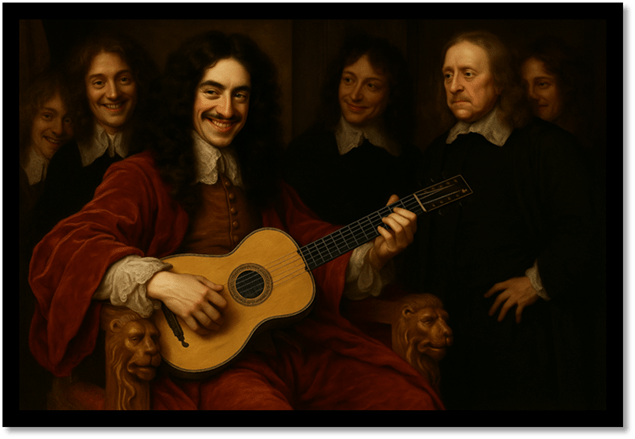
November, 1660
A biting wind blew dry leaves against Whitehall’s towering windows. Upstairs, the Long Gallery shone with newly-polished marble columns and candles flickering in their sconces, the air carrying the faint sweetness of beeswax. The palace, a rambling accretion of Tudor halls and galleries, had never suited the austere taste of the interregnum. Now the hall gleamed with reborn magnificence.
Walnut panels shone under fresh polish, their surfaces cut with vines, cherubs, and crowns. Along the cornices, sculptors had carved twining oak leaves in sly homage to the tale of the king hidden in a tree. New hangings of crimson and gold cascaded where Cromwell’s few draperies had been stripped away.
Portraits in gilded frames gazed down, with Van Dyck’s masterful Charles I chief among them—a proclamation of bloodline and legitimacy none could miss. Beneath, the floor stretched broad with a fresh carpet of deep reds and blues, brushed smooth just moments before. Word of the king’s approach sent the staff scurrying; only one figure lingered.
Gilbert Avery, the King’s Steward, stood solitary by the hearth. Nearing fifty, his lean frame carried the stoop of five years spent polishing silver and keeping himself unnoticed under Cromwell’s rule. Under the previous Charles, he had been a different man—one with aspirations. When they beheaded his monarch outside the Great Hall, he changed. He rose the next day to a look of shock on his wife’s face. She brought him a mirror and there he saw that his otherwise black hair had become infested with strands of stark white. Even now his once full coiffure continued its stubborn escape at the temples. He held a feather duster; a habit he had acquired in that short-staffed era that seemed likely to continue in this cash-starved government. His watchful eyes searched for anything that might be out of place.
Something on the floor caught his eye—a pulled thread running jagged across the weave of the new carpet. He bent quickly, frowning, then shifted a pedestal bearing a plaster bust of Alexander the Great until it hid the flaw. Straightening, he held his duster behind his back and stood smartly to attention. A sigh escaped him; with the renovation budget already spent twice over, and a trade war still damming up the influx of income, even a loose thread in the carpet might wait months for repair.
Footsteps echoed ahead and—was that whistling? Charles Stuart, with sure stride, was climbing the stairs and soon entered the hall with his attendants and three of his beloved toy spaniels in tow with dirty muzzles and bits of leaves in their hair, the entire crew looking a bit too jolly for the steward’s liking. Sunlight streaming from the high windows caught the curls of the king’s hair, striking the deep blue velvet of his doublet so that he seemed for a moment as though he’d stepped out of a painting by an Old Master. The chandeliers above lent a warm glimmer at the edges, gilding the scene as he passed beneath his father’s portrait. His lips curved in a slight, knowing smile, as though he shared some private jest with the painted king.
His followers trailed after, evidently presenting themselves as clerks, judging by their accoutrements—folding tables tucked beneath arms, bags fat with paper and pens. One carried a bottle of ink on his palm as though it were a royal goblet. One trailed at the back, squinting at the morning’s newspaper. He remarked, “Another clever broadside on Bunyan, Majesty—he sells better than his sermons!”
The “clerk” just behind Charles giggled girlishly. Avery frowned as he passed, with his great brown wig that tumbled extravagantly over his cape, and an abundance of obviously false whiskers—evidently to cover for a voice as yet unbroken. He answered his companion gleefully: “The mad Baptist should be grateful for prison walls, else his flock would scatter from boredom—and find more interesting company in Whitehall.”
The king laughed, “The tinker makes better pots than parables!”
Avery joined the retinue after it passed, noticing sadly that His Majesty had not changed his boots after his morning walk, and the hall carpets were now imprinted with mud tracks.
The group entered the Council Chamber, the place of business for monarchs past. That other chamber where the Protector once sat in his plain buff coat was now half-filled with disused trunks, moth-eaten hangings, wooden boxes crammed with ledgers, and a variety of old rugs.
Avery followed them in, taking his customary place by the door as he surveyed the chamber. It was strange to see such companions admitted here as if they belonged to the business of state. Not even the trustworthy sort of clerks: these men smelled faintly of sack, and their quills looked more accustomed to tallying dice throws than accounts. Yet their eyes were sharp, quick to notice the fold of a letter or the moue of a mouth.
The one with the exorbitant wig actually had the temerity to follow the king and his dogs to his throne upon the dais—and to speak rather too familiarly, at least in Avery’s judgment. Charles glanced at his steward and nudged the clerk back toward the wall with the others. The lad, undeterred, summoned one of the companions who had come in with a guitar case strapped to his back.
“Claythorpe!” he squealed, demanding the instrument.
The attendant snapped to attention, producing the slim leather case and unlocking it with practiced ease. From within emerged a delicate French guitar, bowl-backed, gleaming with walnut and ebony marquetry. Its ivory edging and a mother-of-pearl rosette caught the light like a secret flourish. Claythorpe handed it over nervously and Mr. High-Wig as Avery dubbed him, presented it to the King with a decidedly effeminate hand. Avery couldn’t help but stare; however, Charles raised an eyebrow at him, and he was forced to look away.
The poor man satisfied himself with appreciating the updates to the chamber, which had fallen out of use these last dozen years. There was a new magnificence in its livery. Gone were the Tudor roses once painted on the boards, their petals worn away or scrubbed out. In their stead stretched darkened squares, each with an oak tree or acorn at its center, as though the very floor had been planted for the king’s return. Charles strummed his guitar untroubled; humming, smiling, seeming to be at ease with himself.
Avery marveled how men bent toward him without command, caught up in his ease, and how the gravity of the room shifted to his measure. He wondered not for the first time whether counsel or crown could truly bind such a man, or whether he would prove as dangerous as he was captivating.
Two rows of high-backed oak chairs, slender in their carving, were arranged in semi-circles that met upon the short dais where the king was seated. Matching but shorter oak chairs graced the back wall where the “clerks” were now playing with their folding tables and setting out their pens and ink as if they actually meant to take notation.
The chamber was broad rather than vast, walnut-paneled, its warm grain polished to a sheen. Golden leaf glimmered in the carvings, and images of acorns and oak leaves crept through plaster and fabric alike; emblems of a monarchy restored, rooted, and meant to endure. It was a room where the furniture itself expected gravity.
And into this state Charles relaxed with an almost theatrical languor. The crimson upholstery if his throne embraced him in luxury as he swung one leg carelessly over an arm which, like its brother, terminated in a fierce open-mouthed lion head that seemed to leer at the other chairs. The force of the king’s movement caused heart palpitations for poor Avery.
The spaniels settled at his feet, and he looked for all the world like a boy and not the thirty-year-old who had entered London triumphantly just a few months before. Yet the very excess of his seeming indolence hinted at strain; a pose to smother thought—and today there was much to smother.
The king’s humming coalesced into a popular pub tune, “If All the Sky Were Paper,” and his fingers danced lightly over the strings, drawing out the notes with casual grace.
Avery noted the ease of the king’s posture, though a shadow of unease tugged at the edges of his admiration. Beneath the charm, the laughter, and the music, there was a recklessness that could unsettle even the most seasoned courtier. It was a reminder that the man who strummed so lightly was capable, if roused, of a force as sudden and sweeping as the storm that had restored him to this throne.
The steward cleared his throat. “If I may, Your Majesty,” he said carefully, “the floor—your boots—these…impressions…?” His voice rose slightly at the end.
With sudden interest, Charles glanced down and saw his trail of muddy prints across the walnut boards. He gave a small, almost boyish tut and shot a smile not at his steward but at Mr. High-Wig before turning apologetic.
“Poor Avery. I always leave impressions, don’t I?” He brought his leg down from the chair’s arm and lifted his boot obediently as the steward bustled forth, drawing a large handkerchief from his sleeve as he knelt before the throne. Practiced in such ministrations, he swept the smear clean and extended his hand for the other boot. High-Wig mused with his annoying high-pitched voice, “A little mud is no calamity. It stirs the housekeepers to diligence. Better a mark boldly made than a dust so faint it escapes notice—until decay claims the floor entire.”
The jest rang lightly in the chamber, but Avery heard in it a darker echo, as though the conversation was not of floors but of kingdoms. He parted his lips to answer and found no words, his throat dry. Instead, he bent to wipe the floor between throne and door before resuming his post in silence, bearing with him the uneasy thought that some impressions could never be erased.
The idle strumming gave way to song, the king carrying the tune with melodious vigor and High-Wig offering up a falsetto harmony. The attendants joined in turn and lent their own increasingly unrestrained enthusiasm:
If all the sky were paper
And all the sea were ink,
And all the trees were bread and cheese,
What would we do for drink?If all the world were sand-o,
Oh, then what would we lack-o?
If, as they say, there were no clay,
How should we take tobacco?
It was at this moment, when the music which had never been quite courtly now wavered into a tavern-like disorder, that Edward Hyde entered. A man of bulk and gravity, draped in the heavy robes of his office, he looked the weight of his title—newly entrusted as Lord Chancellor of the realm and elevated to Baron Hyde of Hindon. He also had the hope of an earldom at the official coronation in April.
Some whispered he was a Prime Minister in all but name, though Hyde himself knew Charles would never yield so much ground. His loyalty had been rewarded with favor, and he bore it as a man both satisfied and watchful.
He paused in the doorway at the sight of the king on his throne, guitar in hand, with a group of young cronies beyond the Privy Circle—all of them sounding most disrespectful. He assumed Charles brought them along after some evening party. At least one, he noticed, must have come from the theater, and that person’s high-pitched voice called out, “His corpulence has arrived!”
And indeed, the man was not made light by nature: years of sedentary labor, of councils taken seated and arguments fought with words rather than steel, had thickened him through the middle and slowed his pulse to a labored rhythm. Hyde himself felt weighted down by the matters that awaited this council. The merriment of a king engaged in a discussion of royal marriage seemed to him both natural and troubling: natural in youth, troubling in its levity.
With a motion part sigh and part bow, he entered and stood before the carved chair at the king’s right. He settled his satchel, swollen with treaties, contracts, and petitions, each one a tether to duty, and one among them binding the fate of the King to a bride not yet seen. As he drew the first of them forth, the laughter and strumming seemed to mock the gravity of the paper in his hand.
When the song ended, he spoke with a voice that carried the cool authority of law hardened by years of political survival. “Very good, Your Majesty. Do you know anything, perhaps, more reverent while we wait upon the Earl of Lauderdale?”
The king smiled to himself as he tuned the strings a bit. “We are not so much waiting upon the man as waiting for the appointed time, Lord Chancellor, for you are early. Now sit. I am not my father that you must ever stand.” He then straightened a bit and played a brief progression. “Here is something interesting that I heard on my last visit to Oxford.”
The tune was familiar but the lyrics quite different from the well-known Psalm:
Praise God from whom all blessings flow,
Praise Him all creatures here below,
Praise Him above ye heavenly host,
Praise Father, Son, and Holy Ghost.
“Ah,” said Hyde, “A nice use of the Old 100th.”
“Yes, I was intrigued. One of the first tunes I learned to play for my mother, yet I like it much better with this poem. Less clumsy, I think.”
“And did you write it, Majesty? It seems a…er, departure from your usual rhymes.”
“Alas, no, or my poesy might be more highly regarded!” He cast a knowing grin to his friends who chuckled appreciatively, nudging each other. High-Wig seemed about to speak but he raised his voice to continue, “Rather, it was a divinity student singing on an Oxford lawn. I stopped immediately ere I heard him and wrote the lines verbatim.”
“A student singing, hm?” Hyde observed, a bit peeved at the idea a discussion of the Privy Council should include reactions from a gallery of do-nothings. “Well. At least it was to praise God rather than women.”
His eyes turned toward the door at the sound of approaching footsteps, knowing at once whose they were. In strode John Maitland, First Earl of Lauderdale and Secretary of State for Scotland. He was brusque in his movements, his soldier’s frame held stiff with authority. The two men were at the same masque three nights hence, when Charles happened upon them and proposed—rather, demanded—this meeting.
Hyde’s mind calculated the balance of influence: he handled most of the king’s business in England, yet Scotland’s foremost officer could hardly be ignored—especially when marriage negotiations and the increasingly persistent petitions of the Quakers now stretched northward.
Maitland’s eyes, restless and calculating, swept the chamber and narrowed when he saw Hyde seated at the king’s right hand. It was always thus: Hyde too close to the king’s ear for Earl of Lauderdale’s comfort, Lauderdale too demanding for Hyde’s.
During exile it had been Maitland who helped knit Scotland back to Charles’ cause, using Presbyterianism as the thread. The result was a triumph for the king, but Hyde in his Episcopalian faith was sidelined, reduced to the role of European envoy while others shaped policy.
Now Lauderdale sought to press his influence in matters of the king’s marriage, as though a bride’s dowry could be reckoned like a muster-roll. His ambition was no secret; he looked on dukedoms as stepping-stones, and his eyes never strayed far from the crown.
“What ungodly howling reached me from the garden?” he demanded in his thick Scots accent, wasting no ceremony. “I come to discuss the unrest of the realm, and instead hear the unrest of a roadside inn as if it were the wee hours.”
“Yes, I was about to say, your Majesty,” Hyde offered in a fatherly manner, “we have spoken of the guitar.”
As Lauderdale took his seat to the royal left the young king held up the offending instrument in askance. “And I have said before as I do now, it is my souvenir from France, my remembrance of that exile, and it helps me think.”
High-Wig made a subtle gesture, a quick lift of the hand and a tilt of the head: give it back. Charles’ lips curved knowingly, and he allowed himself a mischievous glance, but then rose abruptly, carrying the guitar across the room—not to the intrusive “clerk,” but to Claythorpe. The spaniels padded after him, tails wagging.
Hyde’s eyes narrowed faintly. “Majesty,” he said, in a tone that suggested both caution and disapproval, “the instrument is for thought, not distraction.”
Charles merely shrugged, and with a conspiratorial tilt of the head, whispered something that made the corners of High-Wig’s mustachioed mouth twitch. Lauderdale leaned, looking past Hyde with a sharp suspicion. The theatrical looking person seemed to answer in…a woman’s voice. The Earl thumbed the sheaf of documents he’d brought and wondered if he should interrupt, but the king’s humor, paired with some joke he seemed to share (for the whole nest of silly gowks was now tittering) held the room in a delicate pause.
Lauderdale half rose to get a better look, but Hyde stilled him with a raised hand and a small shake of the head. Not right now.
“Very well,” Charles said at last, turning to face them. “Onward to more pressing business.”
The king now with empty hands began snapping his fingers and hesitated before the circle of chairs, drawn instead to the windows. These, with diamond panes bound in heavy lead, opened on the Privy Garden where the autumn wind tore at the clipped branches and sent leaves skirling along the gravel walks. Charles paused to watch, ever the botanist. His animals settled at his feet.
“You both know what it means to reclaim a home,” he said. “To lift one’s voice within one’s own walls after nine years of exile—France, then Scotland, then the long waiting for restoration. A crown is no light entertainment for a man in his twenties.
Avery noticed High-Wig was listening with damp eyes, and would have joined the king at the windows if it were not for the whispers and subsequent shushings of the others. Yet the moment stirred a sour sensation in the pit of the steward’s stomach, like swallowing spoiled wine. Something in the tilt of the head, the delicate precision with which the hands hovered over papers—it pricked a memory he did not want to name.
Charles too had noticed the tears and continued in mock dismay, “So I take my pleasures where I may—songs, companions, dice, supper, and above all, the dance.” With a sudden turn, he marked a quick step across the floor. “You would do well to try it, Lord Chancellor. It keeps a man supple.”
Hyde flushed faintly. “Alas, Majesty, I was never sure-footed. And now the steps themselves have changed.”
“You may borrow Claythorpe’s copy of Playford’s Dancing Master, no doubt,” Charles quipped. This again earned laughter from the congregation along the wall, as Claythorpe obligingly waved the little volume aloft. High-Wig gave a laugh amidst the dabbing of eyes and face.
Hyde inclined his head. “I thank you kindly, Mr. Claythorpe. At our age, we are content to watch the young find matches while they dance.”
“Is that the purpose of the dance, then—to make matches?” Charles asked with amusement.
Maitland gave a sharp smile, well-hiding his annoyance that the king lingered at a window behind him; a vantage he could neither share nor command. He took out his ire on his rival. “So it seems, Sire—though some fathers have danced more profitably than others. The Lord Chancellor here has placed his own daughter beside your brother James. A commoner turned duchess is a step no minuet could improve upon.”
Charles turned slightly, his eyes glinting. Here was a piece of hard news he’d managed to forget for a few hours: the secret marriage between Hyde’s daughter and his own brother James just weeks ago. He shook his head with a cluck of the tongue, like an old woman chiding a child. More notably he did not bother to point out, as Edward hoped he might, that the daughter of the Lord Chancellor is raised to gentility by virtue of her father’s service.
Instead he said, “The wisdom is sound, is it not? Any prudent father might contrive to have his daughter in just the right place when a Duke is on the floor.” His glance flicked to Hyde with the faintest curl of a smile.
Maitland barked a short laugh across the aisle. “I warrant the matchmakers of England are green with envy that your household struck so fine a prize.”
His victim’s face remained composed throughout the taunts, though a dull flush crept beneath the folds of his robe. “Chance is often a sharper contriver than any father, Sire.”
“Chance,” Charles echoed, laughing softly. “What thanks you must give for so fortunate an accident.” He raised his hand to the glass pane, revealing a beaded ribbon bound about his wrist.
Hyde noted the love token at once—Barbara Villiers’ touch was plain in the delicate beadwork. He shook his head, for the complaints against him regarding a legitimate marriage seemed oddly placed by a man whose duty to marry was so profound, and yet who amused himself consorting with other men’s wives.
By now the king had lost himself in his garden. The wind pressed in from the Thames, scattering leaves across the lawns, rattling the aged walls. “I see changes in the stonework,” he remarked. “Doubtless the so-called Protector busied our gardeners with masonry as well as weeds.” He paused then spoke in a musing manner, “I shall open them again.”
High-Wig led the clerks in standing to applaud this speech and Lauderdale felt his irritation harden into exasperation. It was indignity enough that the King permitted his reeking hounds to prowl the Council Chamber, but now he surrounded himself with these human mongrels, dignified by the implements of clerkish employment. And at least one of them was surely a woman.
Even now they busied themselves with a parody of industry—arranging papers, playing with pens—as though the trappings of office might be mistaken for its substance. Claythorpe, meanwhile, tended the royal guitar with an almost priestly solemnity, having eased it into a case newly lined with velvet, no less sumptuous than the fabric adorning the King’s back.
Hyde leaned slightly as if looking out the window from the far side of the room. “It is a fine prospect, Your Majesty. But even the neatest garden will not withstand a winter such as this promises to be.”
“You would be amazed at the strength of such trees,” Charles replied, gesturing toward the embattled yews, which bowed again and again like penitents before an altar. “Left alone, they would overrun every wall and path, as they have our Roman ruins. Our present craft can scarcely match the strength of the Romans’ ancient works, yet even they disappear eventually under the persistence of nature.”
The Lord Chancellor smoothed the edge of his embroidered cuff with the absentminded elegance of a man accustomed to both ceremony and hesitation.
“Your Majesty…I trust your years in Scotland prepared you for the business of a king—though the realm has begun to wonder…” He lifted a brow, leaving the silence to complete his thought.
“Wonder what?” Charles laughed, glancing back at his amused attendants. His eyes flicked momentarily to High-Wig, who nodded almost imperceptibly and held up a hand clearly belonging to a woman, the wrist adorned with a beaded ribbon like his—a token clearly meant to be noticed by him alone, although Avery now shared in the confidence.
Lauderdale’s lips curved in a dry half-smile. “They wonder whether your years abroad prepared you only for the company of friends.”
At this, Charles sprang back to his chair, brimming with animation, and leaned toward his Chamberlain as though about to confide a state secret. “Do you know, I have devised a marvelous sundial for the Privy Garden—when the treasury allows, of course. A sundial worthy of kingship, clever in its casting, and more than a measure of hours. It shall remind the people that the House of Stuart commands science as no ‘commonwealth’ of clerks and soldiers ever could.” His eyes shone with the fire of invention, and in that flash one could almost believe him the monarch philosophers had prayed for.
The earl listened in silence, concern shading toward pity—though whether for the king, the kingdom, or himself, none could say. “Your Majesty, if you would but attend to our words…” he began gently.
But Charles raised his voice beyond Hyde’s shoulder to High Wig in the back, as if continuing a previous conversation. “Cromwell, with all his sums and reckonings, was a dabbler! A tinkerer! He governed nothing but division.” The pronouncement stirred murmurs of approval among the attendants. He addressed one of them, pointing. “Write what I have said. I shall add it to my diary.”
Hyde ignored the flurry of activity behind him as no less than three of the men made a show of writing what the King had said, and confirming the exact words. Cautious as ever with the capricious monarch, he pressed forward. “Sire, let us not dwell on the past. His name is spoken now only to curse it.”
Nevertheless he continued, though his voice dropped to a more conversational level, seeming to speak to the ceiling but Avery realized he was clearly speaking to her. “When the debts are stanched, when the accounts cease to bleed like a bad wound—then I shall raise the most magnificent sundial in Christendom.” His velvet-clad shoulders sagged, and for a moment the weight of history seemed to bow him as surely as any crown. Financing his many fancies in addition to running and renovating a country was a worry that dogged him from morning to night.
Avery offered a way out of the conversation, half in jest and half in weariness, “One hopes His Majesty watches his hours as carefully as he watches his feet.”
Charles laughed outright, the sound warm, rich, and unguarded, ringing from the stone walls like youth itself. “Enough, then! The sundial may wait upon my design. Now, gentlemen—let us turn to counsel.”
Hyde chose to begin with a small bit of news, shrewdly chosen, to work his way to the verification of a recent state decision that seemed to come from out of the blue.
“Your Majesty, I spoke lately with Mr. Pepys—one of your more industrious assistants, as I recall.”
Lauderdale gave a short grunt, half scoff, half dismissal. “Pepys. He would make a chronicle of the weather if given ink enough. Writes down the temperature as though it were a state paper.”
High-Wig made a show of mimicking the Scotsman’s grousing and Charles laughed, yet as quickly turned his attention back to his advisors. “Aye, and I like him for it. He is business itself, from dawn till dark—which I admit is not always to my taste.” High-Wig gave him a subtle nod, mouthing a word to remind him of a certain matter. “Yes. Indeed. We have given him the Navy.”
Hyde inclined his head—this, precisely, was the point he had meant to verify. The announcement, however, drew a frost-edged glance from the king’s military adviser, who found little comfort in the casual plural “we” to invoke the royal prerogative. Avery, however, knew another reason for the word: the decision had not been the King’s alone.
“Majesty,” said Lauderdale with a condescending tone that clearly irritated High-Wig, “Pepys is no sailor.”
The king only shrugged. “He asks the questions that others are too proud to ask—and that, I think, may yet spare us another Dutch humiliation.” He leaned closer, as though imparting a private confidence. “He tells me he has lately tried a tea from China. Most extraordinary.”
Lauderdale laughed outright, the sound filling the chamber and washing over the lads in the back. “Then he has not traveled where we have. China tea is no mystery to the world, only to England. And the only extraordinary thing about it here is the price—one might buy a herd of cattle for the cost of a few cups.”
Though he was not anxious to agree with his rival, Hyde noted the truth of his point and observed, “Sailors swear it wards off the coldest winds. Of course, they obtain it without cost.”
Maitland interjected, unable to resist. “Or rather, they smuggle it in from their ships, to line their purses at the crown’s expense. I doubt Pepys troubles himself to meet such men.”
“I share only an item of interest, John.”
This was one of the moments of the men’s endless bickering that left Charles faintly exasperated. With a shift in tone and bearing, he cut the tangle of argument short. “But enough of tea and trade. Tell me instead of your travels. For I know the purpose behind them. You would bring me news of the marriage.”
His eyes, a moment earlier alight with mischief, darkened now with calculation, matching High-Wig’s exactly. “It is our hope this agreement will ease our financial burdens, and cool the fires of dissent in our midst.” For this last statement he seemed to be indicating the two men’s infighting, though also that of the kingdom at large.
The Chancellor inclined his head with the air of a man unveiling treasure. “Negotiations advance swiftly, Sire. The treaty is near complete, awaiting only the formal ceremonies of spring. Yet we are bound in agreement. Portugal will grant Your Majesty not only alliance against Spain and France, but a dowry the like of which Europe has never seen—three hundred thousand pounds, and access to the ports of Tangier and Bombay besides. I doubt such a prize shall ever be matched again.”
Hyde was plainly pleased with himself; Maitland, less artful, pressed the matter home. “With Tangier my ships will hold the Strait, and with Bombay the Indies. England’s reach will lengthen farther than the Dutch dream.”
Charles listened, fingering the beads upon his wrist, as though each were a chord upon his absent guitar. He left the question of naval command alone and instead sighed. “Ports, pounds, and princesses. All well enough. But I hope she will not be…intrusive. I have my ways, and I will live as I have done.”
At this, the two advisers exchanged a glance like wary schoolmasters confronted with a mischievous boy. It was Hyde who spoke first, steady and fatherly. “We had hoped, Sire, that marriage would mark an end to certain…attachments. And that Lady Palmer might be returned to her home and husband.”
High-Wig appeared ready to jump out of her skin but the King raised a hand to bid her stay. His eyes flashed, his manner no longer playful. “That Lady is my love.”
Hyde, unwilling to retreat and not noticing that Lauderdale’s attention was suddenly drawn to the seats behind him, answered with severity. “And yet she belongs to another, for it is her husband’s ring she wears.”
“It is my child she carries,” Charles shot back.
The nobles fell silent, their composure shaken. The men along the back smothered their laughter—punctuated by a well-timed twang of the guitar strings by Claythorpe which sent them into spasms. Even Charles smothered a laugh.
Maitland’s glacial stare pinned the King’s Guitar Keeper at once. The leather case snapped shut with a melodious thud that echoed in the hush.
Charles lifted his head. “What? Shall even my guitar be censured now? God’s wounds, must every pleasure be put away with the clap of a case?”
Hyde pressed once more, his voice slow with duty. “My best counsel, Majesty, is that you put her aside. Let her return to her husband and raise the child under his name.”
At this High-Wig rose.
For a moment it seemed part of the jest, another antic in the King’s menagerie. But with a swift, theatrical motion she cast off the wig and moustaches, curls tumbling in a heap, and shook free a mane of auburn hair that glowed like flame in the candlelight. As Lauderdale stared in anger she removed her cape in a grand motion, the ribbon on her wrist catching the gleam of light. Hyde turned in time to see her, garbed in a man’s clothes, her tabard pulled down tight over a pregnant belly.
Lady Palmer—Barbara Villiers, no longer clerk but queen of the chamber in all but name—marched to the dais and stood behind the throne.
“Talk of Portugal if you must,” she said, her voice rich and steady, “but you will not talk of me as though I were some tavern trull to be dismissed at whim. I am mistress here, and you know it.”
Hyde’s lips parted as though to speak, but no words came. Maitland’s jaw set like stone.
Charles leaned back in his chair, eyes alight with dangerous amusement as he patted her hand upon his shoulder. “Gentlemen,” he murmured, almost purring, “you see why I cannot part with her. Such a mind!”
Barbara’s gaze lit upon one, then the other without flinching. “If His Majesty must wed for dowry and dominion, so be it. But do not imagine that a Portuguese girl will rule this palace. I will have my place.”
Hyde’s composure cracked, his voice rising. “Your Majesty, do you mean to draw all counsel from your friends at parties and taverns? Shall England be steered by dice, song, and—” his gaze cut toward Barbara, “—whim? If the King’s mistresses may enter where ministers sit, then what rule, what law, what order holds the realm?”
Barbara did not flinch. She stepped nearer, running her hand down from on Charles’ shoulder to his arm, standing beside him as a queen might do. “Be careful in your words, my Lord Hyde. You may have the King’s ear,” she said evenly, “but I have both his ear and his heart.”
Lauderdale and Hyde exchanged a look heavy with long labor and sharpened patience. “Majesty,” Lauderdale said, voice tight, eyes fixed on the king, “there are those who have wrested this crown from chaos for your benefit. Their diligence must not be mocked in favor of trifles or personal fancy.”
Hyde inclined his head, his tone measured yet firm. “The household you assemble is yours, Sire, yet the structure of England rests upon more than affection or caprice. Even loyalty must respect law and precedent. Positions of authority, particularly within the Queen’s household, are not granted lightly, nor to settle private ambitions.”
In spite of the serious tones and barbed words, Charles smiled with amusement. “It is true—and let it be said, I do not surround myself with insipid people. Otherwise this room would be full.” Even as he patted Barbara’s hand, his eyes danced toward Lauderdale, who scowled, and Hyde, who flushed darkly. Neither could gainsay the King’s tendency toward favoritism, for it had given them both exclusive access to His Majesty’s influence.
Taken another way, however, Charles had given his advisors a sly compliment, and for a heartbeat the King’s words seemed to confer a quiet understanding upon the three men. Barbara felt the room’s attention shift against her. With cooled smile, she bowed her head slightly, feigning concession. “I do not ask to be seated among you, nor to meddle in your papers. But it is my right,” and here she leaned against his chair, and his eyes shone with a conspiratorial gleam, “to be Lady of the Robes.”
Hyde’s jaw worked as he saw Charles’s hand linger lightly over Barbara’s, as though sealing a pact already made. The air thickened with the realization: this was strategy, not whim. The woman sought nothing less than to become the most powerful person in the Queen’s household, wielding authority through office in addition to her constant whispered counsels and note-sending, not to mention her mercurial temper, and an entire litany of escapades; sometimes leaving the palace in a fury only to draw the King to visit her wherever she was, demanding he ask on bended knee for her return. She moved forward now, standing as near as she dared at Charles’ right, her hand on his arm.
The Lord Chancellor straightened in his chair, the faintest lift of his chin betraying how keenly he felt the trial before him. “Madam,” he said carefully, giving her no title greater than necessity compelled, “however it may seem, the King’s counsel is not convened in taverns or at dances, nor at the gaming table. It is grounded in law, in charter, and in the obligations by which this realm is governed. That structure is not mine alone but is supported by the merchants, the Exchange, and those whose estates provide for crown and kingdom alike. If such order could be overturned by a king’s fancy, England would have greater chaos than in our recent war.”
For a moment the two locked eyes, a palpable hatred between them. The tiniest curl at the corner of her lips suggested a forthcoming retaliation. Hyde looked to Charles, who said nothing, allowing the moment to lengthen in a silent acknowledgment that Barbara’s influence was no passing fancy as some might say.
It was a delicate dance, one Hyde could not yet see the full measure of. Then Barbara softened her tone, though her eyes flashed. “I do not seek to govern, my Lord Chancellor. I seek only to serve His Majesty as he has asked me to serve.” She inclined her head just so, letting the faintest sparkle in her glance fall upon the king, a reminder that her loyalty and ambition were intertwined.
Hyde leaned closer to his King then and spoke with firm voice, leaving no room for equivocation. “Sire, you know my counsel well. Lady Villiers rules already by proxy in Your Majesty’s household—her words, her temper, her pleasures set its course. But the Queen’s household is not governed by proxy, nor by favor; it is bound by law and office. To confuse the two is to imperil both crown and realm. She shall not preside over the queen’s household as Mistress of the Robes. This is a position bound by precedence and duty, and to violate it would insult our allies.”
Charles leaned back, smoothing his cravat as though to ease the tension. “Barbara has been my staunchest friend. None here can deny the comfort of her loyalty.” He patted her hand lightly, a seal of private agreement. “But my dear, Portugal has its pride, and I cannot overturn the order of a Queen’s household. What I may grant is a place of nearness and daily trust: Lady of the Bedchamber—such is not an insult, but a mark of singular favor.”
Lauderdale and Hyde exchanged a look that carried the weight of long labors and sharpened patience. “Majesty,” Lauderdale said, voice tight, eyes fixed on the king, “there are those who have wrested this crown from chaos for your benefit, and to them promises have been made. For wives, for daughters, for ladies of the gentry. Their diligence should not be mocked in favor of trifles or fancy.”
The Lord Chancellor inclined his head slightly, the lines of his face softening. “Indeed, Sire, and let it be remembered that their patience has been extended more than most might endure. We speak only to keep your judgment wise, not to curb your spirit.” He appeared to leave the matter there. Both counselors were quiet, perhaps assuming that now the two lovers might take their leave from one another.
There was no movement on the dais, only looks of expectation. Hyde paused, then produced a folded letter from the papers next to him. “Perhaps…we are ready for our next business, if the lady might be excused?”
“No, my Lord Hyde,” said the lady, her voice clear, “though the lady being heavy with the King’s child might like a chair. What is the next business, pray tell?”
With a look to the King for support and receiving none—not to mention the sighs of irritation from Lauderdale’s side of the room—Hyde continued. “This petition is from Margaret Fell, Majesty.”
Barbara cooed softly. “Oh, I do so love the Quakers, do we not, darling? What dost thine petition say?” She giggled with merriment at her jest and laughter rang out from the King and the party along the wall. It was as if a great pressure valve had been released, and some minutes passed before they could reign themselves in.
Hyde abandoned his attempts to deliver the missive to the King, handing it instead to Lauderdale, who was grateful for the distraction. The Earl readily fixed his gaze on something other than the spectacle around him. Poor Avery by the door prayed for the theatrics to end; his brushes with “Lady Barbara,” as protocol demanded he call her, left nightmares second only to memories of the last king’s beheading.
Barbara was the first to recover, leaving the King to his merriment as she plotted to gain control of the business at hand. As Claythorpe intoned in high merriment, “Thou makest a lofty joke!” she crossed behind the throne and approached Lauderdale, hand outstretched, silently demanding the document.
With the paper in hand, she returned to her position at the King’s right. Avery half-expected her to push Hyde from his seat and claim it for herself, but she merely stood reading as the room quieted down.
“I am curious,” she said at last, “to see if this one resembles the petition the Georges are circulating.” Then, turning to Charles, she added: “Did you know, my dear, that Margaret Fell receives dozens of ladies from the gentry at her home each day? I wager there are scores who fancy this Quaker tradition, for she makes suffrage a beloved topic.” Barbara addressed the attendants at the wall, “Because a lady should be allowed to speak in religious meetings, should she not?”
Charles groaned and rubbed the bridge of his nose. “It is a trouble, though. These Quakers spring up like mushrooms after rain. Queen Elizabeth would have swept them from the realm before they had learned to call a meeting.”
The Chancellor coughed politely at this idea of simply “sweeping away” by force what seemed now to be many thousands of Quakers. Yet there was no getting around the greater issue: that of religious liberty and where it must be quenched. Having no quarter with Charles, he looked to Lauderdale for support.
The Earl gave the document a brief glance. “The persistence of these Dissenters is the issue,” he said. “Something must be done about it. They act up, unsettle the magistrates, fill the jails. Nor do the laws silence them. The blatherskites call it conscience, yet to the world it’s pure defiance.”
Charles took the page from Barbara with a short laugh. “Conscience or defiance—it matters little to me so long as they do not turn the streets into pulpits. I have seen enough blood spilt in the name of faith. God grant me a kingdom where men may worship without drawing swords.”
“Even that John Bunyan lad, Sire?” Clarendon asked. “He is a particular irritant.”
“Would that his name rotted in jail with him,” Charles said dryly. “He could save himself a thousand times yet persists in preaching without apology.”
“It seems the Quakers are not so different, but even so I’ve seen your eyes brighten at the announcement of George Whitehead at the gates,” Hyde ventured.
Again Barbara perked up at the mention of a favored name. “Oh, we like him. He is the better of the Georges, isn’t he? Do you know, Charles, I was thinking when we see him next, you must make him promise not to plot against you!”
Both advisors exchanged glances as another round of laughter ringed the room, though briefer this time. Charles waved the paper about with mock ceremony as a call to order. “If you will all hear me now, and my petition.” The room quieted down, though Avery noted Claythorpe was yet strumming the guitar quietly, for all the world as if he were lounging at his home, assuming he had one.
“Now,” said the King, “I have the next order of business. Speaking of those who have ‘wrested my crown from chaos,’ those working on our behalf, our petition is this—if indeed we must make one to enact our own will.” All waited for him to continue, but one of the dogs began pawing at its master’s leg. “Avery…you must take them out.”
The Royal Steward quickly stepped forward to oblige, though thinking to himself that there were certainly others who might be prevailed upon to take themselves and the royal spaniels outside. All watched as the King produced braided and ribboned leashes for each one and lovingly bid them all adieu. Barbara was charmed at the scene, as she was at any semblance of domesticity she might impose upon the Council Chamber. She seemed to especially the act of dismissing the King’s Steward as if he was her own employee.
When Avery’s steps receded in the hall, the King continued. “Since every tinker and tradesman in London throws ink upon a page, railing at bishops or boasting of visions, shall a king not have his say? A broadsheet, then—a tale of the Royal Oak, where Providence shielded me from Cromwell’s hounds. Let it be sung in every alehouse of the destiny that restored this divine monarchy.”
Here Charles sat up with the pride of a storyteller come rehearsal, and dropped his royal We. “I wish to proclaim how the Scotsman William Careless and I sheltered in the arms of the oak tree after escaping Worcester when I was but one and twenty. How we were hidden within the leaves, even as the Parliamentarian soldiers and their hounds were shouting beneath…how I lay there, cradled by those branches, while the kingdom itself trembled. And how God miraculously saved me and has yet restored me to my rightful throne.”
He paused, savoring the moment. The faces of the advisers had turned to stone. For nine years this story had been replayed—painted on chest plates, sung in royalist alehouses—including at every court function since May until even the most loving attendants shifted in silent exasperation. All except Charles, who reveled in the grandeur of his own legend.
Lauderdale’s posture stiffened—the crown had indeed been restored, but only by the labors of men like him, not by the fortunes of charm nor even by grace. His voice cut through the hush, sharp as a Scots blade. “Aye, Majesty, we’ve heard it enough to fill a hundred oak chests. But the tree survives and the Quakers stand, petitioning at our gates.”
“The round-heads would have torn me to bits but for Careless who hid me and even braced me up as I slept, and oh it was the sleep of the dead for I had been running with the dogs at my heels for three days.” He loved to emphasize this very religious-sounding point and sometimes compared it to the time Jonah was in the whale, though thankfully in this rendition he did not. Rather, he summarized with, “I swore then I would see my crown restored, and now by God’s hand I am here. I want it written and proclaimed, and I want Careless rewarded.”
The Scotsman, who had already once ordered broadsides recounting that same escape to stir loyalist zeal, now sat with the air of a man enduring a child’s nursery rhyme. “We’ll need a new tale soon, for the Royal Oak has sprouted its branches in every alehouse song.”
Hyde folded his hands. “It is a stirring tale, Sire. Yet one may ask whether Providence alone restored your crown—or whether the Lords and Commons had their part in it.”
The king’s eyes narrowed, though he kept his smile. “A necessary partnership, my Lord Chancellor. As necessary as fleas upon a dog. Still, the dog remains master.”
Lauderdale gave a low chuckle. “Provided the fleas do not grow too many, Sire.”
Charles smirked at this hint of rebuke, but before he could answer, Barbara’s voice lilted beside him. “And am I a flea? For I too have been a support. And if my opinion has any weight, it is that since His Majesty delights in the tale, let the oak stand. Only—let it be remembered the crown did not grow from branches alone. Its roots were Parliament’s ink and soldiers’ steel, while friends became the branches.”
Charles smiled approvingly at her embroidery of the metaphor. He handed the Fell petition back to Hyde and commanded, “Print it just as she says. The people will have their ballads and broadsides; let them hear also the King’s truth.” He held up a finger to prevent a response from either of his advisors.
In that brief moment of silence Lauderdale noticed Claythorpe still strumming his guitar. He shot a glance at the attendants, and one of them nudged the guitarist, who in turn looked up with a start at Barbara. The sound of his hand across the strings filled the room. A mere gesture from her advised him to put the instrument away—and quickly—for she was holding court at this moment.
Charles, oblivious or unwilling to notice, added, “A second request. My friend William Careless deserves a seat in this room for that day’s loyalty.” It was another oft-repeated refrain, though never advanced, for even a miraculous oak could not shelter so rustic a friend from the intrigues of Whitehall.
Barbara’s laugh was soft but cutting. “William Careless? Shall we bring in the dairymen too, and perhaps the shepherd who mended your boot? Loyalty has its place, my love, but let us not mistake hedge-born fidelity for counsel fit to govern kingdoms.”
The words stung, and a few in the chamber shifted uneasily. Charles only chuckled, stroking her hand as though amused by her insolence, though the shadow in his eyes betrayed a flicker of irritation.
“Majesty,” Hyde interposed gently, seizing the chance to steer the talk back to firmer ground, “your people ask not for legends, but for judgments.” He held up the page. “This petition speaks of ‘change with quiet but firm conviction.’ I take it to mean they will not rest until they have their response.”
The story of the Royal Oak had shifted the room’s mood, reminding them of restoration’s fragility and the weight of survival. Charles, eyes steady, turned back to counsel—this time not as a playboy prince, but as a king recalling how easily a large population could turn against the crown.
Maitland’s gaze hardened. “The Quakers—by which I mean leaders like George Fox and certainly not this mad old widow throwing parties in her home—wish only to profit from the change in administration. Where they failed under the late Protector, they think to prevail upon a Stuart’s leniency. And while they feign peace, their refusal to bend before ministry and judges threatens the order we are sworn to maintain. As for Lady Fell, she is a known troublemaker. She entertains heretics at Swarthmoor with abandon now her husband has passed.”
Charles shook his head, tapping fingers against the arms of his chair. “Is it true then that Thomas Fell left his property to his wife? Extraordinary. Even so, surely her stepson has mettle enough to govern his house and quell such disorder.”
The Earl inclined slightly. “I have heard it was in fact left to her to prevent marriage with a Quaker, for she loses the bequest if she weds anew.”
Hyde added, “The son is but four-and-twenty…”
“And George Whitehead a year younger, who has all the mettle of a pope!” Charles leaned forward and took the petition to read it with fresh eyes. “I am not blind to the danger. With the Georges beside her, Lady Fell might draw all the gentry into her fold unless we act decisively for the realm’s peace and the Crown’s future.”
Lauderdale’s eyes sharpened. “Majesty, I stand in agreement with ye. By refusing oaths, which may amuse some,” here he looked at Barbara, “they reject lawful authority. Let us make the pronouncement that this faith is sedition cloaked as purity.”
There was a movement beside the throne. Not to be dismissed, Barbara spoke with a voice velvet and knowing. “The pulpits speak this already, do they not? Sermons that call down punishments bring a bloodlust into the streets. The trick is not to thunder louder, but to make them dull, unworthy of notice. Nothing kills a movement quicker than yawns.”
Charles frowned, fingers drumming. “And yet—what of that Naylor affair? All England barred their daughters after his blasphemous antics. Might we not play their own game against them, and sow distrust with rumor?”
“Cromwell,” Hyde grimaced at the mention. “He accepted Whitehead’s excuse, that Naylor acted outside the conscience of the movement.”
“And he received a grisly punishment to slake public anger. Now he has died,” Barbara said matter-of-factly. “I would have been gentler and let his shame fester longer, even if it meant tainting young George by association. A bad name is a worse brand than the one they put on his forehead, and far more effective.”
She let the words hang, her composure unflinching. Avery had just returned before this statement, and the dogs scampered across the floor to their master; yet not even the sound of their skittering nails could dispel the hush. She stood perfectly still, savoring the charged quiet, as though testing how deeply her presence could cut.
All eyes but Charles’ were fixed upon her. To Hyde it was intolerable. That she ruled the King’s household by proxy—her tantrums deciding what could or could not proceed in her presence, her masques and merriments filling Whitehall with gaiety enough for Pepys to sing her praises—these disgraces he had long endured. But now she would wield strategy, with a chill more piercing than law or precedent. For a moment she seemed the greater threat than the petition in his hand. Charles alone appeared unfazed, almost entertained, as though her ruthlessness were one more courtly diversion.
He was within the law to summon the guards and have her expelled—and none of the peerage would blame him. Yet none of the peerage would likely take his side. Charles was too knew, his methods too unknown. Hyde valued his place, and as such he chose the very strategy she recommended: he dismissed her by transferring his gaze to Charles as if she no longer mattered.
A gust rattled the windows, as if punctuation were granted by the wind itself. Hyde broke the silence, his tone cautious. “Sire, we cannot be gentle now or resort to mere rumor-mongering. There is danger, not only in the Quakers’ stubbornness but in Parliament’s appetite to make an example. If we answer too mildly, they will sharpen the blade themselves and no village whipping will compare to the punishments to come.”
With eyes glinting, Charles with petition still in hand leaned toward his advisors. “Then I would know now what steel we place in their hands.”
Hyde moved closer, ready to share a plan formed over years of calculation. “Let us draft a declaration that promises liberty of tender conscience to all Protestants. We will call a conference between Anglicans and Presbyterians to create a settlement so that they will cease calling down punishments from pulpits.”
“With such an agreement,” said Lauderdale, “we return to the nation your father proposed. And we maintain the peace.”
Charles considered them, voice steady, regal in its clarity. “Then let it be written and so proposed.” The chamber fell into a hushed silence that enveloped even the whispers of the clerks. Candle flames flickered like watchful eyes, reflecting the weight of the moment. Outside, the wind whispered through bare branches, carrying rumors of unrest yet to swell into storm.
 Friends of Freedom