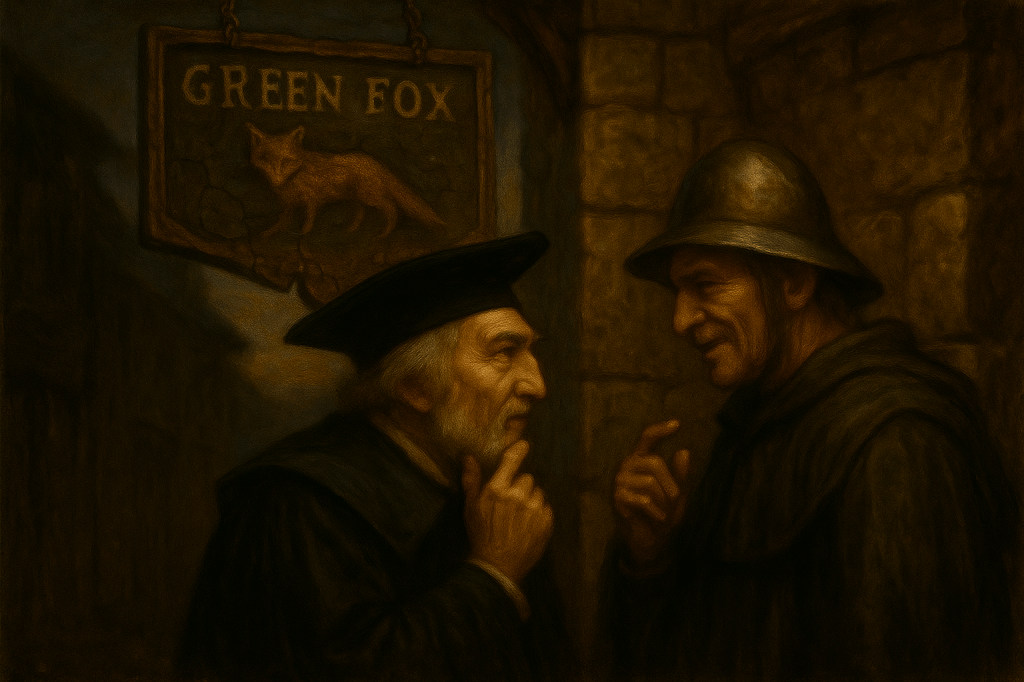
Outside the Green Fox tavern, a cunning but aged sign hung crookedly over the lintel; a carved fox mid-pounce, paint long since faded to a leprous hue. One ear had chipped away, and the remaining paint flaked like diseased fur. A drunken hand had recently scrawled “GEORGE” before the “Fox,” but weather had all but erased it. Above the door, a lantern light swayed in the wind, casting the carved beast in restless motion, as if it would spring at any who dared pass beneath.
Inside, the low-ceilinged room stank of woodsmoke, yeast, and wet wool, for the insistent rains of spring led to a July that met no promise of summer, and all were obliged to embrace heavy dress a while longer. The pub was well-occupied, thick with pipe smoke and whispered wagers. A sleepy fiddler played near the hearth, more for his own fingers than the patrons’ ears. Tankards clanked, coins scraped across the oak bar, and no one made eye contact unless they were looking for trouble.
Toward the rear, beyond an ancient oaken column and the smell of pickled onions, two men met in the box settle, hunched behind its half-wall. An old velvet curtain hung over one side, threadbare in places but shield enough for the purpose.
Swallowed in the shadows, Dr. Vane and Jack Thresher were seated close but not congenial, their words low. A tall mug sat before each man, though the Professor Regius had not touched his in some time and the bulky jailer had two empties already at his elbow. Between them lay a single pamphlet, unfolded and pressed flat: James Parnell’s “A Shield of the Truth”, its margin annotated with Vane’s spidery, furious hand.
Thresher had but a mild interest in the document. He flicked his eyes toward the main room and muttered, “Best put it away. We’ll have watchers here afore long. The boy Whitehead’s made too many friends in Bury.”
Vane’s mouth curled at one side as he folded the sheet gently, carefully, for all the world like it was a precious treasure. “Then I say we must act, while tongues are still wagging and not yet marching. I’m telling you, this ‘Shield’ has teeth, and if you’d read his ‘Truth and Innocency’ you’d see I’m right; he’s lining them up like an army.” He trailed off, muttering, “God help us if the tailors and tinkers learn to read.”
The jailer nodded grudgingly, fingers drumming against the scarred oak. “What I say is, let the Assizes try ‘im.” He gave a hopeful look at his companion. “We’ll see he doesn’t walk without a purse that’s been properly bled, eh?”
Vane sat back appalled, his anger building. In another moment he leaned forward, eyes glittering with rage as he spoke through gritted teeth, “What of the money? I care nothing for whatever paltry sum might be wrung from these poorlings.” He slammed down a fist, drawing attention from the bar. “It’s the message that must be stifled once and for all.”
The jailer snorted faintly, but looked away as he drank, pretending sudden interest in the wooden Aunt Sally doll nailed crookedly to a back board. A broken clay pipe stem protruded from her straw belly like a crude spear. When he spoke, it was only to caution in an undertone, “Ye forget the purpose of the box settle, Doctor.”
They both looked to their mugs until the front of the house returned to its raucous tone, Thresher taking a long draw, finally muttering, “You’ve a taste for trouble, whereas I’ve a taste for quiet. And a roof what holds through winter.”
Vane leaned forward, voice now an urgent whisper barely heard above the creak of wet wood in the surrounding walls. “I’m not here to chat about the weather, Thresher. And you’ve received enough money from me to repair a dozen little rooftops. I am telling you, don’t leave it to the court. Find some new trespass, some heinous misbehavior—make it stick. He needs to die by his own misdeeds, and if not by whipping then starve him.”
Again, his listener seemed at odds with Vane’s point, and with enough courage from his cups to bear forth his own thoughts he continued, “I have no understanding of your concern.” He looked around the edge of the curtain then turned back and mouthed in a stage whisper as he counted on his fingers, “We was Catholic, right? Then Protestant. Now the Puritans rule.”
“As they should,” snapped Vane, pulling aside the curtain himself as a serving maid carefully wiped the tables nearby. He caught her glance and motioned for her to leave, only continuing after she moved out of range. He edged forward on his seat, pushing down the fingers that were still being counted and raising his own to Thresher’s face. “I need you to understand that this…paper religion is an infection. These people are like the Dissenters, wanting no pulpit, no priest, no tithe to support the churches, the hospitals, the parish jails.”
Thresher pushed the hand away, smiling and shaking his head. “My job’s nothing to do with parish jails, Doctor. I work under the Mayor, and for nearly nothing. What I get’s from the prisoners and their families, and of course well-wishers such as yourself.”
The old scholar would not be outdone. “I train men who are sure of what they preach and why they preach it. This new business is just some ill-fed weaver claiming God told him how the world should turn.”
The old warden meanwhile took another pull from his tankard before responding, “Well, it’s all the same, ain’t it. More trouble for us as only wants peace. And any man with a press and some ink gets ‘em all going like he was bloody William Wallace.” He gave forth a long belch. “Pardon, Professor. In any case…” he leaned forward conspiratorially, even as Vane pulled back, putting his sleeve to his nose. “It seems to me it hardly matters how they worship God, long as they use His name to hang the next man.”
Vane debated continuing the discussion which appeared at least on one side to be headed toward a heretical crime of its own. Yet he could not help but mutter. “I suppose you want us to let them rant treason on every corner?”
“No. What I’m saying is, each lot claims God backs their banners, and we little folk carry the corpses off the field. You burn a Catholic, the Protestants cheer.”
Vane held up a hand up to signal a quieter tone, and the jailer obliged after another low burp. “…then Cromwell hangs a Papist and the Puritans sing psalms. Now these Quakers come along and say all men have light in ‘em, and somehow that’s sedition.”
The old man’s fingers twitched at his cuffs, anxious to end the conversation, though he yet wanted what he came for—the assurance that young Tom should disappear to an unknown grave. “I see, so you think there is no truth at all. Just let every man write his own gospel, shall we?”
Thresher shrugged. “Wouldn’t be worse than what we’ve got. Least that way, no one’s hanging.”
For a moment, only the hiss of the hearth answered them.
Finally Vane exhaled sharply and leaned back, tapping the table with two fingers. “The difference, Friend Jailer, is that I—we— still remember the cost of disobedience. They don’t. That’s why the boy must be made an example. The others will quiet down if they see what comes of liberty taken too far.”
“‘Liberty taken too far,’” Belton repeated with a bitter chuckle, lifting his mug. “Funny how that always means some lad in a cell while the lords keep their wine warm.” Finding the cup light, he examined the insides, astonished to find it nearly empty. Then as if remembering why they were there, “But, Proseffer…erm…proffoss…let me just say. This example you so desire be not easy to accomplish. This new lot…” he leaned forward, tapping the table and again giving the old man a face full of beery breath, “they are like them of the Dominican Order, them Hounds of God as you call ‘em.”
“They’re nothing like,” Vane replied as to a stupid young student. “The Dominicans are Catholic.”
“Aye, but their resolve is rooted too deeply. These Quakers be like hounds, preaching this way and that, never a thought of giving up. We bethought the child might give way, yet he has done nothing but bewitch my jailers into nursemaids.”
Vane moued his mouth in disgust. “I have heard of your besmitten Duffy. Can you not reassign him?”
“Oh, I would, and have him tending the diseased at no pay if he were not already doing so, now Jail Fever’s spread to every corner. I dare not get too close myself.” He shook his head. “Aye, that the boy might die of it and be done.” He espied the serving maid passing near and grabbed her arm, taking a long drink to drain his tankard.
“More.” He gasped.
Vale frowned. She shot him an arch glance and nodded toward his mug, and he replied with a scornful shake of the head. When she again moved away he muttered, “I pray typhus take the both of them.” Thus, the Green Fox snarled its silence around them as they sunk into their miserable thoughts.
Bury St. Edmunds
July, 1656
The hayloft creaked overhead as George Whitehead finished speaking and stepped down from a stack of oat sacks. The quiet that followed his words felt charged, like the crackling sky before a storm. No one moved. He allowed the Spirit to minister to the people huddled there as he carefully wrapped his Bible and replaced it in his pocket.
Dust motes drifted through beams of lamplight, cast from horn lanterns nailed high on the posts—their waxy glow soft but steady. The scent of hay mingled with the earthy tang of wool blankets and tallow smoke, each breath steeped in both peace and peril.
Then a rustle. A cough. A murmur of cloak hems and wooden soles on packed earth.
They had gathered in defiance—farmers, weavers, shepherds, even a town midwife—their faces lit not by chandeliers or cathedral glass, but flickering lamplight and the fire in their hearts. Some wore rough jerkins, others the finer coats of small tradesmen, but all looked uneasy. Not at George’s preaching—that had been balm—but at what might come next.
From the back, a man stepped forward—older, with a deep scar at the corner of his mouth. He twisted his cap in his hands.
“Friend, my name be Elias Northfield.” He shook and wiped his rheumy eyes, voice gravelled with age. “Me lad Jeremiah’s been in the Ipswich jail since Candlemas. Seized for not attending the steeple house and refusing tithe. They say he’s been ‘released’—but he’s still held. They want six shillings a week for his board, and more for the turnkey’s ‘trouble.’ We’ve not six farthings to our name.”
He looked down. A woman nearby touched his arm in sympathy. Her eyes brimmed with the anger that comes from seeing such injustices too often.
“Thou speak of Light, Mister Whitehead and I do feel it,” she said, “but what of the darkness where they keep our sons? What Light burns in a pit of lice and debt?”
A murmur of assent rippled through the crowd.
The gravity in his bearing belied George’s youth, and perhaps he was not so young as others his age, since he knew the pain a jailer could inflict. He also knew he had been spared a heavier sentence more than a few times, thanks to his wit and a tongue that could outmatch any second-son reverend in even the simplest of debates. He stepped forward again, his voice quieter now. “The Light does not always lead us out of the fire. But it will lead us through it. Yet we must labor—in the Spirit, and yes, in the world.”
He turned to one of the men—a Friend from farther east, clad in the plain coat of a minor tradesman.
“Richard, thou still hast friends near the Council of State, dost thee not?”
The man gave a hesitant nod.
“And,” George added, “Fox has lately gone to London. He means to seek another meeting with Cromwell himself. To plead for those imprisoned without cause.”
A murmur: “They’ll not listen.”
“They listened before,” said George. “The Light moved one heart; it may yet move others.”
A matron stood forth—not yet thirty-five, with seven strong sons beside her and a baby girl wrapped in her woolen shawl. She raised her hand, not meekly but with contained fire.
Her husband moved to stop her, but George nodded for her to speak, saying, “John Lawrence, we are beholden to you and your goodwife Mary for the use of your barn. Let her speak, as she is as much Christian as you or I in God’s kingdom.
The couple exchanged looks, and John nodded.
“And what of these jailers and turnkeys?” she asked. “They have the right of a living, they say, yet these long sentences are becoming commonplace. And they are now as bad as the priests for making themselves a livelihood out of the poor unfortunates.”
George looked at her, and though his face bore weariness, there was a flicker of something like steel behind his eyes.
“Then we shall go to the jailers next. Truth does not end at Parliament’s door.”
The people remained quietly for a moment. Some bowed their heads. Others reached into their cloaks—coins passing hand to hand.
Standing in the back of the room, George Fox the Younger, so named because the boy found himself in possession of a now-famous name, leaned forward and held his breath. Something was stirring in him—not just the words, but the courage behind them. He knew within himself and without doubt that he too would soon speak as Whitehead had done.
The gentle clink of many coins broke the silence. A small purse passed from hand to hand until it reached the goodwife. She brought it to the old man.
“Take it,” she said. “They’ve no cause to hold him now.”
His eyes brimmed with disbelief. He spoke with broken voice, “They claimed he owed for the wood to make his fires, and the moldy bread though I brought him better every single day.” He held up the purse and the palsy of his hand added emphasis to his grief. “They said they’d not let him walk till it was all paid!”
“And now it is,” George Whitehead said simply. “Let God be the judge of them, that these jailers find no profit in this misery.”
All remained silent for a time, then individually and in families they disbursed. John Lawrence nodded to his sons, and they set to work putting the barn to rights, that none might guess there was a meeting here. The eldest doused the lanterns with a snuffer-pole, reaching carefully to each in turn until the barn sank back into shadow.
George, meanwhile, stood outside and uttered a whispered prayer as he watched the old father disappear into the darkness, still weeping, still unsure such coin would be sufficient to overcome a sadistic jailer’s greed.
Mary joined him, with Fox beside her. He turned to them with a haunted look.
“We bought one free tonight, but how many still lie behind stone and straw?”
The goodwife guessed the source of his question.
“Your young friend Tom…how long now in the heretic’s cell?”
John now stood ready to close the great barn door as his sons passed through. “Aye, we heard it’s a dungeon fit only for plague-rats and murderers.”
George nodded grimly. He waited until the boys made their way back toward the house before speaking his mind.
“Past a year now. Tom suffers because I gave him words too sharp for his age, and not enough wisdom to sheath them.”
“No,” Fox dissented quietly, “he is there because the world fears truth from any mouth—even a child’s. Or perhaps especially that of a child. Do we not see mostly clearly at that age, before the temptations and cynicisms of the world make us heathens?”
George wiped the sweat from his brow. He looked up toward the heavens, at the Milky Way’s cascade of stars burning in purity above them.
“They saw a scapegoat and sacrificed him for their own perverted sense of justice. And it pleased them to do so.”
“They dare call us seditious,” said young Fox. “When all he did was speak against a hireling system that sucks the poor like leeches.”
George lowered his gaze. “He did more than speak. He echoed words I myself barely understood at his age. And I sent him into that lion’s den thinking Scripture and Spirit were enough armor.” “He believed it,” Fox said, “believes it even now. And so do we.”
Before The Lord Protector
The corridors of Whitehall were hushed under a ceiling of opal gray, a brief breath of sunlight filtering through rain-streaked windows, set high with thick diamond panes that fractured the rays so they appeared like leaded scripture across the floors. The guards in their russet coats and iron helmets barely moved as George Fox was ushered in and bid stand until his presence might be announced. He was like an errant scrap of paper in a great gilded manuscript—colorless, solemn, wholly out of place.
He did not seem uncomfortable and waited in patient prayer that sought more than an audience—he sought mercy from the man who had done what Guy Fawkes only dreamed: unseated both King and Parliament in a single generation. If only his thirst for purging had passed, if only the yearning that stirred him still might turn toward something gentler—a new way of being, not by fire, but by Light.
Deeper within the stalwart edifice, Oliver Cromwell had taken the old council chamber for his office—a long, drafty room lined with dark oak panels and tapestries that muffled both sound and sentiment. These were Flemish, dense with silken thread and Biblical conquest—masterworks of art and weavery that remained when all other ornament had been stripped away. They were meant to impress…and to warn.
One end of the room was anchored by a high-backed chair and a great writing table that held to one side a pile of pleadings, at the other dispatches and well-worn maps. In the center a thick ledger, pen and ink, and a plain folded kerchief—bloodstained at one edge. When seated there he faced the room like a judge surveying the floor of a court. At other times he held conversation before the great hearth beyond his desk, where many a plan for England’s grand future had taken place.
Along each wall, beneath tall, mullioned windows, an ever-present line of clerks worked at their narrow desks in silence, their hands moving in quiet choreography; ink dipped, margins blotted, initials inscribed in corners like private signatures on history. Without emotion, they efficiently sealed and handed their various documents and letters to couriers who came and went through an inner door, often bringing in more than they took away.
At this moment, the broken streaks of water flowing across the clear glass panes cast the room in a shifting silver gloom. Cromwell stood before the hearth, silhouetted against the flickering warmth which lent a restless light to the plaster ceiling. He was wigless, Puritan-plain; his coarse brown hair cut to the stubborn line of his jaw. It fell in irregular lengths, as if trimmed by practicality rather than vanity, exposing a broad forehead furrowed not only by age, but by war and sleepless governance. His crown shone faintly with sweat in the firelight, the scalp tight where pain nested, as though even his head bore armor for a war not yet ended.
His doublet of iron-gray bore a faint sheen of wear at the elbows where habit had polished the wool. One glove hung loose from his belt, forgotten; the other was he knew not where. On his feet, plain boots of blackened leather gathered flecks of ash from the hearth as he listened, deep in thought. His son-in-law and Deputy, Charles Fleetwood, was reading the latest dispatch from the garrison at Carlisle, his voice practiced, dutiful, as though he knew this was not the sort of dispatch that changed fates—but still, he read it as if it might.
In contrast to the Lord Protector’s plain guise as gentleman farmer, Charles embodied the careful polish of inherited power. His coat was military in cut yet softened by civilian compromise. The year before he’d been excused from his role as Ireland’s Lord Deputy, and the matter still stung. His high collar—once stiff enough for parade—was now worn just enough to hint at habits of command in retreat.
As he read to his master and father, he yet moved with the assurance of a baron’s son; although with the uncertainty of being third in line, and born many years after his brothers. He was a man always keen to catch up, and to be taken seriously.
Near the firelight Charles’ loose reddish hair—touched now with ash though he was not yet forty—stood out like a fading flame amid the darker garb of Cromwell’s court. Indeed, while his woolen surcoat was the requisite gray, it featured a double row of gleaming buttons contrasting the tarnished pewter variety worn by his father-in-law.
Beside Cromwell—whose plainness was not just ideological but physical, as if his very garments had grown weary with the burden of command—Fleetwood looked like one clinging to the dignity of discipline even as the storm-walls of the old world collapsed around him.
The Lord Protector shifted his weight from one foot to the other, slow and deliberate, the motion small but telling. The gout had returned like a sentence from God—unwelcome, unrelenting. The fire offered no comfort, only a flicker of mockery as it painted his brow with warmth while his joints ached with ice. He stared into the flames as if they might offer absolution.
Charles lowered the dispatch, sensing the change in air, that tightening of muscle and meaning that often preceded his father-in-law’s temper.
Cromwell exhaled through his nose. “Carlisle,” he muttered, “always snowed in or starving, none but bleak seasons for them. I begin to think we ought to give it back to the Scots—if they’ll have it.”
He turned from the fire and paced once toward the heavy writing table, one hand resting on its corner. Behind him, Fleetwood lowered the parchment with a soft crackle of stiff paper.
“That leaves us the Quaker,” Cromwell said. “Still here, is he?”
“Two hours now,” Fleetwood confirmed. “His patience is vast.”
“I will hear him.”
At this, a figure advising a clerk at one of the window-side tables raised his head. Attorney General Edmund Prideaux gave a sharp look, his powdered wig slightly askew. A barrister, not yet sixty, and now legal advisor to the Council, he had made himself indispensable to the Commonwealth’s machinery. Cromwell appreciated his skepticism, if it did sometimes mask a lesser intelligence than his own.
Why receive him at all?” he said, voice clipped and cool. He stepped toward the desk, casting a glance at Charles, who—perhaps irritated by another official inserting himself into the conversation—was making a great show of helping his father-in-law settle into his chair. He would have offered a hand himself but knew from experience it would be bitten. Was it not enough to be made Deputy? The man hovered like one coaxing an infirm lion to purr. Better to fight the battles that mattered.
“He came last year in chains, Lord Protector, to beg his release from Lancaster jail. Yet as often as you release him or any other Quaker, they commit the same offences. ‘As a dog returneth to his vomit, so a fool returneth to his folly.’”
He bent as close as he could without seeming overly familiar. “My Lord, we have warrants enough in circulation to see them all confined, or banished if you’d rather spare the expense of jail.” He gestured toward a small table piled high with parchment. “These petitions grow increasingly theatrical. My counsel is…none. Send him away.”
“They do not seek counsel,” Fleetwood replied, “they seek protection, though they do not deserve it.”
“We agree. They want the law bent for them, even as they bend it to breaking.”
Cromwell waved Charles away, arranging the items on his desk rather than answering either one. It was not simply that George Fox had come again. It was the timing; summer refusing to warm, his body betraying him with fresh cruelty, rumors swirling from Parliament’s halls like chimney smoke. And now comes the man who had once turned down a captaincy to walk the fields barefoot and cry judgment, entering his sanctum to demand pity.
He felt an ague coming on, and his attention turned to a paperweight of polished agate in the shape of a large pawn, which he now turned slowly in his fingers. “The jails are already full with hundreds of men, women—even children—who follow him without regard to their own protection.”
The old attorney shrugged, “Banishment, then. The new world needs slaves.”
“There is precedent,” offered Charles, also a one-time student of law. “You sent the Irish papists to Barbados.”
“These are no papists,” said the man who held their livelihoods in his hands with calculated strength. “They are simple children of God, if misguided. And speaking of this particular guide, consider that he walked into Scarborough Castle and spoke peace to soldiers who’d lost their reason. He called them to temperance and prayer, and they obeyed.” He looked at Charles, who now positioned a chair to observe the inevitable audience. “So said the governor.”
The deputy glanced over as he sat elegantly. “I am not so much interested in the observations of the Scarborough governor. It is yours that have meaning, Father.”
This last word was delivered as if no one else were present. The Attorney General looked down, jaw flexing—but said nothing.
“Then I observe that my government is a military one, and these men bear no arms.”
Prideaux struggled to keep his temper. “How do we judge among them? They cannot be tried for they swear no oaths. They refuse hat-honor at court, even to Parliament. This Fox will likely wear his hat even here.”
“Is a wig different from a hat, I wonder?”
Prideaux scoffed, then worried Cromwell was serious. That man in answer shared a sly grin with his son-in-law.
“I also observe,” Cromwell continued, holding the agate aloft, “he commands the ear of soldiers, fishermen, women, and brewers.” He looked up as the rain began anew, tapping hard against the mullioned glass. “His kind exhorts our ministers as Peter exhorted his shepherds, ‘Feed the flock of God which is among you, taking the oversight thereof, not by constraint, but willingly; not for filthy lucre…’” He turned toward Prideaux. “I am more inclined to hear what the ministers made of the reminder than how many lashes were dealt to the messengers.”
His attorney remained silent, jaw clenched. The faint sound of horses pounding through puddles in the outer courtyard bled into the stillness. Hearing no further arguments, Cromwell put the pawn down, stood before his seat, and motioned to the waiting steward.
“Bring in Fox. We’ll see what he wears on his head.”
Prideaux muttered something about the dignity of government. Charles rested his chin on his walking stick, the one man of the three who understood the quiet power of being seated when others stood.
A moment later, the door creaked open. George Fox stepped into the chamber without the benefit of an announcement other than the soft tread of his boots on the wooden floor.
He looked almost precisely as he had at his previous visit: weather-stained, a mud-splashed leather coat that reached his knees and exuded the sour tang of dried earth. He carried a wide-brimmed hat loosely in one hand; not removed in deference but simply held like a satchel. His eyes, a striking pale gray, scanned the room with neither fear nor haste. The steward motioned for him to stand a respectful distance away, which he did obligingly and with grace. From inside his coat he then produced a paper packet and held it aloft.
“A record,” he said, “of Friends now suffering imprisonment in York, Kendal, Banbury, Carlisle, Colchester…Ipswich, Edmundbury…”
Fox held it out further, looking askance toward who might come to retrieve it from him. The steward took a step forward, but Cromwell lifted a hand.
“Hold,” said the Lord Protector. “My demand comes first—then, perhaps, yours.” He cast a slow glance at Prideaux. “I do not grant audience without payment.”
Fox halted, withdrawing his arm but keeping his gaze steady.
Cromwell leaned forward, voice sharp as steel.
“You Quakers stir trouble, sir—consorting with royalists, no doubt. I hear their prattle still: their king hid in an oak, as if God Himself shielded him from our muskets.”
Fox answered plain, unflinching.
“We side not with prince nor parliament, only the truth that binds all hearts.”
Cromwell’s fist struck the desk with a crack that startled the clerks.
“Do not school me!” he roared. “You set yourselves against order, against ministers, against Parliament itself. You print seditious tracts without license, bow to none, call the rabble to preach in barns and fields. By such insolence you rouse the mob and tear at the very sinews of the nation. And when the lash finds you, when the gaol binds you—you cry persecution! As though you did not provoke it with your own tongues!”
Fox stood unmoving. “We provoke none. We answer only to Christ within.”
The silence that followed was long, broken only by Cromwell’s ragged breath.
He leaned on the stone mantle, his stance uneven, as if one foot no longer belonged to him. Gout, like politics, had settled in for the long war, and pain followed him like a loyal retainer. Each step was a negotiation between honor and illness.
Yet he continued, turning back to face his errant citizen with the irritated sense that he was repeating himself. “You disturb settled congregations. You publish tracts without license. You rail against ministers. You claim every ploughman and milkmaid may preach the Word, may upbraid any and all as the spirit moves them. Yet here you are, asking me to intercede with justice.” He paused for effect, staring down the evangelist as he settled himself, back to the fire and hands behind him. “I ask again: what do you truly want from England?”
The room held its breath. For his part, Fox appeared to be consulting his inner Light. Cromwell sighed at this lack of an opponent and turned once again to study the fire. He had learned to allow silence to win his battles.
With a voice of quiet steadiness, his eyes the color of cold ash just before the wind stirs it, Fox gave his reply. “We seek the liberty to obey God as He speaks within. To worship without bishop or blade. To speak as we are moved. To walk in the Light—even when that Light leads through shadow.”
Without lifting his eyes, the king in all but name wondered almost as if to himself, “Even when that Light burns England to the ground?”
Just as quietly Fox answered, “If England be built upon sand, let it fall.”
There was a long silence. Only the ticking of a distant clock and the continued tapping of the rain outside. Charles well-hid his fury and fingered the engravement of his family crest. Prideaux was all impatience but held his peace with a grimace.
At last, England’s Commander turned and gestured tiredly to the steward.
“Take the paper.”
Not without a sneer did that man step forward and receive it from George’s hand, then with a more respectful mien, offered it to his lord.
Cromwell took it with a practiced frown, then moved across the room to place it atop a stack of parchment on a table near Prideaux. He gestured toward the pile, “It is added to these that arrive daily from your friends.”
The Attorney General took the opportunity to add, “These have learned the cost of speaking plain in England.” Charles scoffed at the way the old barrister inserted himself into the exchange.
Fox beheld them all with a sorrowful comprehension and continued, “Such atrocities are done unto innocents—deeds that, were they done to thine own son or daughter, would surely stir even thine ire.”
Cromwell nearly snarled at the bold reference to his children. “I’ve read the names. You call them ‘Innocents!’” he scoffed. “Inciters, you mean. There are but two of them that interest me, and I’ve no doubt they are on thine list as well. The case of James Parnell and his lackey, Thomas Lightfoot. A mere boy.”
George nodded an acknowledgement. “He was but ten when they took him. He is perhaps twelve now. Still, younger than thine own son Richard was when he first bore arms.”
Cromwell’s mouth twitched at the corner—not quite a smile. “A poor comparison, Friend Fox. My son fought for his country’s liberty as a man of three and twenty. Your boy defied England’s very magistrates.”
“Then thine liberty is counterfeit,” Fox said softly, “if it cannot bear the voice of a child.”
Silence settled in the room, broken by Prideaux muttering, “His ‘thine’ and ‘thee’ for God’s sake. Shall he spit upon us next?”
The Puritan General regarded his own lackey for a moment. “Youmay speak, as you have opinions on these cases.”
Prideaux stood slowly, nodding to his sovereign who appeared willing to make a trial here and now. The deep furrows of his aging face settling into disapproval, he took a breath and began as if he were at Westminster Hall, which amused Charles no end. “My Lord. The work of a century gave us the doctrine of Sola Scriptura, the Word of God in every man’s hand,” and here he held up a Bible of moderate size. “Yet these citizens would throw it away like rubbish.”
George made as if to speak, but the barrister had the floor and held up a quick hand to stop him as he carefully put the Bible back in its place. Then drawing himself up into his full courthouse posture continued, “It was not merely that the boy spoke such heresy before our most venerated teachers, nor that he disobeyed a lawful order to cease.” He emphasized his next words with a finger that pointed at Fox. “It was what he said. That Jesus is the Word of God, not the Scriptures.”
He let the heresy hang in the air like a sour scent.
Cromwell dabbed at the moistness of his face with a plain handkerchief square and muttered, “Many a preacher makes fine distinctions.”
But Prideaux’s tone grew firmer. “Distinctions, yes—but this is the cornerstone of their revolt. They raise this “Inner Light” above all written truth. It makes every man a pope, every milkmaid a bishop, and every pulpit a public hazard.”
Fox stepped forward now, his voice low but resolute. “We do not scorn the Scriptures. We say they testify truly—but they are not the life. The Life is Christ.”
The old lawyer sneered. “And so you give every tinker and weaver leave to discard a thousand years of careful doctrine in favor of private revelation. No wonder the jails are full.”
Fox’s eyes burned. “And if the Spirit of God speaks to a child?”
Prideaux folded his arms. “But there is the case, Mr. Fox. The Spirit of God did not give the child those words.” Now he rose to full oratorical pitch. “You and your George Whitehead, now rightfully jailed, again,” Cromwell interrupted him with a look, forcing the man to pause mid-sentence.
“Again, you say?”
It was Charles who offered the explanation, “Indicted at Edmundbury as common disturbers of both magistrates and ministers, my lord.”
“Aye, my Lord,” continued Prideaux, “and should have been indicated for willfully corrupting children, for he and this man before you gave words to Thomas Lightfoot which he repeated without a complete understanding, nor the ability to expound upon them. You made this boy a heretic, Master Fox, and as we have heard, no amount of time in the bowels of Castle Hill can free him from what he now believes to be true.”
Cromwell shifted his weight and drew a breath through clenched teeth, the dreary light casting deep shadows in the hollows of his cheeks. “Yet he is still a boy.” The fire snapped behind him with a sound like bones shifting in a deep bed of coals.
As he moved to sit, Charles was already there, helping him settle slowly even as he caught himself with a wince. The favored son nodded to the clerk with the lord’s pewter cup, who passed it quickly over.
As the ruler drank, his Attorney General took the moment to step to the desk and counsel quietly, “He is a boy, yes. But not unknowing. He speaks as one trained—trained not in humility, but in defiance. He’s learned to prize his own stirrings over all established judgment. That is not innocence. That is rebellion given voice and scripture’s cloak. Here is the scripture you should mind well: ‘Pride goeth before destruction, and an haughty spirit before a fall.’”
Fox’s eyes did not waver. “It was truth that stirred his heart to speak. The lad said only what the Spirit gave him in the moment. He meant no harm.”
This last was too much for Charles. “Our church leaders are clear on this point. He denied the Word of God. Who will speak heresy and treason next if babes are encouraged in this manner?”
“I say he named Him rightly,” Fox answered, quiet and steady as Daniel in the lion’s den. “For the Scriptures themselves declare the Word to be made flesh. It is not parchment that saves, nor ink that sets us free, but Christ Himself, living and risen.”
Prideaux scoffed, the sound like dry parchment torn across a desk. “So you would let every cobbler overturn catechism? Every boy challenge priest and justice alike?”
With a bang that was perhaps louder than he expected, Cromwell set the cup down on his desk and carefully wiped his lips. All watched and waited.
“Let us not forget, gentlemen, that the priests and justices have done no small share of the overturning these past decades.”
Fox bowed his head slightly, acknowledging the defense with gratitude. But Charles, speaking carefully and quietly, his shoulder turned away from their adversary as he unfolded a lap blanket to cover the ailing man, attempted to drive Prideaux’s point home. “Father, hear me. Without a rule, without the Scriptures to bind the conscience—there is no England. There is no church. There is no law. You, my lord, may pardon a child. But please do not mistake an arsonist’s fire for holy light.”
Fox spoke again with quiet force. “If it is divine fire, it is because the Spirit burns in this generation. And if it is a holy light, it shall not be hidden.”
Silence fell again as Charles straightened the blanket, received gratefully with a shiver. Cromwell nodded toward the empty cup and his son-in-law held it aloft to be refilled before offering it to him again. The world in that room paused as the water poured, the hearth crackled, and a parchment fell softly to the floor.
Having accepted his drink, Cromwell looked at his desk wearily, then at the interloper before him. “We are told, ‘Blessed are the merciful: for they shall obtain mercy.’ Yet mercy is no cloak for disorder, Friend Fox. In fact I am reminded of this proverb: ‘There is a way that seemeth right unto a man, but the end thereof are the ways of death.’ And this reminder to the Corinthians, ‘If any man seem to be contentious, we have no such custom, neither the churches of God.’”
The rain stopped and in that sudden silence, clarity seemed to strike. He took a deep breath before forcing himself to sit up straight, waving Charles away impatiently along with the blanket. Standing again, he spoke as if each word were a lead weight. “I am with my counsel on this issue. This ‘boy’ you hold before us with such sincerity and pleadings was but your trained monkey, a tool of sedition carved by your own hands.”
He forced himself to walk to the window and rested there, even then shifting his stance every moment or so in a small, habitual motion—the slow dance of a man whose bones have turned seditious. After a long look outside, at his kingdom, he turned to face his subject. His voice now rising into an ire to match his agony, he said too loudly, “Thomas Lightfoot stood in open court and refused to recant. He called the ministers hirelings. He denounced his elders.” Leaning in as the echoes of his voice faded, he added more softly, “And he spoke blasphemy, if you ask some.”
“I do not ask some,” Fox said. “I ask thee.”
The Lord Protector chuckled ruefully, the sound brief and graveled. “You’re bold. But not unwise.” He made his way forward to take a turn about the room. “Not so much the boy, who appears to lack both cunning and wit. He’s certainly no Whitehead. And to your point he is perhaps no enemy of this state, but…” he paused in remembrance of other conversations, rubbing a scarred knuckle with his thumb as he continued, “he has made enemies for himself. Dangerous enemies, you would agree.” Here he glanced toward Fox, who, though haltingly, gave a slow nod. “Our Attorney General is fast becoming one himself, it seems.”
“No, my Lord,” the latter spoke hastily. “I am no enemy of the boy, but of his words and his unwillingness to guard them.” And with that, the old Parliamentarian seemed to feel he had stated his case. He sat to rest, removing his wig and mopping his head with a handkerchief.
Shuffling slightly, his hand at his back, Cromwell passed one clerk then another, straightening a paper here and there before he turned to accuse again; “You, Master Fox, must bear in your soul the consequence of using children as your cannon fodder. I know of no other Christian body which allows mere babes to take the pulpit.”
“We argue intellect. Whitehead himself was but fourteen when he set forth to minister.”
“A prodigy!” Cromwell allowed the thought to wash over him and chuckled ruefully, “He must have been either joy or fury to his schoolmasters. Perhaps both.”
He was now a mere arms-length from Fox, who at any other time might have laughed and allowed the conversation to devolve into mere pleasantries. Yet the Quaker eyed the other two men, the man of the courts and the man of the militia. He stood rigid lest the purpose of his visit be lost, instead answering gently, “Galatians in the fifth chapter tells all Christians to walk in Spirit. It does not distinguish as to age.”
The Biblical excuse unleashed a new and greater fury with which both staff and family had become well-acquainted. “Folly! Complete foolishness!” This was uttered with just inches between them. Cromwell took a breath and stepped past Fox to lean against the wall, looking up at the tapestried scene of Hagar’s banishment to the desert, her child in her arms.
He fumed, “These patriots who send their little boys to sound the drums and reload the guns pour the blood of innocents on a thirsty ground, as you yourself have done and continue to do.” Here he grabbed a small side table and smashed it against the ground. “I say it again—Lightfoot is not imprisoned by his own fault but by yours!” He pointed a long finger at Whitehead, who bore the accusation calmly even as the clerks exchanged glances and shook their heads.
“And no, he may not be dangerous, merely stubborn, which does him in good stead.” He huffed and shuffled back toward his makeshift desk. “Many a stubborn boy becomes a dull man—more concerned with bread than fire.” He reached his destination, placing his hands on the front of the table and raising his eyes to the ceiling. “Let this Lightfoot sit a while longer. Let the world wear him down.”
George’s mouth was set. “He is not made to be worn down.”
“Then he’ll die,” came the simple answer, as the Lord Protector turned, again adjusting his stance in an attempt at relief. “And you will make him a martyr. Is that what you want?”
Fox did not answer. The silence stretched between them, taut as a drawn bow.
Cromwell moved toward his chair, steadying himself as he went, as if steadying the very Commonwealth. He did not sit, being too agitated, but stood and sifted through papers, eventually lifting one well-handled parchment. “Let it not be said the Protector’s Court tramples babes underfoot.” To Prideaux he roared, “I am ready to rule!” The Attorney General nodded to his high clerk, who in turn snatched up his quill ready for the forthcoming order.
“See this boy moved to the House of Correction and let him begin to repay his considerable debt.” To George he said with a voice clearly waning, “As long as he does not stir up sedition, the lash shall remain unused.”
Charles stepped forward and helped the ailing man sit again. This time he allowed it, grasping for the blanket with a shaking hand and eyes closed in agony.
Fox made another move to speak but Charles superseded him with a steady glare. “You are very kind, Lord Protector. The boy will be fed and sheltered and learn a trade if he is not too stupid. And when the Summer court sits, perhaps they may speak of him again.”
George made a slight step forward, his voice now low and deliberate. “Justice that waits for the turning of the seasons is no justice at all.”
Charles sent a quiet signal to the steward, who stepped forward quickly. “You tread a narrow road, Quaker. Your people may yet tilt the balance too far.”
At this, the evangelist withheld the commentary that sprung to mind, that he might not jeopardize the boy further. Cromwell looked up and at each man in turn, his lawyers and the supplicant. “Are we all agreed?”
Fox’s face did not move, but something in the set of his shoulders eased.
The sovereign cleared his throat softly and renewed his search of the papers on his desk, finally pointing to one well-marked sheet which Charles retrieved. “As for this James Parnell,” he said, “let his case be heard properly at the next Assizes.” The high clerk again wrote furiously as his ruler looked up sharply at Fox, as if to dare him to beg further.
Returning his gaze, the evangelist responded gently, “My list includes Whitehead, and others held at Ipswich and Edmundbury.”
Charles laid his hand on his father-in-law’s shoulder. “I will review the cases on this latest list personally.”
Cromwell nodded and pointed generally to the pile near the old attorney, “I have already reviewed the others…as so noted for each. You will see my marks.”
Curious, Prideaux jumped up, still without his wig, and picked a page from the middle of the pile. He looked at it sideways, then nodded to Charles.
The Lord Protector seemed now to be in a fever, and continued in an almost singsong voice, “You see, Fox, the law must stand but let it not be twisted by a thirst for vengeance. For vengeance belongeth to the Lord.”
George bowed slightly, not to the man, but to the task accomplished. As he turned to leave, Cromwell’s voice came again, strained and low.
“Yet one more…request, you son of Light. A prayer—as one Christian owes another.”
There was an audible sigh near him but Cromwell went on, half to Fox, half to himself.
“My physicians speak in riddles and humors. Fever in the limbs, bile in the stomach…I seek a prayer against this ague. A prayer…” He added, almost as a whisper, “For, ‘The effectual fervent prayer of a righteous man availeth much.’”
His voice faltered, lips dry and pale. Charles took possession of the man in the chair, shielding him from Fox as he summoned another blanket, materializing just as quickly, as if it were all part of a well-choreographed play. The steward also moved in front of the supplicant, awaiting orders.
George meanwhile did not move, nor speak, though he seemed to be communicating to One who could not be seen nor heard in that great hall of worldly power.
Replacing his wig, Prideaux gestured for the steward to remove the man. Without force, but not without firmness, he ushered his charge back through the door and closed it with a finality.
As he approached the desk, the Attorney General dismissed the clerks who already stood awaiting orders. To his high clerk he said privately, “Summon the Lord Protector’s valet and his doctor.”
Cromwell leaned back painfully, wearily, and caught Edmund’s arm as soon as he neared. “God gives me no sons fit for this labor. One thinks with his nerves, the other with his purse. And Richard…Richard is a sheep among wolves.” At this Prideaux glanced at Charles, noting that he had bitten his lip.
He responded quietly in measured tone, “My Lord, it is no matter since the law permits no dynasty in a Commonwealth. Not unless Parliament wills it.”
“They will…if I bid them.”
As the three waited together in the rain-washed silence, Prideaux could not help but mutter, “Then it is not a Commonwealth, is it?”
A Letter from Tom
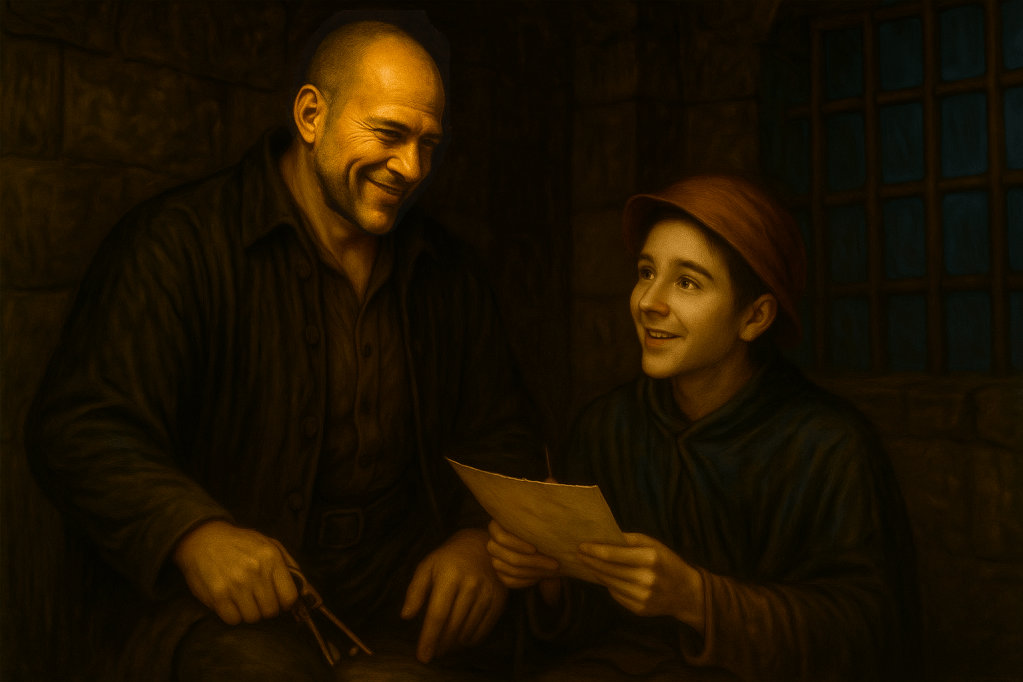
The window was too narrow to climb through, too high to reach without a stool, and yet the light it cast was generous. A square of gold moved across the whitewashed stones as the sun rose, paused briefly to warm the far wall, then vanished again in the hush of late afternoon.
Tom watched the dust motes floating in the sunbeam—a favorite activity, for he liked to think of the bright sparkles as little souls untethered. Outside, a cart rumbled by; the rattle of iron-rimmed wheels and clop of hooves dulled by his thick walls.
The cell had been scrubbed in the first month of his habitation. He could still smell lye and wood ash in the seams of the floor, still remember the rough work as Bess plied her brush and enjoined him to apply his. They had spent an afternoon of it as Duffy and Pip sat together with a basket of sweets made for the purpose. Speaking with a mouth full of pasty, the tough old turnkey commented on her great alacrity. “Go at it good lady, them walls hain’t seen such a cleanin’ since they was laid by the Normans.”
Since that day, he’d even proposed to her more than a dozen times, each time seeming more sincere in his offer of a house of her own to clean. She would have none of it. The Blakelings and Tom, these were her family.
Now more than a year later, the boy nestled into fresh hay that had not yet settled—its scent grassy and clean, as if it remembered the field from which it came. He let his fingers run along the coarse woolen blanket brought specially by Mistress Blakeling, though it made her heart sore to be there, and she could bear it no more than a few minutes.
In the corner he had a bright clean bucket and basin, treasured possessions. On the ledge beneath the small window a cup of water, its surface still. It was quiet enough to hear the scratch of his quill as he wrote, quickly while he had his hour of good light.
But most precious were the pieces of coarse writing paper laid across a board upon his knees. For on this day he set out to write to the dear ones he had not seen for some time, to assure them he was well and had no hard feelings if they did not come again, though he wished with all his heart they would.
Duffy had given him ink, though he knew this benefit was more than compensated by a packet of sweets from Bess. His pen was a gift from Whitehead, and with it Tom wrote carefully, every word etched as though he were inscribing it on stone.
The next day found the old turnkey eagerly making the journey down from Castle Hill to deliver Tom’s letter in person at the servant’s door of the Blakeling residence. And though Bess was grateful to receive it, she was yet loathe to find her admirer had yet another excuse to invade her habitation, for no sooner was the latch loosed but he was in the premises and seated at the bench before her worktable, waiting expectantly.
He held up the missive but couldn’t pass up an opportunity for courting. To her dismay he spoke rather intimately, “Now lovely Bess, we haven’t seen ye for some time, lass. Are ye ill yet, lady?”
Flustered with the proffered letter and a lack of privacy to open it, the still-ailing woman shook her head with a blend of denial and palsy as she took it from his hand. “Nay, Marster Duffy, only I have yet some weakness. But I mean to come soon.” She paused wonderingly, examining the ink marks across the envelope. “To think he’d write us.”
“Yes, it’s quite kind, ain’t it, fer a small boy. And besides which, I have some news for ye. But the letter first, the letter first.”
He gestured toward the missive even as he found himself a wooden cup and started pouring from the cider jug.
“Oh, it’s a bad light in here, Marster Duffy. Perhaps if we go outside…”
The lady of the house chose that moment to peek into the kitchen, hearing an unfamiliar voice. Her thoughts at seeing the turnkey gave mixed feelings.
He on his part was only too happy to toast her. “To thine health, Madame Blakeling!” Duffy drank noisily and poured again with aplomb, though in the next moment Bess rescued the cider jug from his hand.
“I am sorry Mistress! Only he says there’s news. And he brung this letter from our Tom…” She held it forth. “I carnt read in this light…”
The gentlewoman received the envelope, noting that between the jail cell and Duffy’s pocket, it delivered much in the way of dirt and odors. She turned at once, calling out with alacrity, though her husband was only in the next room. “John!”
Even as the mistress removed herself from the kitchen, her servant was not far behind, attempting to maintain a respectable distance from her employer while yet escaping the clutches of her would-be lover. He was only too happy to follow out to the hall, where Blakeling was ensconced in his favorite chair, perusing the latest pamphlet and looking up Biblical references with great concentration. At this sight Duffy fell back, preferring the fireplace to the center of Quaker activity.
Bess brightened the lantern by John’s side even as his wife handed him the envelope. “Only look, my love. It’s from our dear Tom. Please read it. We are all exercised in Spirit to hear these tidings.”
Taking a view of his audience, the gentleman sat up, putting his pamphlet carefully to the side. He well-hid his astonishment at the condition of both envelope and paper, but read in kindly voice nonetheless:
“To Friend George Fox, or to Friend George Whitehead, or to Dear Bess and the Blakelings, if they would know I remember them kindly. I write to…”
Here Duffy interrupted, “I helped with that bit, friends. For he weren’t sure whether to send to one or all. It’s a nice middling point, ain’t it?”
Blakeling nodded with some irritation, “Yes, we thank thee Duffy. Though I’m sure any greeting would be most welcome by one or all. Now let us continue:
“I write to thank thee for thine kindnesses. Know ye that I am in good health and have had no further illnesses in the weeks since Bess brought me her soup.” The reader paused to see if this might draw comment, then proceeded: “My straw is yet new and the blanket given me at new year is even warmer than the last, which the rats did eat holes in.”
Eleanor was aghast at this idea, and stepped back to her chair. Duffy made a motion to reach over and comfort her, but Bess cut him off. Though she would have rather witnessed her employer’s finger upon the lines as he read them, she instead stationed herself at her lady’s side. That personage, for her part, shielded herself with her knitting as Duffy used the moment to insert another comment.
“Thy soup was indeed good, dear Bess. The boy wanted me to taste of it as he was that proud, and though I only had the smallest bite, I could tell it was something special. As to witness by the boy’s improved health, I might say.”
Husband and wife both absorbed this information with mouth agape, while for her part, Bess was mortified. Yet as there was more of the letter, the reader continued:
“It was in my thoughts to tell ye, that while I miss the sky above, yet have I joy not just in the Light of my Savior, but this same Light has revealed my many blessings. I have a room to my own, and none comes to beat me or put me out it.” Here Duffy shook his head in complete agreement. Blakeling pressed on: “I have family and friends where I had none, and have found a kind of peace here. And so each morning and night I thank our God for all He has done for me.”
Duffy puffed up like a yeasty roll at this point, for though he did not write the words himself, having no deep religion to speak of, he yet prided himself on his part as encourager, not to mention his hand-delivery of such a poignant piece of literature. John waited, for he sensed the man was surely about to speak, yet Duffy magnanimously waved his hand forth, nodding for him to continue:
“I would not like to say I am never afeared, nor that the silence does not press upon me betimes. But it is a different kind of lonely than I knew afore. I used to fear the streets and the cold and the hunger what ate at me in the night. Now I fear only that I will be forgotten and lose you all, especially if I am freed and sent out into the world again.”
Bess marked the words with a sob, handkerchief to her wet face as she abandoned her lady to see herself the words being read. The couple looked at each other. Eleanor, wiping a tear or two of her own with a finger, silently motioned to continue:
“I remember well the cloak I wore when I was with Friend Whitehead in Norwich.” Here John espied his wife drawing out her own plain bit of handkerchief, declining the rather dirty one offered by their guest. She motioned again for her husband to read:
“It was too big for me and smelled, but the memory of it has become to me like,” he paused again but doggedly pressed on, “…mother. And I remember too Friend Blakeling’s old hat…” here the reader rubbed his forehead in mortification, as it was a challenge not to cry with the women. For fear of being offered Duffy’s cloth, he read quickly, “…which he placed upon my head. I think of it now as a benediction…from a true earthly father.”
With relief he saw the next line was not for him but for his servant, whose name he rather emphasized: “And Mistress Bess—she is betimes as sharp as vinegar, but she is also gentle in her words, and kind to me. Now I know what it is to have a godmother.”
All were pleased with this part, and the men nodded to each other before John continued: “As to my teachers, my Georges who have both lit my way, know I have written on my wall with chalk, and I read these words when I wake each morning and again from memory at night: ‘The Light is with me. That is all, but it is enough.’
“If thou thinkest of me sadly, do not pity me, for I am safe here. God has not left me alone, and I feel I am better off now than I was ever before in my life. Thy young Friend, Thomas Lightfoot.”
All breathed a sigh to have the telling done, but where the householders felt their hearts weigh heavier, Duffy chuckled. “Well now, I have news to add to that, didn’t I say? Didn’t I say, Bess me old dear.”
“I am not—” John put up a hand to Bess and begged her to hold. “What news from the prison, then?”
Battles Won and Lost
The fire in the Blakeling hearth had sunk low. It wasn’t for want of wood, for there was a neat stack of birch and alder by the back door, but no one had moved to stoke it. The orange glow pulsed faintly against the walls, throwing long shadows that wavered across the rush-strewn floor. Candles guttered in iron sconces, their flames casting halos through the smoke of a supper long gone cold.
George Fox sat in the corner chair—John’s favorite, though he had offered it without hesitation when the men arrived. His elbows rested on his knees, one broad hand holding the rough letter while the other rubbed at his chin, slow and thoughtful.
Whitehead stood by the window, staring into the dark. The moon was a pale sliver, caught behind the thin veil of cloud. He said nothing, but his jaw was set and unmoving, as if he had bitten down on some hidden pain and refused to speak it aloud.
Bess wiped her hands on her apron, even though they were already clean. She had not moved since the letter was read again for the visitors, save to shake her head now and then, softly, slowly—as if disbelieving what she’d just heard and needing time to believe it anyway.
“A scholar’s cloak as a mother’s arms,” she repeated under her breath. “Oh, that boy. My boy,” she choked.
George looked up, met her eyes, then looked away quickly. Even he seemed shaken, though he was not a man easily undone. He folded the letter once more, careful with the creases, as though returning the boy to rest.
“I knew he had strength,” he said finally, “but I did not know he had poetry.”
Bess sniffed hard, then reached for the ladle she’d left on the hearthstones. “He’s still a child. Still wants a home, even if it’s one he must imagine.” She turned, ladle forgotten, and faced them. “He ought to be here. In this house. At that table. Duffy had no right to expect us to be happy with his horrible news.”
Whitehead turned from the window. His face, caught in the firelight, looked much older than his twenty years. “He would not be safe here,” he said softly. “Not after all that’s been said. Vane would have him hanged given another opportunity.”
“The county correction house is no sanctuary, even if it’s to work out a debt.” Bess replied.
“No,” said Fox, rising to his feet, “but nor is it a grave. And Cromwell did promise—no lash, no irons. That he would be fed. That a trade would be taught, if Tom will learn it.”
Bess folded her arms, as if holding herself together. “What trade teaches you not to cry in the night when the wind finds every crack in the wall?”
Whitehead stepped closer to the hearth. “You heard the letter. He is not crying. He is watching the Light.”
“And so are we,” said George. “But not idly. I must write to Parnell. And to Judith. If the Summer court will not hear their cases, we must begin petitioning again. Every Friend who can read must know their names.”
He paused, unfolding the letter once more, smoothing the edge. “He has named us his family, and so we are. That carries duty.”
Bess said nothing more, but she crossed the room and looked at the letter once more. The young man handed it to her reverently. She held it and with a finger traced the boy’s scrawl as one might trace the edge of a loved one’s face.
“Can thee make a copy,” she murmured, handing it back. “To keep it near the lamp. For the dark days.”
“Aye, a copy for myself that thine hands may hold the true.” Outside, the wind picked up through the hedgerows, rattling the latch and whistling beneath the door. But inside, the fire was tended at last. A new log laid, the blaze caught and crackled to life.
 Friends of Freedom