
London, February 1662
The bells of St. Bride’s pealed melodiously as a small wedding party emerged under a shower of lucky grains, the church’s great ringing notes scattering over Fleet Street and mingling with the cries of the hawkers below. It was as if London’s life went on unshaken—yet beneath the familiar bustle lay a malignant shadow.
Not a year before, Thomas Venner and his Fifth Monarchists had stormed these same streets; fifty men wild-eyed with their cry of “King Jesus” to unseat Charles Stuart. They fought like cornered beasts—cutting down soldiers and passersby alike, holding Ludgate Hill until musket fire and pikes dragged them into the dust. Their bodies were made a spectacle after, as a warning to others.
The memory clung like smoke and the streets reeked of suspicion, every bystander a potential zealot. Dissenters of all kinds blurred into one fanatical swarm so that the slightest biblical allusion could mark a man. And with the Quaker Act declaring every gathering of five souls a conventicle of sedition, danger hovered like a hawk over the most ordinary conversation.
In the months since its passing, the prisons had swelled. Friends dragged from their meetings were herded into Newgate and Bridewell; women were left all night in the cold for no crime but silence in private worship. Woe to those who were with child, for the foul vapors rising from the prison drains soon stifled the life within—and not long after, the woman herself. Word of such deaths passed through the city like sparks before a storm, stirring both outrage and unease.
Now, with the city on edge and every street watched by constables and informers, Fleet Street and Ludgate Hill were more zealously patrolled than any other part of London. Every corner and shop window might boast a pair of watchful eyes spying out some lingering knot of talkers.
Not so long ago, George Whitehead had lifted his voice in this very place, preaching peace instead of the sword, conscience instead of compulsion. But to these watchmen and whisperers he was as notorious as any felon, though he carried nothing sharper than truth itself. Thus he waited cautiously near the courtyard of St. Paul’s Cathedral, hat drawn low over his brow, reminding himself that prudence was its own form of courage.
Anne Downer had asked him to a meeting in the back of a local shop. On her approach he tugged his hat further down and made his way forward, following just behind. She moved quickly, cloak drawn close, her straight-backed poise betraying a life disciplined in endurance and service. She smiled faintly at the sound of his steps now matching her stride.
Beyond Temple Bar, the street curved toward Newgate, its foul stench seeping into the morning air. There the spies watched for Quakers bringing provisions to Friends, like spiders on the lookout for flies. But down in the clamor of Fleet Street they had good hiding for a brief conversation, just as the linen shop to which they walked provided shelter to mask a meeting, with its bolts of cloth hung in the windows and a constant coming and going of customers.
As they went, half hidden by the rush of trade, Anne held up a kerchief as if against the stench of the street and spoke in a voice meant only for George, “They were questioning at the prison this morning. Four women who brought food were kept all night in the cold. I have been to see them.”
In return he held his hand below his nose with an expression of disgust and responded, “Thou put thyself in danger.”
“That is no reason to keep silence and withhold comfort. We are all in danger.” There was a school-dame’s sharpness in her tone.
“This in spite of our reasonings before Parliament!” he said mostly to himself. Then with a quick look around them he continued, “The danger grows. They call us ‘plotters’ now, and ‘seducers of the people.’” He looked across to her, even as her pace quickened. A gang of children ran past, pushing the two apart.
A few steps further on he tried again, “Friend Fox and I would have thee curb thy errands for a time, and offer prayers instead for others’ comfort.”
“I would rather work out my faith in person—as thou hast, and Friend Burrough, and Friend Hubberthorn in your pleadings before the very lion’s den. And so soon after your illness.” She glanced toward him reproachfully, “One we thought was unto death.”
She suddenly turned into a narrow lane, leaving George to walk past, inspect a shop window, then circle back to follow unnoticed. Away from Fleet Street the noise dwindled, and they were alone for a moment. George studied her face. “Since thou hast mentioned it—when I lay in Norwich Castle sick of the fever, thinking each hour my last, thy steadfastness came often to mind. It burns within me yet that back when I pleaded for James Parnell’s release, thou thyself wert in bonds…and I did not ask after thy welfare. Thou hast never spoken of thine own time there, only what was done to others.”
Anne hesitated. Her hands tightened in her cloak. “Friend George, I was—am—a good deal older than thou, and by God’s grace was able to bear it. Better thy efforts were spent on the younger ones—thou being but scarcely past youth.”
“Not so young,” said George, reaching for her hand, which vanished beneath the folds of her cloak.
“It is not a tale I bring forward willingly. Can any of us boast greater abuse than Friend Parnell?”
They approached the doorway of the linen shop—shutters half drawn. Within was a hidden anteroom where bolts of cloth were stacked to the rafters. The merchant, a silent ally, gestured to them within and disappeared further into the shop where a quiet meeting was taking place. George closed the door yet hung back, drawing Anne into a shadowy corner behind the entry to give her space to speak.
She removed her hood. “I will tell it only to strengthen thine heart by hearing the victory of another’s trial. I was but thirty-two then. We had gone to stand against the market-day oaths. The sheriff’s men struck at us with staves. I was thrown down as a dog is tossed to the gutter. I was then dragged to the Compter, locked three nights among drunkards and harlots in a pit of filth. They jeered, spat upon me, tore at my gown.”
George’s jaw tightened. He could picture it too well.
She continued, “They charged me as a disturber, fined me beyond my means. When I would not pay, I was put with the thieves and debtors, lice crawling at my wrists, meager food barely fit for swine. Yet…” her voice steadied, “yet I was not alone. The Light was with me in that hole. Others listened as I prayed, and one poor woman said she had not remembered God in twenty years, till she heard my praises to Him. When I was released, I was not ashamed of the bonds, but glad.”
For a long moment George was silent, even as he heard someone speaking in the hidden room. He thought of his steady prayers for a confidante, an educated person whose understanding matched his own, being equally yoked in all ways. Here was one who did not shrink from speaking of both the pain and the blessing of their efforts.
“Thou wert faithful,” he said. His voice carried more weight than he intended.
Anne’s eyes steeled. She had always noted that he seemed drawn to her. “We are all called to be faithful, Friend George. Even when it costs us dear.” There was an uncomfortable pause, which she interrupted with, “I am to marry at the next meeting. Your fellow grocer Benjamin Greenwell. He has…inquired many times and I have at last consented.”
George’s mouth gaped in dismay, but before he could form an answer, the shop door burst open, pushing them further into shadow. Two constables crowded in, the smell of beer heavy upon them, cudgels swinging, eyes that glinted in anticipation.
“I can hear ‘em—in the back!” barked the first. “I told you these seditious folk keep unlawful meetings.”
The merchant emerged quickly to keep the men at the front but they shoved him roughly aside. George moved to come out and distract them, but Anne held him back as more officers pressed in from the street. Soon the men were tearing at bolts of cloth, tossing them to the floor to reveal the meeting room. Through the air thick with dust and the smell of linen they rushed at the Friends, men jumping up from a bench on one side, women on the other.
“Make haste,” Anne whispered. She pulled him through the door, her skirts whipping across the threshold. George followed, heart pounding as shouts rang through the shop behind them. They paused, scanning the street, unsure whether more constables might appear. A hand waved at them from a narrow passage nearby and they followed it into a narrow alleyway, beneath hanging laundry and open windows where at any moment a head might emerge and cry alarm.
There came a great crash behind them, followed by the anguished cries of women dragged into the street. Their guide pressed them into a shadowed back entry, and from there they watched two young women flung roughly to the cobbles, their bonnets ripped from their heads as they struggled against the constables’ blows. Whitehead glanced around to see who had intervened, and to his surprise it was Robert, the linen merchant’s son.
“I escaped through a loading hatch,” he said, catching his breath.
“We thank thee, Friend Robert,” said Anne. “Did any others follow?”
“Yes, two elder women. They are already away. We had best take different paths.
Yet George clung to the shadows, watching as more of the Friends were hauled out and thrown into the gutter. He longed to intervene, though he knew not how. Anger rose in his throat, and with it the ache of helplessness.
Anne laid a hand on his sleeve. “We cannot save them now. But we can meet again tomorrow—and the day after, till London tires of locking us away.”
“Friend George,” Robert urged, “there are none yet at the windows above, and a few steps further we are safe. Let us hurry now.”
There was no time to argue—Robert was already leading Anne away, their hoods drawn close. George followed, the tumult behind them fading as they merged with the crowd at Ludgate.
They would not always escape. Yet like Anne he knew the work would go on, in spite of prison or constable. And hers would go on in the house of a grocer.
At the Wool Warehouse
London, August 1662
The height of summer came and went without a sense of warmth. A silent figure kept to the south side of the street near Bishopsgate, avoiding torchlight. A drunken reveler was sprawled against the door of a draper’s shop, snoring in the heavy summer air. Not unkindly, the traveler noted how far such men lived from the new laws that bound the Friends.
He turned toward a wool-factor’s loft, two stories above a shop whose shutters bore the painted sign of a black sheep. The place had been chosen not for comfort but for its crooked entry passage, which bent sharply enough to hide visitors from the street. It was a warehouse converted for concealment long before these Friends were born, in the days when Catholic priests were the hunted. Now the pursuers were different, but the need to hide was much the same.
He tapped quietly—once, twice, three times—in the agreed rhythm. The door opened to reveal a young man of seventeen. He stepped back quickly, his face pale under a mop of brown hair. The visitor entered under the boy’s whisper, “Friend George, thou art late.”
He did not answer the chiding, only gave a weary smile and said, “Friend Adam, thy jaw hast grown broader since I saw you last.” The boy moved back into shadow to guard the door, but he seemed to stand straighter as he felt of his chin.
Whitehead climbed the narrow, splintered stairs, brushing against the damp wall where mildew stained the plaster. At the top, the air was warmer, smelling of tallow smoke and wool. Somewhere beyond this room, the Thames moved sluggishly in its August tide, and the muffled sounds of a city going about its trade rose and fell like breath.
A man sat near the stairs at a long table, appearing to study a stack of ledgers. He looked up and nodded once. “Didst thou have company along the way?”
“Aye, Friend Peter,” Whitehead whispered, for it was the wool man of the coffee house who owned this place. “It took some time to make them forget me.”
George waited for a moment near the wall, his shoulders to the boards. The habit of caution had been bred into him these last years—not caution of conviction, for that had only deepened, but caution in stance and movement. Had he been followed then at any moment, a knock or boot at the door might break the quiet, and the King’s officers would enter with their writs and staves. The Quaker Act, barely two months old, had given legal form to the resentment that had long been growing in both Parliament and parish pulpits. Its clauses lay like a trap, wide enough to catch every Friend who persisted in their meeting and worship outside the boundaries of the parish church.
He leaned forward a bit and spoke again with lowered voice. “Thy son grows in both height and character.”
Peter smiled at this and nodded, yet did not speak. A clatter outside put them both in a stance of tense listening. Then a drunkard’s song that faded into quiet. They breathed for several moments then looked at each other. After a silent agreement, George moved further into the room.
He continued beyond a wall of sacks and bales through a small maze that led to a carved-out sanctuary of rough wooden benches. Two dozen or so Friends sat listening, most of them known to the local magistrates as members of the Valiant Sixty. Men were on one side, women on the other, their hats on, their eyes turned toward a thin man standing at the center, his hat in his hands to show his face. A single lantern hung from a beam overhead in the windowless room. It swayed faintly, sending shadows like reaching fingers over the sloped rafters.
The Friends came to these gatherings with a stillness that might seem to outsiders as being either sullen or angry, yet they were neither, for they were listening to the Spirit within. There was no priest, no altar, no opening hymn to give shape to the hour. Only the silence, and in it, the sense of being held—by God, by one another, by something too large to name. When the silence broke, it was because the Spirit pressed words on the mind of one or another.
In this case the man speaking was Thomas Loe, who in his younger years had traveled the length of England and Ireland preaching to miners, farmers, and gentry alike—famously convincing William Penn who lost his admiralty under Cromwell and was sent to the Tower. Now in his forties, Loe’s many imprisonments and beatings both in jails and the streets had not diminished his voice. Though he spoke quietly, it still carried with it the warm authority of a bell heard across a valley.
“The magistrates will say,” Loe was telling them, “that to refuse the Oath of Allegiance is to deny the King. They will say we harbor rebellion in our hearts. But I tell thee—our King is Christ, and He hath forbidden us the oath, saying, ‘Swear not at all.’ What then can we do? Shall we obey the commandments of men, and break the command of the Lord?”
From the shadows, a woman’s voice answered, “Nay, we cannot.” It was Anne Greenwell, her widow’s veil pulled close about her face. “When I was imprisoned the first time, they told me, ‘Just speak the words and ye may go free.’ But the words were chains. I would not.”
Whitehead decided he had waited long enough and found a place on the bench nearest Loe, lowering himself and stretching cold-stiffened fingers. The air in the loft was close, carrying the musk of wool and well-traveled garments.
“They will have us swear, or they will have us gone,” said an older Friend, Samuel Blayton, his voice gruff with the accents of the North Riding. “The Oath of Allegiance, they call it. And if we refuse — as we will — they will have the law’s teeth in us. Transportation. Gaol. Confiscation of goods.”
There was a stir at this, but no dissent. All knew the words. All had weighed them in the watches of the night.
Friend Orwin, broader and heavier than the rest, rose from the back. “Yet I say this—if we resist in all things, we give them cause to crush us altogether. These are not the days of Cromwell’s toleration. The King remembers his father’s death, and we are easy to despise. If we speak the oath but keep our hearts clean, is that sin? For Christ himself teacheth, ‘the Sabbath is for man, not man for the Sabbath,’ and this oath-rule is becoming yet another Sabbath law that weighs us down rather than lifts us closer to God.”
At this, murmurs rose among the benches, the scrape of boots shifting. Some nodded grimly; others sat rigid, faces set.
Blayton nodded, “I have heard some say that to swear in the King’s name is but a civil thing, not a matter of faith. That we may keep the truth in our hearts and let our lips do what they must. I would have thee speak on that, Friend George.”
All eyes turned toward Whitehead. He lifted his face slightly, not so much to address them as to let his voice carry. “Friends, hear me. When the Lord spake the Sermon on the Mount, He did not say, ‘Swear not unless it be convenient.’ He did not say, ‘Swear, but keep a pure heart.’ He gave no exceptions for kings or princes.” He let that settle a moment and stood, addressing them gently. “He said, ‘Swear not at all.’ If we bend the word to suit the day, the word is no longer our Master—we have made the day our master.”
Orwin’s face reddened. “And what of our families, George? Will the commandment feed them? Will it keep the constable from our doors?”
Loe motioned for the group to remain quiet and responded with lowered voice, “Friend Orwin, did ye not know he has only recently recovered from the fever which nearly took his life in prison twelve month ago? And that we are still protesting, even before Parliament.”
“Yet,” the man replied, “it is as Moses reasoning before Pharoh, whose heart was hardened against God’s people.” Orwin tried unsuccessfully to speak in a lower tone, “And even so, the Israelites did not tempt the Egyptians to fury by refusing respect. For Peter tells us to submit to the King.”
Another rose up, Loe again motioning to keep a quiet voice. The man nodded and responded to Orwin, “And the apostle James says submit to God and resist the devil. We continue to resist in our way.”
There was a silent impasse at this, and after a moment all took their seats grudgingly except George, who for his part answered wearily, “No, Friend Orwin, this commandment does not protect thee from a people who have turned their backs on their God. It did not feed the widow at Launceston, when her husband died for the same refusal. It did not keep the whip from the back of the boy in Bury St. Edmunds.” His voice sharpened. “But it kept their witness pure, and that is worth more than bread.”
Mary Howgill rose now, her small frame trembling—not with fear, but with conviction. “The young ones are grown, George. Those who were free to roam the countryside in the days of our first journeys are now married, with wives and children to think about. They have seen prison. They have felt the rod. And yet—look—” She spread her hands to the circle, “they are still here. Shall we give them an easier path now, after so much?”
“Friend Mary,” he turned toward her as if to reason with her personally, “to take the oath, even as a civil thing, is to depart from plain speech. We speak the truth always, without the call of an oath, and by that the magistrate may know us.”
From near the door, a younger Friend spoke up—a man Whitehead knew as Samuel Fisher, whose face still bore the gauntness of his own imprisonment. “If we take the oath, even in secret thought, we set the first stone for the ruin of all we have built. We have no bishops, no steeple-house, no altar. Only our word, which is yea and nay. If our yea becomes maybe, then the world will rightly call us liars.”
The lantern guttered, sending a ripple of darkness through the loft. In the pause that followed, Whitehead looked about him at the familiar faces—some lined, some young still, but all marked by the same patient fire. He thought of their journeys across England, of nights in the fields when the stars were their only roof, of prison cells rank with moldering straw, of the first days when they had stood together in defiance of the world’s oaths and titles, and the corrupted religious leaders and their tithes that made them ever hungrier for more.
“The Quaker Act will fall upon us like a hammer,” he said at last. “As Pharoh removed the straw from the bricks, we too will see a heavier lash. More than before and with less mercy, we may be beaten, fined, imprisoned, and possibly new punishments we have not yet known. They will seek to break us with the oath. But if we yield, even once, then we are broken already. Friends, I say we hold fast. For we know not the plans of God. What seems foolish to man becomes clear in time, as it was to the men who blew the trumpets around Jericho without seeming purpose for seven days.”
A younger man, not yet thirty, spoke from the back. His voice had an edge to it. “But if the King’s justice knows us, will that help us when we are before the bar? Will they not say we are obstinate—that we prefer martyrdom to the word that might set us free?”
Whitehead’s gaze moved toward the voice. “Aye, they will say it. They have said it these last eight years. But to make an oath to save our skin is to sell the truth for the price of our liberty. I tell thee plain — a lie in service of life will not keep life, nor will it save the soul. The King may command an oath; Christ commands truth without oath. Which master shall we serve?”
The room was quiet again. One could hear the creak of the boards as someone shifted, the faint rattle of a cart going past in the street.
It was Margaret Fell who spoke next, her voice steady, the words falling with the weight of long conviction. “It is not only for ourselves we stand fast. Every soul that comes after will know whether Friends today held to the Word, or bent the knee. If we bend now, the seed will be choked before it takes root in England.”
A murmur of assent passed through the gathering. Not loud, but enough to tell that the unity was there. Still, there was weariness in it—the kind of weariness that comes not from a single trial but from the slow attrition of years.
Whitehead felt it himself. Like the rest of those in the room, he thought of those who had grown thin, grey, stooped though not yet thirty. Some were dead. Others were still in the fields and towns, laboring as they could, the flame in them not out but guttering for want of breath.
“Friends,” he said, “we are called to stand because the Lord hath made it our portion. Let us keep the testimony He hath given us, that no man nor king can take away.”
The silence that followed was not the silence of doubt. It was the silence of decision made once again. In that dim loft, in the cold heart of London, they renewed the covenant they had made with their God, knowing it would cost them dear.
The meeting another continued two hours, with discussions broken up by silence as they listened for the leading of the Spirit. The raftered darkness above seemed to hold in its timbers the faint echo of a communal prayer in which some spoke, others allowed stillness to hold their turn. Afterward George lingered with the Friends, his hand meeting theirs in quiet pressure, his nod wordless but sure.
Outside, the night lay still. Peter, still at his table near the stairs, was still unsettled by the midnight clatter, and the following bit of drunken singing that had drifted through the shutter cracks. It had passed without consequence, but left a trace, like the aftertaste of smoke in a cleared room.
Downstairs near the door, Adam stirred. There was a shift of a shadow under the door. His face was pale under the brim of his cap, eyes flicking up to the stairs. He tugged at a rope beside him that ran up the inside of the building to the warehouse floor. There, a white bit of fabric danced about. Peter rose quickly to stay the group who were already moving toward him through the hay.
He signaled to George to come, but to the rest he gave a small, uncertain gesture—not yet. The others murmured, but Anne’s hand brushed George’s sleeve. “We will pray,” she whispered. Loe moved them back through the bales and pulled a hay-covered board across the opening to conceal them.
Peter counseled with his friend, whispering. “Best go first, George. Street’s not cleared.” The two looked at each other, remembering the same moment. knowing he would likely be arrested on some charge, yet firm in his belief that like the apostle Paul before every city he entered, there would be more gained than lost even if the visit ended in violence, Whitehead slipped his cloak closer about him and descended the stairs.
As he stepped into the street, the door closed quickly behind him. He was glad of it, glad there were no guards to force their way inside. The air hit him sharp as glass, for this August brought a chilled fall and now an early frost. His breath made clouds that drifted over his shoulder. Walking south along the lane, the timbers of darkened houses leaned over him like eavesdroppers.
His mind replayed the turns and back-ways he had taken earlier, when he’d been certain of a shadow. He had cut across the market square, doubled back through the mill yard, and lingered in the cover of the tannery sheds until the sound of boots behind him had faded. Whoever it had been was surely gone. Yet Adam had said…
A solitary lamp swung in the breeze outside a shuttered shop, throwing long, thin shadows across the frozen cobbles. The only sound was his own tread.
Then, from a doorway ahead, a man stepped out. The shape was bulky under a leather jerkin, and the badge at his breast caught the lamplight like a coin tossed in the air.
“Well now,” said Constable Jenkins, his grin spreading under the droop of his hat. “I thought I’d given myself away with that little song.”
George stopped. “Song?”
The man chuckled. “You didn’t think a drunkard could follow a straight road, did you? That was me, Friend. I’d tripped on a bucket but sang like a tavern fool so you wouldn’t think I was followin’ ye. While you were making your clever turns, I was already at the next corner, waiting.”
George’s mouth tightened, but he said nothing.
“Come along, then,” Jenkins went on, in a tone both casual and sure. “We’ll not have you abroad at this hour with no lawful purpose. Disturbing the peace, we’ll call it. A quiet peace, mind you, till you came.”
They set off, the constable keeping close at George’s side. The Quaker complied easily, for he had learned over the years that resistance of the body was rarely the same as resistance of the spirit. Friends did not wrestle with constables; they walked beside them. Jenkins could hardly suspect that there was an unspoken defiance in the very act of walking beside him without bowing the head.
Their steps rang in the silence. Now and then, frost cracked underfoot with a dry snap. They passed shuttered taverns with their signboards creaking faintly, and once, a lean mongrel dog trotted across their path, pausing to sniff before vanishing into a side alley.
The absence of protest seemed to amuse Jenkins. “Not much to say, eh? That’s all right. I’ll put it down in the book just the same.”
They followed streets that curved inward toward the heart of the town. Here the air was damper, carrying the smell of the river. The watch-house squatted in a corner where two lanes met, its small windows barred, and the lamp above its door burned a sallow light into the mist.
Inside, the room was cramped, the hearth empty but faintly warm from earlier use. Jenkins took a key from a peg and opened the narrow cell door.
It was a bare space of cold stone. A fairly recent pile of straw lay in one corner, flattened where the last occupant had lain. The walls held the damp within, and somewhere above, water dripped at a slow, uneven pace.
George stepped in without resistance as the door closed behind him, the iron bolt sliding home with a hollow finality.
“You keep yourself quiet now,” Jenkins said through the gap, his voice uncharacteristically friendly. “Morning will see to you.”
His footsteps retreated. In the dark, George lowered himself to the straw, his cloak drawn about him. His thoughts returned to the Friends in the warehouse, to Adam at the door keeping watch, and to the quiet resolve in the eyes of his still-valiant Friends. He listened to the cold breathing of the cell until the sound of Jenkin’s boots faded entirely from the world.
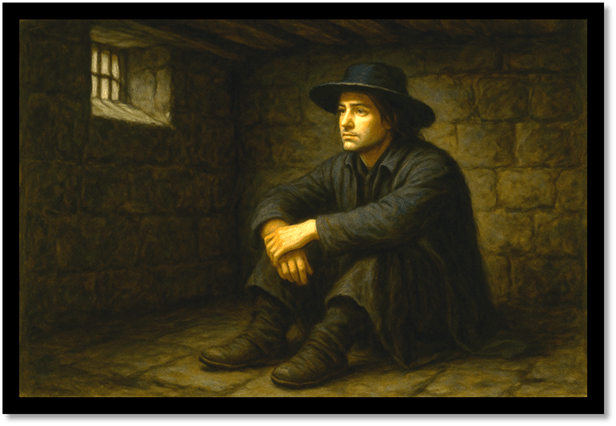
In the morning, another constable delivered him to the magistrate, a man of portly build and shaven jaw. The hearing was brief, for he seemed more concerned with the proper recitation of the Act than with Whitehead himself, it being his first opportunity to deliver the sentence.
“You are required to take the Oath of Allegiance, thereby affirming the King’s supremacy and renouncing all foreign powers. Will you so swear?”
“I will not swear,” Whitehead answered calmly. “I affirm before thee that I am a faithful subject in civil matters, but in spiritual I have no master but Christ.”
The magistrate nodded with a pleased look, for having heard the same tune played too many times, there was now a means to an end. “Then you will be committed until you find reason to obey.”
And so, by late afternoon, Whitehead found himself in a stone cell whose dimensions were more suitable to a cupboard than to a man. It had a low arch of soot-blackened brick, a door studded with iron, and a single slit of a window that admitted only a blade of light. The air was cold enough to make each breath visible, though the sun had already managed to warm the frost off the city.
He sat on the floor, wrapping his coat closer. He intended to spend the time in prayer, yet instead each lingering moment brought memory. The hush of the wool-loft in that last meeting, the sound of Anne’s voice and his quickened sense when she touched his arm, the blocking of type in the shed by the press, even the steam of coffee and opinions in the coffeehouse—all of it seemed insistent and defining.
He breathed deeply with eyes closed, and in the stillness came something more: the sense that he was not alone in his struggle. He heard again the quiet of the first meeting of the Friends when met George Fox, the silence that pricked the air, and the odd promise it carried—that a whisper of Spirit, once caught, could grow into a gathering unstoppable by any amount or severity of threats.
In time another face came unbidden—thinner now in memory than it had been in youth—the face of Thomas Lightfoot.
He was the subject of much discussion at the wool house. The boy was frail, barely eating, yet carving all the same and feeding hope into others when none was left for himself. Someone had rankled at first that he had carved dice to gamble with and sent the message back with Duffy that in no uncertain terms must a Friend create such tools of the devil. He remembered Anne’s eyes when this was said, and how sad she was for the boy.
Ah, but that was not the half of it. The lad had taken to carving little crosses, hardly understanding that these were the same crosses up in the rectories all over England to which people prayed instead of praying to the One who had sacrificed his body for all sin. Orwin had wanted to complain to Vexler himself, little realizing that to do so would cost the boy his guardian and probably his life. He was grateful to Friend Loe for making it clear to all that they must not go near the prison—nor to Duffy, for Vexler’s spies were everywhere.
The thought of Tom’s precarious situation gnawed now in the dark cell as surely as the rats nibbling at his shoes. He remembered Parnell’s death, the slow wasting that the gaoler and his wife called justice, and could not separate his last visit with James from the picture of Tom in his mind. He felt sickened at the thought.
All in a moment he forced himself to sit up and stretch a little. There was no sense allowing these thoughts to continue. Raising his hands in supplication, George felt the familiar tingling like a ball of ethereal power pulsing between his palms. He lifted his voice in the quiet and prayed, “Father, I know Thou art Tom’s strength…but I beg that thou wouldst help him to eat and regain his health. Remember him for good, oh God, and forgive me for my actions that led him to misery. Let him live, oh God, let him live!”
He felt the Spirit within him lift at these last words, as he poured his whole heart into them. These were not words for the ears of men, yet they filled the small chamber as though the stone walls themselves could hear.
Outside, the sound of boots passed, then faded. Somewhere down the corridor, a prisoner coughed painfully—a deep, rattling cough that spoke of damp and neglect. He knew such places were meant to wear down the body until the will followed, but he also knew that the will, once anchored in something beyond the reach of the King’s prisons, could outlast the body. He wondered how long he might remain in this place, and if he would be sickened again; perhaps unto death.
Yet again he thought of Anne. Perhaps she was praying for him now. Perhaps she might care for him…might join with him in this fight no matter the battles and terrors yet to come. And here he was petulant for a heartbeat. To be presented with the barest promise of a partner to share his journey, only to be denied it at the last. Surely this was not the end of his days! He must live, must do his part in offering supplications the king could not deny. Must find a way to help Tom…
He slept fitfully, haunted by troubling dreams. At one point he woke with a start and wished for all the world he could speak to someone. Not any someone, but a person who understood his heart and his burdens. Was he truly called, or were his arguments mere vanity, as his schoolmasters used to say? It was no use asking George Fox, for his answer was always to return to the field and continue the harvest.
Another time he thought of Stephen Crisp. Older in years, though not longer in the Truth, Crisp bore himself with a kind of weathered steadiness. He did not try to overmatch George, nor shrink before him. There was a stillness in the man that suggested he could receive another’s burden without haste or judgment. He was filled with a great yearning to speak to the man—not to command, nor to shepherd, but simply speaking to one who would hear him and prayerfully give an answer.
Three days passed in this way; praying, pondering, agonizing, and seeking God in the stillness.
On the third day they released him. No reason was given, save that the cell was needed for another. The constable who returned his hat and coat seemed half-apologetic, and Whitehead took his belongings without remark, stepping into the daylight. Eight years ago, he would have counted it a mercy to be freed so swiftly. Yet in the silence of the prison he had sensed a greater trial ahead—just as the apostle Paul had been led, not by chance, to stand before Caesar in Rome. The thought puzzled him, for his meetings with the unserious Charles had seemed all but fruitless. Even so it was now clear—there was a weightier reckoning to come.
 Friends of Freedom