I ran across a notable person while researching my ancestry, something every genealogist hopes to find. His name was Thomas Lightfoot, born in Cambridge, England in 1645. We know this from later biographies, but there is no civil record of him until he appears in Ireland in his late thirties. Then thanks to Quaker meeting records it’s well-documented that he raised a large family and emigrated to the newly formed Pennsylvania colony.
According to various family trees, Lightfoot lost his mother when he was around four years old, and his father (also named Thomas) a few years later. These appear to be guesses, unfortunately. In genealogical forums, one user might record a place or date for further review and before you know it others who are researching the same person have copied it to their own trees. Without verifiable records, we can’t be certain.
Oh, but what surprises await us in unexpected places! Late in his life, an early leader of the Quakers named George Whitehead recalled that when he was but seventeen, one Thomas Lightfoot walked with him more than sixty miles in the rain from Cambridge to minister in Norwich.
Whitehead’s memoir, written at the height of Thomas Lightfoot’s renown in both Pennsylvania and at the annual London meetings, doesn’t specify whether the person he walked with was the one well known at the time of his writing, or some other man. If it was indeed the former, then this Thomas who walked with him as a teenager would have been…nine years old.
Shocking, yes, and compelling enough to prompt this journey.
I have since learned that that the age of accountability in the 17th century was far younger than it is today. And as for the Quaker movement, far from it being the purview of fusty old Puritans, it was in fact a youth awakening fueled by defiance and an idealistic conviction that the light of truth could overturn established authority.
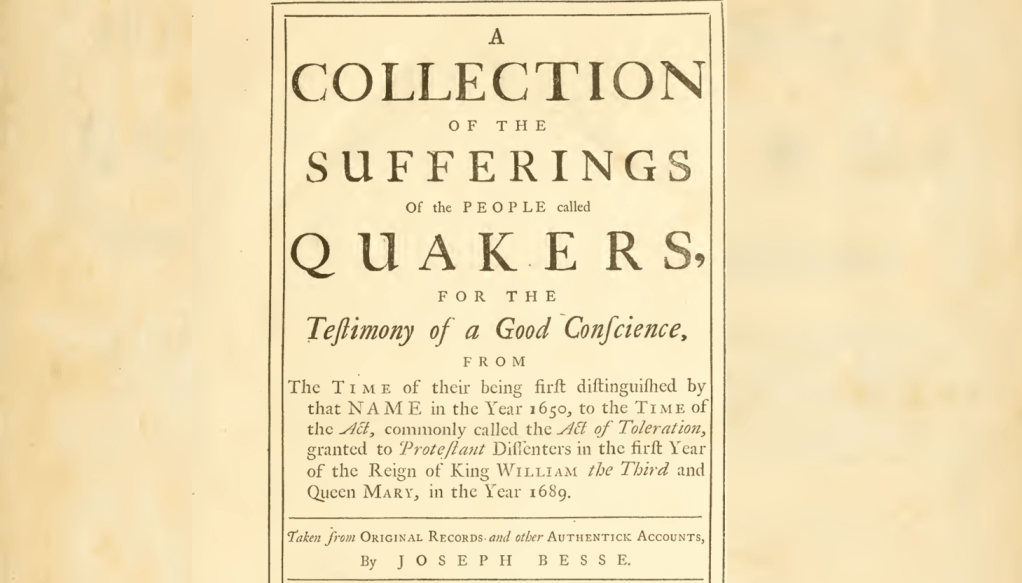
Whitehead himself, being something of a child prodigy, would have been sent away to formal studies by six or seven. At fourteen, he was “convinced and persuaded that tithes ought not to he required or paid, under the gospel dispensation.” Picture if you will a clergy that financed itself with tithes, burdening a people already laboring under the weight of the king’s taxes. Thomas Besse’s Sufferings of the Quakers relates incident after incident of over-zealous “tithe-mongers” helping themselves to excessive portions of a farmer’s crops and animals.
George abandoned his university career and the promise of a comfortable pulpit. Instead he set off across England to find and follow George Fox, the leader of what was then called the Children of Light. It was a dangerous decision. Like the apostle Paul in the Bible, the Children of Light faced beatings and imprisonment wherever they went. There is an entry in the Sufferings that tells of an incident the year after Whitehead’s journey to Norwich, when in 1654 Thomas Lightfoot was imprisoned and threatened with death for arguing a religious point with the high professors of Cambridge. The argument itself is recorded, and it reads as both impulsive and immature.
The imagination soars at such an idea. Could this same little boy be imprisoned for his faith? Yet again we must remember that poor children as young as seven were part of the working economy, and both church and society held them accountable for matters of conscience.
If he was intelligent, Tom would have been apprenticed out, particularly if he was an orphan and under the responsibility of parish authorities. He would have been expected to learn a trade, and we have evidence of such. When Lightfoot died, he left behind the “tools of a joiner,” a craft of fine carpentry requiring extensive training and skill.
If in fact Tom was free at age nine to walk with George Whitehead on a ministerial journey to Norwich, he wasn’t a very good apprentice. Such contracts typically required boys to remain within their master’s household, running errands at all hours in addition to working six days a week and attending church on Sundays. To not be in his parish church at the appointed times would have been a punishable offense, both for the boy and the master who was responsible for him. The young Tom we see in these records seems to have been unusually independent and prone to religious idealism.
Something else Tom might have known about was a Cambridge incident at the very beginning of the Sufferings. When Tom was just eight years old, he might well have seen two women who travelled to the university town to preach. Mary Fisher was in her twenties and Elizabeth Williams a bit older. There they met a group of religious scholars; cocky boys in their teens who mocked the women, for they were dressed in the plain clothes that had become associated with Quakers.
When the women accused the scholars of having false gods, they were brought before the Mayor of Cambridge, who in a state of fury commanded an extreme punishment. In turn, their response stunned the watching crowd.
Imagine the boy who observed them, the orphaned son of a hard working man, one who delivered coal and various foods from his smallholding; chickens, eggs, and rabbits like my husband’s father, and his father before him. I can see it, the whole story.
 Friends of Freedom