Tag: bible

  • A Tip of the Scales of Justice

    A Tip of the Scales of Justice

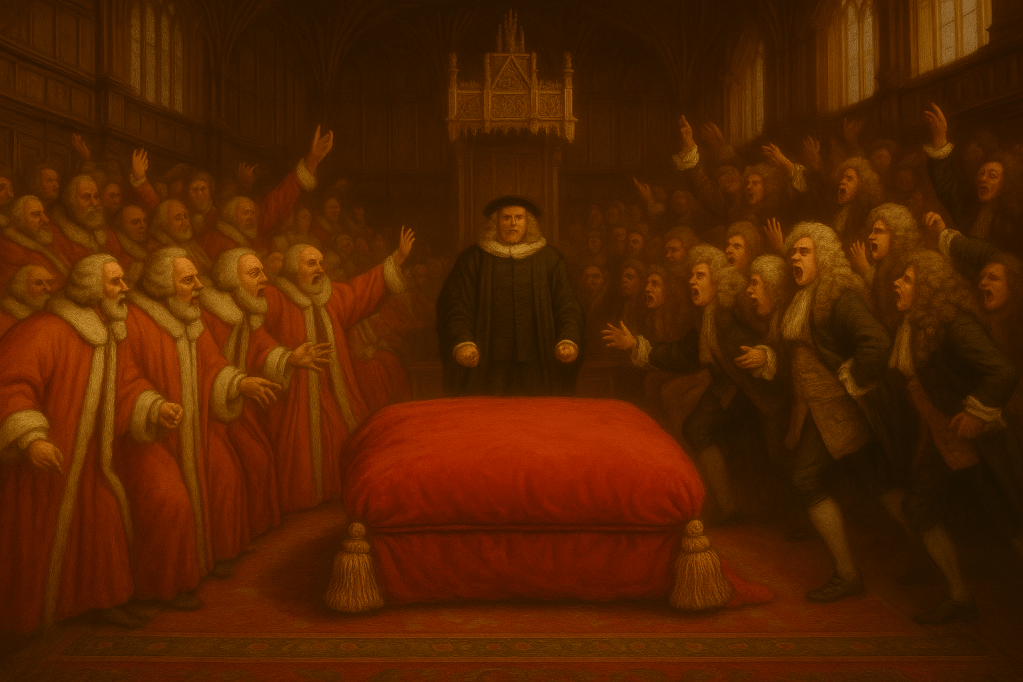
    Having finished with my introduction of Charles II and his courtiers, I have moved on to another research-heavy chapter: how the punishments for Quakers were ramped up by the House of Lords in spite of the King’s desire for tolerance.

    It has taken many hours of inquiry in the form of discussions with both Google and ChatGPT-5 about what the chamber looked like at the time, and the characters involved on both sides of the aisle, and of course a lot of writing and rewriting to get from the starting point of the King’s request to the ending legislation that created what amounted to a police state throughout England. The Quaker Act punished severely any perceived religious meeting of five or more people, and suddenly any thief or drunkard could lessen their fines by turning someone in.

    It helped that Eddie happened to watch a meeting of the House of Lords recently. I was shocked at the yelling back and forth and how it appeared to me like an undisciplined high school debate, sprinkled with calls of “Here-here!” and a great deal of booing and even the stomping of feet. So that had to be worked in as well.

    All of which brings to mind, as does every chapter and sometimes individual paragraphs, the similarities between those times and these. Turbulence. The will of the people, however divided they may be. The will of lawmakers. The will of the heads of state. How can there be peace on earth when there is a continual sense of dissatisfaction with the status quo and a desire to improve juxtaposed against the wealthy protecting their funds?

    As Christians, we are taught by the Bible to continually seek to be more like Jesus. To forgive seventy times seven, to love the unlovable including ourselves, to refrain from even calling anyone an idiot because in doing so we destroy them as a person. But there is also a desire within humanity for better, for more, for improvement of our personal circumstances. All of that is the individual stuff. Layer over that the call to improve our church body. And over that the desire of the clergy should they oppose us.

    And then this is where my eyes cross, because as a free person in a free country, I have always had the ability to just leave if I wanted. Imagine if your church was assigned, and the clerics above you were assigned, and you could not “wipe the dust from your feet” if you disagreed with them. I have said before that money was the issue and if you follow the money it pretty much stinks to see how the wealthy bishops used it. And this week I discovered how the bishops were squandering the hard-earned tithes of the people, by doling out livings to any who would support them in their careers.

    As a result of their legislation, there was a period when Quakers who threatened this way of existence were exiled to plantations in the American Colonies or the Indies.

    Once I complete my work on this chapter, the next one examines this police state and how even the mercy of the King could not save his subjects. And how some people cheered and others felt justice had been done. Sound like anything happening in our world today?

    I grew up with a generation of elders who had witnessed the worst in people, and who were proud to say that we, the people of the United States, had helped put an end to hatred and antisemitism. Imagine my horror to find that my generation should actually bear witness to its return. And that Christians of all kinds could have targets upon our heads.

    I’m not so sure this book is about Quakers or even about Spirit-filled youth. As God leads me through the story, it seems to be about how a society can be divided against itself and one citizen can turn against another, both believing they are in the right. And let us not forget the money that stokes the divisions.

    Thoughts on the matter? Leave a comment.

  • Party Hearty Charlie!

    Party Hearty Charlie!

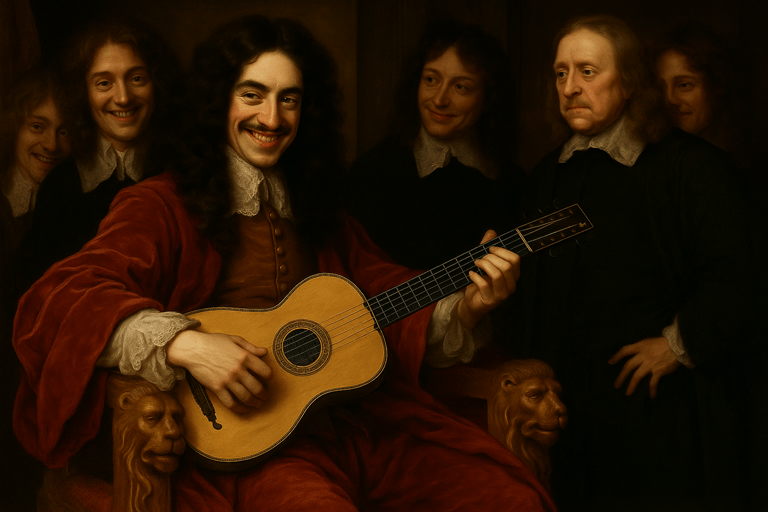
    I’m now two and a half weeks into the life of Charles II. The info keeps coming, like a firehose. There are so many complexities to his character, and ChatGPT tells me that while he is not the main emphasis of the story, he is a “hinge point” that must be addressed. Google tells me, “a hinge point in a story is a pivotal moment or event that causes a significant, often irreversible, change in the direction of the plot or a character’s journey.” So Charlie gets all the attention for now, until I can get past him.

    What a card this guy was, and what a departure from the austerity of Oliver Cromwell. I find myself wondering just how much I need to go into his rather sordid life; especially as I see this book becoming an important read for teenagers who are trying to understand what they believe, as I learned this week from a Kirk Cameron video. (Seriously, he learned on-camera that his kid became an agnostic for awhile.) So now I want to provide

    All of these questions about the personal faith of teenagers leads us carefully away from the man who *ahem* fathered many children but not one in wedlock who could be an heir. However, he had a soft side. He refused to divorce his barren wife (kind of the whole reason the Church of England was created, amIright?). He also remembered generously those who helped him escape to exile–even those who were Quakers.

    The reason it was under Charles’ rule that the Quakers suffered most is in fact because he was so lackadaisical he allowed his closest advisor to run things on the Quaker front. Was this guy just evil in his hatred of the Friends? Evidently no. Google tells me the First Earl of Clarendon wanted to be more lenient in what would be called the “Clarendon Code” but the new Parliament, called the Cavalier Parliament, went a more ruthless route. So now I have to decide how to cover all that in a way that is both informative and compelling.

    GPT-5 tells me that what George Whitehead takes from all this is that government is mercurial. What I know is that God is faithful. Kind of what young David learned when his pal King Saul went on the occasional murderous rampage.

    So while I go back to my writing struggles, here’s a highly entertaining Charles II video from the Horrible History crew. This is why I’m portraying him like a modern celebrity with his posse on the sidelines!

  • The Part I Journey

    The Part I Journey

    Even with the help of AI lending a bit of Asimov grittiness to my text, this has been quite a research project. Who knew there was so much of today in the actions of the 1600s? Having attended a Lutheran church I’ve been aware of the Reformation, but the English Civil War and Cromwell and especially the Quakers…that was all new to me.

    I continue to add more layers even as I move forward to Part II. For example I only realized yesterday while talking with my daughter about tea and coffee that it was Oliver Cromwell and his Puritan ideals that brought us coffee. It was favored by the Jews, whom he protected (as Lord Protector), and also of interest to him—and not just because Puritans disliked beer being distributed to one and all (you couldn’t drink the water because it could kill you, so yes even the kids had weak beer or cider to drink). Cromwell suffered for years from malaria and gout and all kinds of fevers or agues. He saw coffee as a health drink, and it gave him a boost of energy. So I wrote coffee into the end of Part I.

    I also did not know until I looked it up that coffeehouses came into fashion around 1650 and had become salons where ideas were exchanged by the time of Cromwell’s death. So Part II begins in a coffee house. We’re also about to learn why the Brits drink tea! I love a good narrative that gives you all kinds of information bites along the way.

    Another thing I’ve wanted to write about regarding my Part I journey is that to get into the mindset of these young Spirit-filled activists, I decided to surround myself with a kind of “Quaker quiet.” And by that I don’t mean utter silence because I don’t function that way. I had heard a song by Sounds Like Reign some months ago, so I was drawn back there. I discovered on their YouTube channel and Notes from Home vlog a family that was part of a whole network of homeschoolers and YouTubers living a minimalist life. And although Bracken’s well-appointed workshop and equally awesome sound studio aren’t exactly “minimalist” in some aspects, it is a non-commercial life, plugged into God, not man. And that is where I sort of existed while the characters flowed from my keyboard into a noisy and disruptive world.

    And speaking of Disruptive, the Quakers were called to be just that. In our modern parlance we would think of people yelling, jumping, screaming, holding up signs not just to point out the wrongs of that society, but also pointing TO what was right. And in God’s good timing I happened upon Brackin’s recommendation to follow another homeschooling family, who produce the Jordan Michael Tuesday Show for their YouTube channel. Jordan does not wear plain garb, but he and his family give of their tremendous energy to teach Biblical truths through entertaining parables. So yes, Jordan Michael Tuesday is woven into my story even if there is little humor in it. There is disruption and a dogged hold on what is true and a tired perseverance even when it seems like people aren’t watching.

    And to that point, in this echo chamber with no followers even amongst my own family (at this writing), I remember that I am the follower of God’s voice and God’s leading. Maybe the time for this story to be made known will be after I’m gone. And if that is the case my job is to get it all out there and share the message God has planted within it.

    So there you go. Part I finished, two more to go. We shall see how George Whitehead and his compatriots bravely met with kings and appeared before Parliament, seeking relief for God’s people. What he could not know in the 1650s is what greater good will come of his efforts a century later in the form of the American Bill of Rights, and ultimately in the entire concept of liberty we espouse today 400 years later. This is inspiration for the rest of us to continue laboring at tasks that seem pointless or vain. We don’t know where God is taking this, but we trust and labor on.