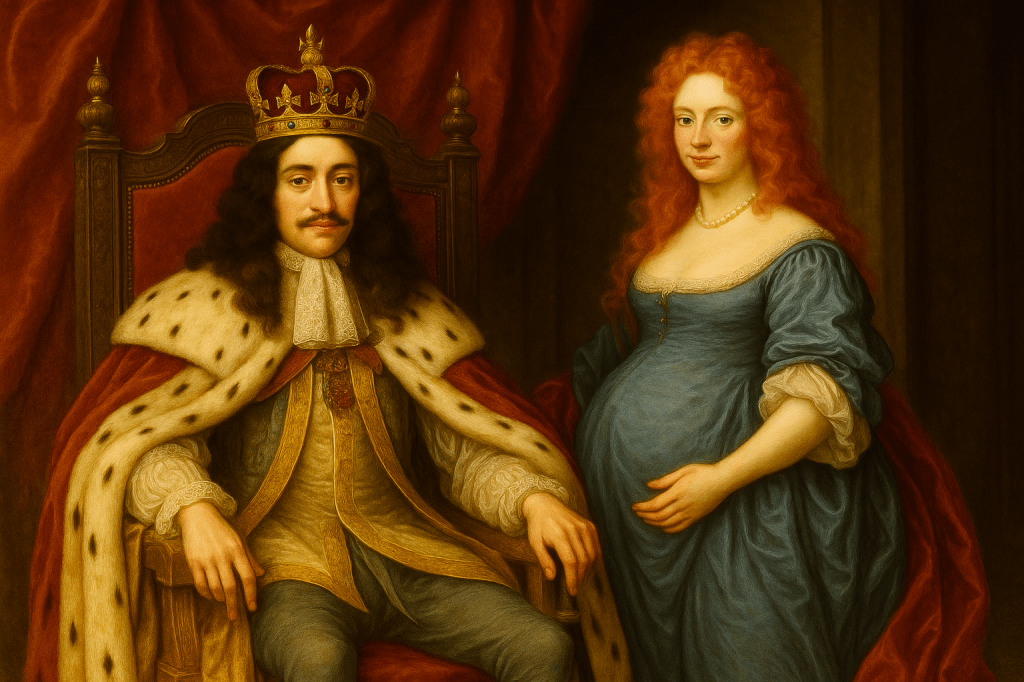
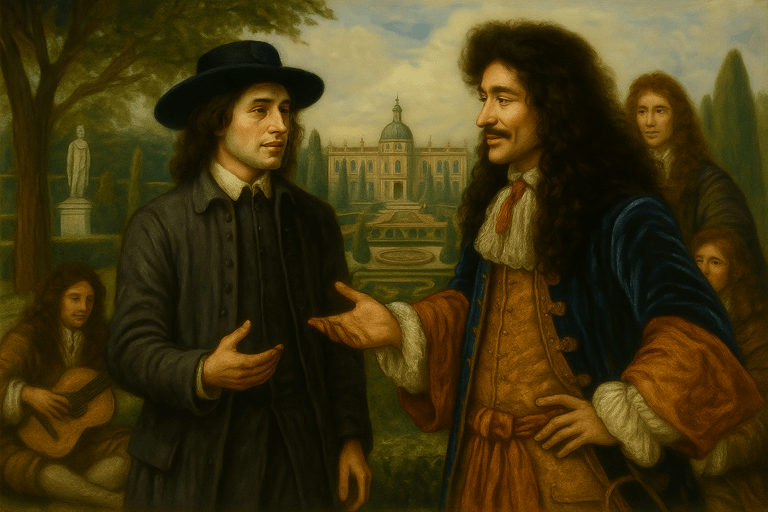
Tag: england

  • Writing in Absentia

    Writing in Absentia

    When I started this journey, I was able to take advantage of a 9-week stay of marital execution. By which I jokingly mean, my husband was in England with his family and new grandson for a couple months and I was free to favor the execution of my work as a writer over my duties as a wife.

    As a result, Part I of this work flew by like a breeze, just me and ChatGPT-4 whistling while we worked.

    Back then, I would turn off the TV at 9am and write sometimes for the next 12 or 14 hours. At one point I completely forgot to attend a potluck until two hours after it ended. Fortunately I had put my ice cream cake in the church freezer the day before.

    Today, four weeks after Eddie’s return, my work has slowed to a crawl. Not all his fault. I have posted about my difficulties with Charles II and all the intricacies of his court, as well as the need to press the pause button earlier this week as I sought additional information.

    I believe what I was supposed to pause for was this: I had begun my written portrait of Charles II by having him followed into the great council room by a band of hangers-on, like a Leonardo DiCaprio posse. But as I watched hours of historic videos about Charlie 2, I realized the premise I have been following–that George Whitehead had an impact because his intelligence appealed to the king–would have been true of everyone the king surrounded himself with.

    That means, if this king had a posse, the least of these had better have some good witticisms to share. And more to the point, as I realized in the middle of the night recently, his mistresses would not have been air-heads either. So off I went to Google the next morning and yes, Barbara Villiers was a very bright woman who ran the palace (even with Queen Catharine there) for a decade. She was instrumental in the decision to sell the French port of Dunkirk back to France, mainly to support her lavish lifestyle.

    Even more influential was his next dalliance with the French noblewoman Louise de Kérouaille, who had a foot firmly in the household as a lady in waiting to the Queen. Louise acted as a French spy, influenced Charles in ways that would be advantageous to her country, and blatantly sold access to him. It reminds me of those stories you hear about pop stars whose lives are run by someone who gets close to them. I’m sure you can think of modern examples.

    So my task in the last couple days has been to understand those who were not in positions of authority, but who had access to King Charles II, and then to reimagine a scene where an intelligent woman inserts herself even in the Privy Council. The only problem is…I’m back to being half of a partnership. One in which we are flipping properties in an attempt to gain a foothold in an ever more inaccessible housing market. We’ve managed to purchase a property with a trashed-out mobile home an hour outside Raleigh.

    That means long drives to submit permits and arrange utilities. Luckily I didn’t have to be there to watch the destruction of the trailer and subsequent brush clearing. Although as a good wife I did have to watch the videos and respond with encouragement.

    After errands today I managed to get back to my story just before 2pm. An hour later Eddie asked if I wanted to go spend time with the kids. Not to be a bad grandma, but honestly, there is an entire universe in my brain. One with a boy starved and starving himself in prison, our young hero George Whitehead arguing compassion and human rights in the middle of a century that was tussling over the direction the Protestant Revolution should take humanity, and a wild and crazy king who was leaning toward religious freedom for his own secret reasons.

    So my response was…no.

    I asked Google for a good writer’s joke. Here’s what I got: “If you need me, I’ll be in another world for the next few hours. Don’t worry, I know the way back…mostly.”

  • John Bunyan, Quakers, and the King in a Tight Spot

    John Bunyan, Quakers, and the King in a Tight Spot

    As my time with Charles II stretches on toward a month together, I feel as though God is staying my hand from finishing the scene where he calls down fury upon the Quakers. And rightly so, because every day some new fact arises that educates me further on this pivotal moment in history. Especially on the point of who was to blame for making life intolerable for our Spirit-filled Friends.

    Recently, while Eddie and I were fishing around YouTube for something interesting to watch (Time Team is a favorite and has informed a surprising amount of this work), we stumbled across a video about John Bunyan, the author of The Pilgrim’s Progress. Even if you’ve never read it, you may be aware of the book as I am from its use in Little Women by Louisa May Alcott. The book is not just mentioned, but was used by Alcott as a framework for the entire story.

    Well as it happens, Bunyan was arrested in November 1660—the exact date of my scene. Now he needs a mention.


    Bunyan, Whitehead, and Charles II

    Thanks to the wit of our Quaker George Whitehead (and the King’s appreciation of wit), he met several times with Charles II even though he was considered by many to be a troublemaker. Meanwhile the Baptist John Bunyan, who would go on to write his international best seller from prison, was distinctly disliked by the King. Why is that, if both Dissenters were religious malefactors?

    Perhaps Bunyan was a poor conversationalist or worse yet, too free with his judgement of Charlie’s lascivious lifestyle. Though I’m sure George arched a disapproving eyebrow as well. Who can explain why we vibe with one person and not another?


    The Case for Tolerance

    The fact is, the King was a closet Catholic and could have used some religious tolerance for himself and his soon-to-be bride from heavily Catholic Portugal. Moreover, the Lord Chancellor and Charles’ closest advisor Edward Hyde, 1st Earl of Clarendon, was a staunch Anglican/Episcopalian. While he was free to be Anglican again at this point, he had been forced to keep a low profile during Charles’ exile in Scotland. Both men had every reason to lobby for at least some level of religious tolerance as the country moved forward.


    The Clarendon Code and Its Reach

    This brought me to Clarendon’s proposed “Quaker laws.” At first intended to keep order, they became crueler when Parliament took them up and shaped them into what would be called the Clarendon Code, parts of which remained in effect for more than 150 years.

    One part banned religious meetings of more than five people. In practice, that meant a pair of plain-dressed Friends speaking quietly in the street could be seen as conspirators. Enforcement relied on constables and informers—paid for turning in offenders. This created an atmosphere some historians liken to a police state.

    The Presbyterians were also swept up in this. As a result of the Code, ministers who had served in parishes in the past century since the Reformation were suddenly required to take communion from the Church of England. More than 2,000 ministers refused, losing their pulpits and their livelihoods. No wonder so many Presbyterians, alongside Quakers, later found their way to Pennsylvania.


    My Writing Crossroads

    So, back to Charles II and Clarendon. Did they simply say, “Send all the Quakers to jail!”? No. They actually tried to shield Presbyterians from the worst of the laws, even though their patience with radical dissent was thin. Charles still disliked Bunyan. Clarendon still wanted order.

    Oh and lest I forget, there is also Lady Margaret Fell’s petition to account for—she was bold enough to proselytize across the peerage and lobby for women’s rights, which became intrinsic to the Quaker movement. So you have the Crown caught between Fell’s influence from above, Bunyan’s in the streets, and the restless clergy in their pulpits. It’s no wonder the King and his advisor felt pressed to act.

    My task now is to imagine how Charles and Clarendon could sit together, weighing these voices, and convince themselves that laws restricting worship were not persecution but peacekeeping. To prevent mob violence, to steady a kingdom still raw from civil war, and another unfortunate necessity—to continue the flow of tithes to the Church of England, which supported not just churches but libraries, universities, and hospitals.

    That’s where my pen hovers today. I’d love to hear your thoughts. Comment below.

    Our story from the beginning: Prologue

  • Charles in Charge

    Charles in Charge

    This past week has been all about Charles II as we delve deeper into the royal negotiations that will set Tom and 500 other Quakers free. It is a significant move toward our Bill of Rights and the man in charge requires a maze of research topics.

    I have written much of what happens when Charles steps into the arena–at first to make life incredibly more difficult for dissenters and other dissidents with a Cold War type of lockdown that makes Putin seem friendly. These folks couldn’t even talk in the streets without being whipped and beaten by the locals who had been stirred into a frenzy by their clergy. Not unlike the frenzies stirred by our own media today, except theirs were far more vicious in terms of physicality. They watched bear-baiting for fun, remember.

    The question is, what will it take to bring this king to the point where he makes a concession to the Quakers? Well I happened to see something interesting on a History Hit video last night. I have to tell you, it’s like God shows me things on this journey right when I need them.

    So there is this oak that all British people know about but Americans do not, and that is the Royal Oak. It’s where young Charles–he would have been about 21 at the time–was being chased down by the “round heads” which were the Parliamentarian soldiers with their round helmets. He was running here and there, being hidden in this place and that, and finally he met William Careless (later called Carlos, the Spanish for Charles), a ranking officer who had escaped the routing of the Royalist army.

    The story is that William gathered some food and told Charles to climb up a large oak tree. Together they spent the day up there watching as the Parliamentarians and their dogs hunted for them. When Charles napped, William supported him so he wouldn’t fall. At one point, according to Charles, a soldier passed directly beneath them.

    Fast forward to the royal Restoration, and Careless/Carlos was made one of the Privy Council, the closest advisers to the king. He was also made a knight of the new Order of the Royal Oak and was given monies and favor and what-not. Which is to say, if Charles liked you, you were set. I will use this character trait to show how the very person who began by despising Quakers came to be a great help in whatever capacity he could muster.

    On a separate note, Charles evidently loved telling everybody about hiding in the tree and being that close to detection, calling it a miracle and even having the narrative printed and distributed throughout the land. Evidently many pubs changed their name to The Royal Oak after that and even today it is the third most popular pub name in all of England. So now I have these new threads to weave into my story. I hope GPT5 will have some good suggestions.

    Also…it goes without saying, we need another scene at the Green Fox, after it is renamed The Royal Oak.

  • The Restoration’s Lash

    The Restoration’s Lash

    November, 1660

    A hard wind blew dry leaves against Whitehall’s towering windows. Inside, beyond the heavy oak doors that guarded the entrance, the long corridor now shone with newly-polished marble columns and flickering sconces. It was no longer the plain, functional passageways of the interregnum, but instead a procession of grandeur restored—walls hung with tapestries depicting the Tudor rose and Stuart lion, gilded frames containing portraits of monarchs past staring down like silent sentinels. Chief among them and most prominent was Van Dyck’s portrait of Charles I with his family, a declaration in itself.

    The floor was laid with a carpet woven in deep reds and blues. A close inspection might reveal places where it was worn thin by decades of shuffling feet; however with a trade war yet raging, now was not the time for such repairs.

    Footsteps echoed ahead; Charles Stuart with sure tread made his way with attendants in tow, passing beneath the portrait of his father. The light was fading, pale through the high windows and throwing long shadows that mingled with the golden candlelight that already burned in heavy brass chandeliers. There was a sense of power still unsettled; haunted by years of exile.

    The group entered a chamber at the far end of the hall; the monarch’s chosen place of meeting, as it had been for those who came before him. The chamber where the Protector once sat in plain buff coat was now half-filled with disused trunks and moth-eaten hangings.

    Two members of His Majesty’s Privy Council had convened to bring news and discuss the unrest still simmering beneath the surface of his restored realm. The door was flung open, revealing a room both sumptuous and commanding.

    Inside, a long table of dark oak stretched between two banks of windows, each pane bordered with lead and diamond-cut glass. Heavy curtains were drawn aside, revealing the Privy Gardens, now reeling from the winds that cruelly tore the leaves from carefully cropped branches. Charles took note as he entered, always the botanist.

    He passed walls hung with rich tapestries, their threads catching the candlelight in a way that made the images shimmer—scenes of English victories and royal triumphs, of kings crowned and realms united. A vast fireplace carved with heraldic lions and dragons dominated an entire wall with a fire that crackled and spat to life. Charles made his way to the windows, remembering again the years he had enjoyed this same view—though it was very different now.

    He watched as the wind came in gusts off the Thames, driving spray against the stone and sending dead leaves swirling across the neat lawns. The trees bent and twisted like supplicants in some ancient ritual. Charles seemed for a moment less a king restored than a gentleman of leisure gauging the temper of the elements.

    A light cough behind him advised that he was expected to take his seat in the grand chair at the head of the table—a throne of carved oak, gilded with gold leaf, the arms terminating in fierce lion heads that seemed to leer at the gathered men. To the right of it Edward Hyde, Lord Chancellor, stood expectantly in heavy robes and powdered wig. He was man whose sharp eyes missed nothing. His voice carried the cool authority of law hardened by years of political survival.

    Opposite him stood with rather more impatience John Maitland, Duke of Lauderdale, a soldier and politician both, his bearing lean and intense, his gaze restless and calculating. He was a man used to command, used to pressing advantage, and well acquainted with those who sought to challenge the status quo.

    The Chancellor leaned slightly. “It is a fine prospect, Your Majesty. But even the neatest garden will not withstand a winter such as this promises to be.”

    “You would be amazed at the strength of such trees,” Charles replied, gesturing toward the embattled yews. “Left alone, they would overrun every wall and path, as with our Roman ruins—still standing after fourteen centuries—our present craft can scarcely match the old strength. The masons of England have chased Roman concrete for generations, yet even now we build with envy.”

    He turned and sat, his voice carrying a hint of amusement. “They tell me Cromwell had the gardeners mending these grounds for months, then locked the gates to all but himself—the old Puritan fox. I mean to open them again—when the treasury can bear the cost. And perhaps a sundial I have in mind that will tell far more than the day’s time,” he added, one brow arched, “to remind our people that the House of Stuart holds a finer command of science than any commonwealth could boast. Cromwell, for all his sums and calculations, was a mere dabbler.”

    The king’s mind, like his forebears’, ran to instruments that marked not just the hour, but the harmony of the heavens themselves. “But that will wait,” he said, “until the kingdom’s debts are stanched and the accounts stop bleeding like a bad wound.” He settled into his chair, and despite the magnificence surrounding him, the king’s posture was cautious, almost tentative, as though the weight of history pressed upon his shoulders more than the soft velvet and ermine could conceal.

    Hyde cleared his throat, breaking the silence with a hint of wryness.

    “Your Majesty, I spoke with Mr. Pepys recently. You recall, the diligent clerk who accompanied your return from exile?”

    Lauderdale grunted. “Pepys says the weather of this century is worth noting in his diary. Records the temperature as though it were a state paper.”

    “Aye,” Charles chuckled, “and I like him for it. Pepys is no sailor, yet we have given him the Navy. He asks what others are too proud to ask—and that may save us from another Dutch humiliation. He tells me he has lately tried a tea from China that was quite extraordinary.”

    This brought a smothered laugh from Lauderdale. “Then he has not travelled as we have. Your interest in Portugal made us well-acquainted with their fetish for this China tea.”

    Hyde added, “One would think his sailors would have told him, for they claim it warms the body against biting winds.”

    Charles’s mind turned. “And what of your meeting? Tell me of the marriage.” His eyes darkened with calculation. “It is our hope this agreement cools the fires of dissent in our midst.”

    The Chancellor inclined his head. “It is all but sealed, sire. The treaty is signed, though the formal ceremonies await the spring. Still, the agreement binds us now. A useful alliance, strengthening our hand against Spain and France alike.

    Maitland added, “She brings not only a dowry but ports—Tangier and Bombay—gifts that expand England’s reach and influence.”

    The Lord Chancellor’s tone shifted, his fingers tightening on the desk. “And yet, Your Majesty, not all fires are quelled by marriage. If we are ready for our next business?” As both nodded, Hyde continued, “We have petitions from the ‘Georges.’”

    His majesty groaned. “These Quakers! Queen Elizabeth would have swept them from the realm before they’d learned to call a meeting.”

    Again, the unfortunate Chancellor coughed, and the duke nearly asked if he was suffering from cold. But Hyde continued, “There is another petition, quite similar, from Lady Fell. Both speak of change with quiet but firm conviction.”

    Maitland’s gaze hardened. “They may say they seek peace ‘quietly,’ but their refusal to bend threatens the order we are charged to preserve. As for this woman, she is a known trouble-maker. Entertains the heretics at Swarthmoor all the more now her husband is dead.”

    Charles shook his head. “Has her son no spine to bring his house into order?”

    “Thomas Fell left the house and grounds to her, to prevent marriage with one of these dissenters. It was to preserve the family, though an ill choice to my mind.”

    At this the king turned fully, unfolding the petitions deliberately. “Then let us give our answer speedily, for I fear she will gather all the women of the gentry to her bosom lest we act with authority for the realm’s peace, and for the Crown’s future. We hardly need another dissenter to overtake these grounds.”

    The wind gave a sharp knock at the windows, as if to punctuate the thought, and the king looked at his two advisors expectantly.

    Hyde was first to reply, his voice a rasp like dry parchment, “Sire, the chief difficulty is that these petitions are brought for as in humility, yet the very words strike at the root of our Church and Crown, threatening the very order that holds this realm together. You are correct; to permit such dissent unchecked invites even greater chaos than the last reign’s failings.”

    Lauderdale nodded sharply, eyes hard. “They refuse oaths, spurn the militia, reject lawful authority. Their meetings disrupt the peace. This faith is but sedition in disguise.”

    Charles sighed impatiently. “Yes, yes, all are agreed. What is your counsel?”

    With a gaze sharpened with resolve, Hyde set forth the plan he had been crafting since Cromwell’s death. “The Corporation Act, Your Majesty. Soon to be presented to Parliament. It will secure municipal offices for those loyal to Church and Crown, requiring oaths that exclude these recusants. Constables under the old regime held sway, but many proved timid or corrupt. This law ensures municipal authority remains steadfast and uncompromised. Their influence will be curtailed; their gatherings suppressed by law.”

    Lauderdale’s eyes darkened. “The militia must be ready to quell disturbances swiftly and decisively. Constables alone cannot withstand the uproar—those howling sectaries, disrupting worship and irritating ministers and magistrates. Nor even the ministers and magistrates inciting mobs against these Quakers. Let us be clear–loyalty is not a matter of convenience but an unyielding allegiance to King and Church alike. But above all we keep the peace.”

    The king considered his council, voice steady and firm. “Let the law bind all subjects equally. None may claim conscience as a shield from obedience. Disorder will find no refuge in these realms.”

    The chamber quieted, the candle flames flickering like watchful eyes as the weight of the decision settled. Outside, the wind whispered through bare branches, carrying rumors of unrest that would soon swell into storm.