Tag: faith

  • Solo Flight?

    Solo Flight?

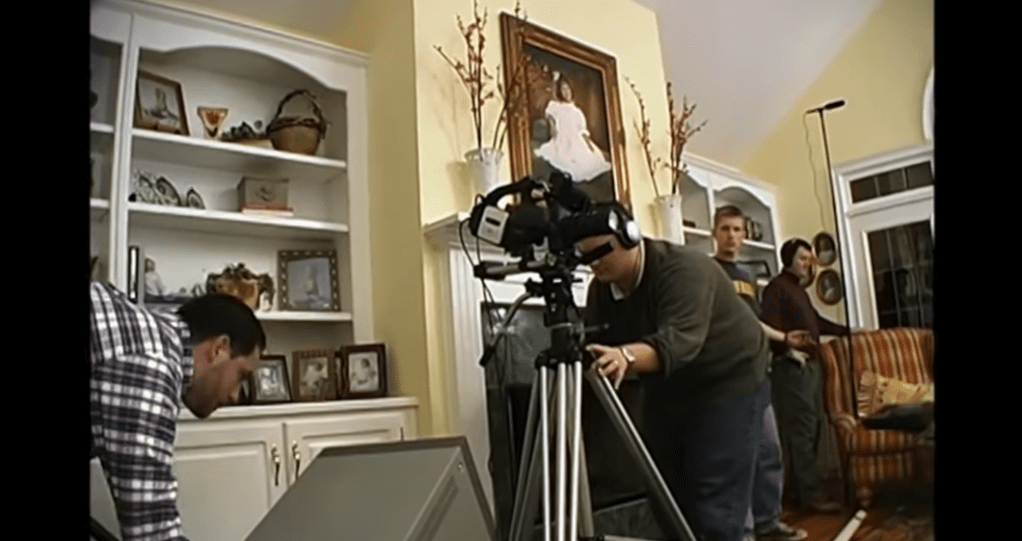
    I just watched this incredible video by Alex Kendrick, telling how God led him and his church to create the Christian film Flywheel and others like it. How the movies all appeared in theaters, much to his surprise, and even won awards. He tells how he was never alone but always working with God and prompted by God. Just as I feel I am.

    But even more amazing is that when he hit a wall and prayed, he no more than said “Amen” but someone knocked on his door or his phone rang or a neighbor walked over and by God’s grace provided the answer. And what was given was in proportion to what he asked. Every time!

    Real miracles happened right there in front of him. And of course being human, the very next time a need arose it shook him like the Israelites were shaken in the desert, with manna in their bellies and miracle water in their cups. He was in despair all over again, just as we all are. How quickly we forget God’s grace, even when we’re in the midst of it.

    I was struck by the fact that he was never alone. I feel utterly alone. Everything around me says quit writing. My family wants my attention. It takes too much space, too much quiet that rarely exists. Put the computer down!

    And I would, I really would, except these stories won’t leave me. How many times have I written here about characters wanting to be heard? And after watching Kendrick I feel like there’s even more to it. There’s a story to be told.

    God’s story.

    You know, He’s always playing the long game, and the place we are right now is a journey to someplace else. It stretches from Eden, from Joseph and his years in an Egyptian jail through years of captivity and the Exodus, through the prophets of retribution and the salvation of Christ. And beyond that point to a world that still tells the story of Mary anointing Jesus’ feet with expensive oil.

    The long game includes Constantine, the rise of the Church in Rome, to the Reformation and the Dissenters who made their way to the New World either by force of imprisonment or flight of mercy. It includes the rise of the United States and its place as protector of the free world, as a model of freedom.

    Some would ask if this is the end of the United States, to be struck down and divided up into kingdoms of varying faiths and feuds. The vision given to George Washington says otherwise, but the proof is in God’s hand.

    There is a plan, an end-game. Probably long after I’m gone. I have no idea if my little writings will be a tiny note on the pages of history or perhaps will die with me. If this is a solo journey, then that would be the case, wouldn’t it? I honestly don’t mind either way, except that I am driven to get this story and these people out of my head.

    God please provide the time, the space, the encouragement, and yes the help. Let me know I’m not alone in this. Amen.
  • Site Activity

    Site Activity

    That’s what WordPress calls it. “Click here to see your site’s activity.” And like so many blog sites out there, this one had settled into a stasis. It’s one of a half dozen I’ve started over the years. What I used to store in a box of various writings up in my closet I now store online. A screenplay, a collection of short stories, another site with an attempt to collect some of the many facts that leak out of my British husband’s brain periodically.

    But for my latest increase in personal site activity I credit my late mother’s gentle encouragement: “Slow and steady wins the race.” I’ve now rewritten the previously ponderous prologue for Friends of Freedom and instead carved into it Besse’s listing of the first of the Quaker sufferings. From 8-year-old Tom’s perspective no less.

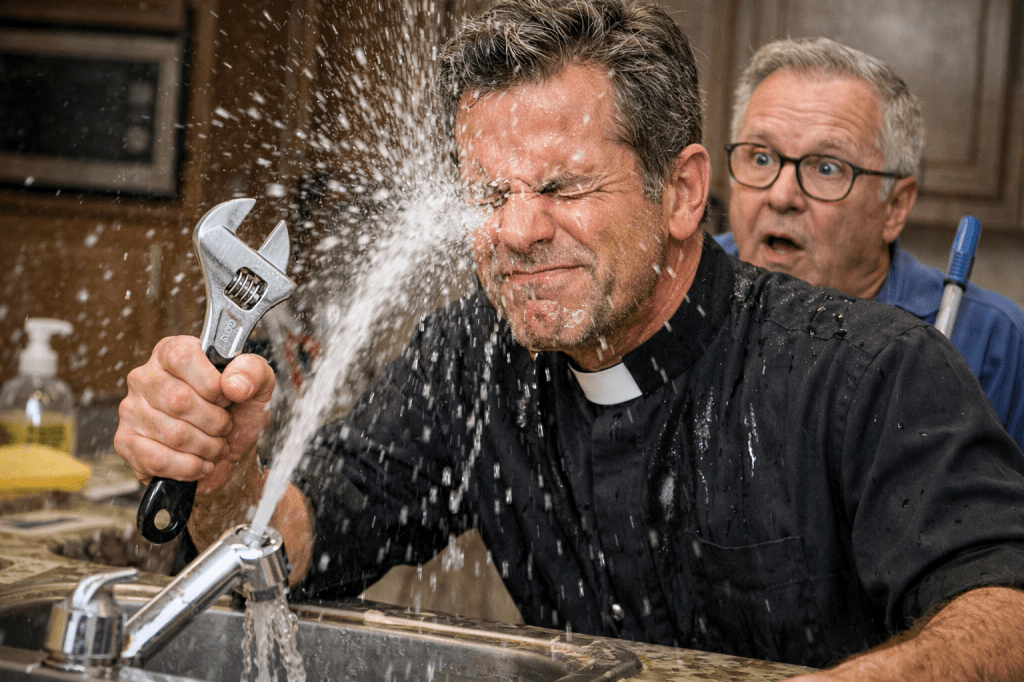
    But also, I have returned with inspiration to a short novel I’d struggled with a decade ago: Recommitted. The story was finished but the mechanics didn’t make sense. It’s about a proud youth pastor who has made a late in life career change from plumber to pastor, deciding he’s experienced enough to take over the head pastor job. Instead he’s called to a dying church on the other side of the Dallas Metroplex (and if you know Dallas, you know that the move of a dozen miles means a different life, because it’s too hard to commute back and forth to the friends and places you once knew). In any case, the issue was that I felt the title was God-given, but my hero was already committed to getting the big job, so it didn’t make sense that he had to recommit himself to his faith. Except in a roundabout sort of way, I suppose.

    Then after my last post I realized this long-neglected story niggling in the back of my mind could work if the impetus at the beginning was different. I’ve been struggling with how much work we should expect from ourselves now that we’re retired. What if my hero was happily settled in his semi-retired role as youth pastor and didn’t want the added responsibility of a whole church? Especially the effort required to keep a congregation together after many have fallen away.

    This flash of inspiration included the events of my last few years when, as I approached a relaxing retirement, we joined a church of elderly volunteers. Seriously, at 60 I was one of the youngest people there and everybody seemed to be volunteering for something. And just as suddenly I was laid off, not quite ready financially to go without at least part-time employment…and the pastor offered me a lightly paid position as the church treasurer.

    That was a day, let me tell you. Because at the same time I had a promising interview for a well-paid tech writing gig. You know, it’s been a pattern in my life that God always seems to offer two options when I’ve faced big life changes. It’s like the movie Sliding Doors but without one being good and the other being bad. As a pastor in my youth once described it, it’s like God is offering you balloons of different colors. You want red? Take red. You want blue? That’s fine, take blue. But the paths they represent are mighty different.

    I took the lesser job, was a terrible treasurer due to my poor math skills but turned out to be a fantastic social media manager. And I did that until my Social Security kicked in.

    So in any case I did rewrite my Recommitted Chapter 1, but now I realize the storyline for poor Pastor Dave will need to change a little. I can’t force him to take the blue balloon…he has to choose it. Just like I need to keep choosing to pick up my laptop and write.

    *********************

    By the way, I hope you enjoyed today’s featured picture. This is how I envision my characters as I write their stories; pick known actors and let them play out the parts.

  • A Tip of the Scales of Justice

    A Tip of the Scales of Justice

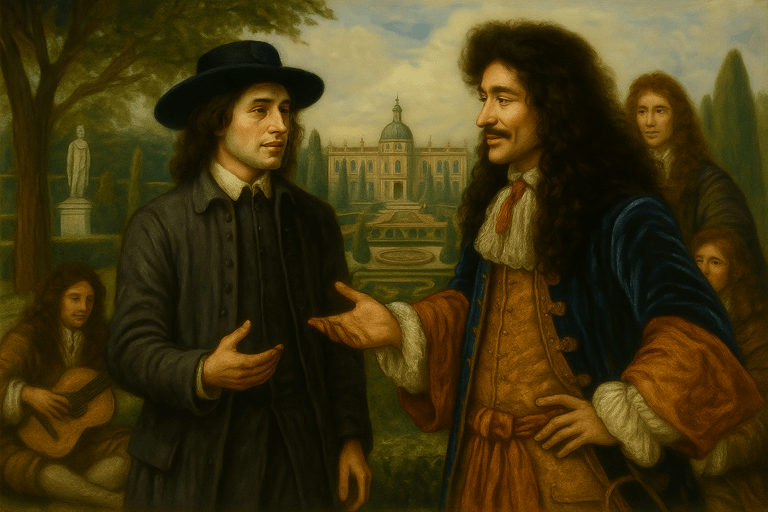
    Having finished with my introduction of Charles II and his courtiers, I have moved on to another research-heavy chapter: how the punishments for Quakers were ramped up by the House of Lords in spite of the King’s desire for tolerance.

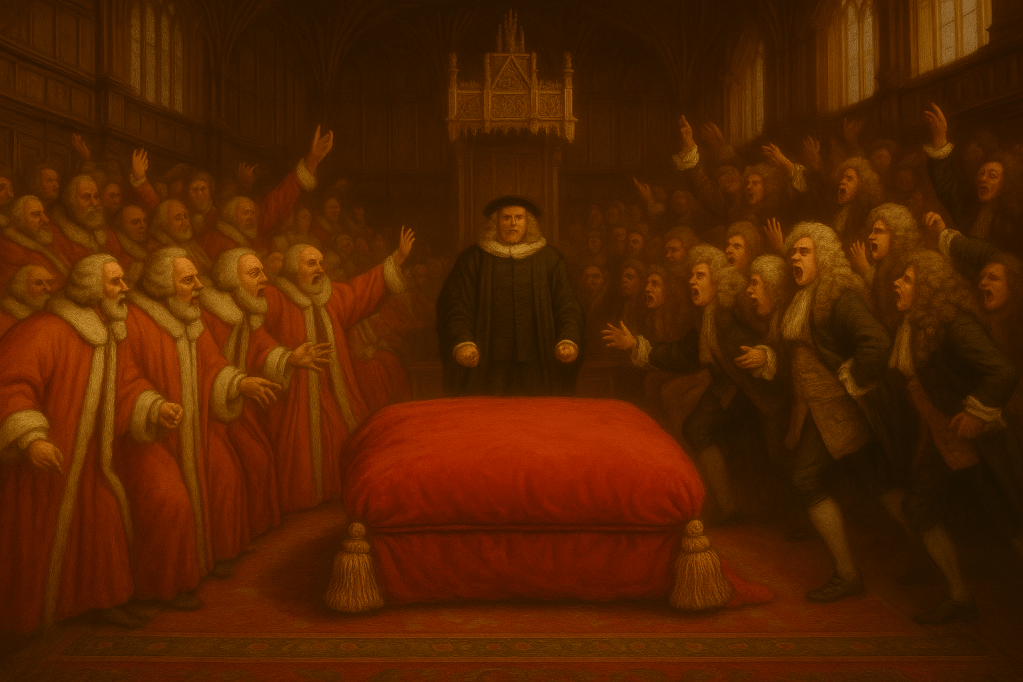
    It has taken many hours of inquiry in the form of discussions with both Google and ChatGPT-5 about what the chamber looked like at the time, and the characters involved on both sides of the aisle, and of course a lot of writing and rewriting to get from the starting point of the King’s request to the ending legislation that created what amounted to a police state throughout England. The Quaker Act punished severely any perceived religious meeting of five or more people, and suddenly any thief or drunkard could lessen their fines by turning someone in.

    It helped that Eddie happened to watch a meeting of the House of Lords recently. I was shocked at the yelling back and forth and how it appeared to me like an undisciplined high school debate, sprinkled with calls of “Here-here!” and a great deal of booing and even the stomping of feet. So that had to be worked in as well.

    All of which brings to mind, as does every chapter and sometimes individual paragraphs, the similarities between those times and these. Turbulence. The will of the people, however divided they may be. The will of lawmakers. The will of the heads of state. How can there be peace on earth when there is a continual sense of dissatisfaction with the status quo and a desire to improve juxtaposed against the wealthy protecting their funds?

    As Christians, we are taught by the Bible to continually seek to be more like Jesus. To forgive seventy times seven, to love the unlovable including ourselves, to refrain from even calling anyone an idiot because in doing so we destroy them as a person. But there is also a desire within humanity for better, for more, for improvement of our personal circumstances. All of that is the individual stuff. Layer over that the call to improve our church body. And over that the desire of the clergy should they oppose us.

    And then this is where my eyes cross, because as a free person in a free country, I have always had the ability to just leave if I wanted. Imagine if your church was assigned, and the clerics above you were assigned, and you could not “wipe the dust from your feet” if you disagreed with them. I have said before that money was the issue and if you follow the money it pretty much stinks to see how the wealthy bishops used it. And this week I discovered how the bishops were squandering the hard-earned tithes of the people, by doling out livings to any who would support them in their careers.

    As a result of their legislation, there was a period when Quakers who threatened this way of existence were exiled to plantations in the American Colonies or the Indies.

    Once I complete my work on this chapter, the next one examines this police state and how even the mercy of the King could not save his subjects. And how some people cheered and others felt justice had been done. Sound like anything happening in our world today?

    I grew up with a generation of elders who had witnessed the worst in people, and who were proud to say that we, the people of the United States, had helped put an end to hatred and antisemitism. Imagine my horror to find that my generation should actually bear witness to its return. And that Christians of all kinds could have targets upon our heads.

    I’m not so sure this book is about Quakers or even about Spirit-filled youth. As God leads me through the story, it seems to be about how a society can be divided against itself and one citizen can turn against another, both believing they are in the right. And let us not forget the money that stokes the divisions.

    Thoughts on the matter? Leave a comment.

  • John Bunyan, Quakers, and the King in a Tight Spot

    John Bunyan, Quakers, and the King in a Tight Spot

    As my time with Charles II stretches on toward a month together, I feel as though God is staying my hand from finishing the scene where he calls down fury upon the Quakers. And rightly so, because every day some new fact arises that educates me further on this pivotal moment in history. Especially on the point of who was to blame for making life intolerable for our Spirit-filled Friends.

    Recently, while Eddie and I were fishing around YouTube for something interesting to watch (Time Team is a favorite and has informed a surprising amount of this work), we stumbled across a video about John Bunyan, the author of The Pilgrim’s Progress. Even if you’ve never read it, you may be aware of the book as I am from its use in Little Women by Louisa May Alcott. The book is not just mentioned, but was used by Alcott as a framework for the entire story.

    Well as it happens, Bunyan was arrested in November 1660—the exact date of my scene. Now he needs a mention.


    Bunyan, Whitehead, and Charles II

    Thanks to the wit of our Quaker George Whitehead (and the King’s appreciation of wit), he met several times with Charles II even though he was considered by many to be a troublemaker. Meanwhile the Baptist John Bunyan, who would go on to write his international best seller from prison, was distinctly disliked by the King. Why is that, if both Dissenters were religious malefactors?

    Perhaps Bunyan was a poor conversationalist or worse yet, too free with his judgement of Charlie’s lascivious lifestyle. Though I’m sure George arched a disapproving eyebrow as well. Who can explain why we vibe with one person and not another?


    The Case for Tolerance

    The fact is, the King was a closet Catholic and could have used some religious tolerance for himself and his soon-to-be bride from heavily Catholic Portugal. Moreover, the Lord Chancellor and Charles’ closest advisor Edward Hyde, 1st Earl of Clarendon, was a staunch Anglican/Episcopalian. While he was free to be Anglican again at this point, he had been forced to keep a low profile during Charles’ exile in Scotland. Both men had every reason to lobby for at least some level of religious tolerance as the country moved forward.


    The Clarendon Code and Its Reach

    This brought me to Clarendon’s proposed “Quaker laws.” At first intended to keep order, they became crueler when Parliament took them up and shaped them into what would be called the Clarendon Code, parts of which remained in effect for more than 150 years.

    One part banned religious meetings of more than five people. In practice, that meant a pair of plain-dressed Friends speaking quietly in the street could be seen as conspirators. Enforcement relied on constables and informers—paid for turning in offenders. This created an atmosphere some historians liken to a police state.

    The Presbyterians were also swept up in this. As a result of the Code, ministers who had served in parishes in the past century since the Reformation were suddenly required to take communion from the Church of England. More than 2,000 ministers refused, losing their pulpits and their livelihoods. No wonder so many Presbyterians, alongside Quakers, later found their way to Pennsylvania.


    My Writing Crossroads

    So, back to Charles II and Clarendon. Did they simply say, “Send all the Quakers to jail!”? No. They actually tried to shield Presbyterians from the worst of the laws, even though their patience with radical dissent was thin. Charles still disliked Bunyan. Clarendon still wanted order.

    Oh and lest I forget, there is also Lady Margaret Fell’s petition to account for—she was bold enough to proselytize across the peerage and lobby for women’s rights, which became intrinsic to the Quaker movement. So you have the Crown caught between Fell’s influence from above, Bunyan’s in the streets, and the restless clergy in their pulpits. It’s no wonder the King and his advisor felt pressed to act.

    My task now is to imagine how Charles and Clarendon could sit together, weighing these voices, and convince themselves that laws restricting worship were not persecution but peacekeeping. To prevent mob violence, to steady a kingdom still raw from civil war, and another unfortunate necessity—to continue the flow of tithes to the Church of England, which supported not just churches but libraries, universities, and hospitals.

    That’s where my pen hovers today. I’d love to hear your thoughts. Comment below.

    Our story from the beginning: Prologue

  • The Part I Journey

    The Part I Journey

    Even with the help of AI lending a bit of Asimov grittiness to my text, this has been quite a research project. Who knew there was so much of today in the actions of the 1600s? Having attended a Lutheran church I’ve been aware of the Reformation, but the English Civil War and Cromwell and especially the Quakers…that was all new to me.

    I continue to add more layers even as I move forward to Part II. For example I only realized yesterday while talking with my daughter about tea and coffee that it was Oliver Cromwell and his Puritan ideals that brought us coffee. It was favored by the Jews, whom he protected (as Lord Protector), and also of interest to him—and not just because Puritans disliked beer being distributed to one and all (you couldn’t drink the water because it could kill you, so yes even the kids had weak beer or cider to drink). Cromwell suffered for years from malaria and gout and all kinds of fevers or agues. He saw coffee as a health drink, and it gave him a boost of energy. So I wrote coffee into the end of Part I.

    I also did not know until I looked it up that coffeehouses came into fashion around 1650 and had become salons where ideas were exchanged by the time of Cromwell’s death. So Part II begins in a coffee house. We’re also about to learn why the Brits drink tea! I love a good narrative that gives you all kinds of information bites along the way.

    Another thing I’ve wanted to write about regarding my Part I journey is that to get into the mindset of these young Spirit-filled activists, I decided to surround myself with a kind of “Quaker quiet.” And by that I don’t mean utter silence because I don’t function that way. I had heard a song by Sounds Like Reign some months ago, so I was drawn back there. I discovered on their YouTube channel and Notes from Home vlog a family that was part of a whole network of homeschoolers and YouTubers living a minimalist life. And although Bracken’s well-appointed workshop and equally awesome sound studio aren’t exactly “minimalist” in some aspects, it is a non-commercial life, plugged into God, not man. And that is where I sort of existed while the characters flowed from my keyboard into a noisy and disruptive world.

    And speaking of Disruptive, the Quakers were called to be just that. In our modern parlance we would think of people yelling, jumping, screaming, holding up signs not just to point out the wrongs of that society, but also pointing TO what was right. And in God’s good timing I happened upon Brackin’s recommendation to follow another homeschooling family, who produce the Jordan Michael Tuesday Show for their YouTube channel. Jordan does not wear plain garb, but he and his family give of their tremendous energy to teach Biblical truths through entertaining parables. So yes, Jordan Michael Tuesday is woven into my story even if there is little humor in it. There is disruption and a dogged hold on what is true and a tired perseverance even when it seems like people aren’t watching.

    And to that point, in this echo chamber with no followers even amongst my own family (at this writing), I remember that I am the follower of God’s voice and God’s leading. Maybe the time for this story to be made known will be after I’m gone. And if that is the case my job is to get it all out there and share the message God has planted within it.

    So there you go. Part I finished, two more to go. We shall see how George Whitehead and his compatriots bravely met with kings and appeared before Parliament, seeking relief for God’s people. What he could not know in the 1650s is what greater good will come of his efforts a century later in the form of the American Bill of Rights, and ultimately in the entire concept of liberty we espouse today 400 years later. This is inspiration for the rest of us to continue laboring at tasks that seem pointless or vain. We don’t know where God is taking this, but we trust and labor on.