Tag: fiction

  • The Coleman’s Son

    It’s possible my tendency to geek out over historic trivia has overwhelmed my story. So in the interest of more “show don’t tell” I have developed this scene to replace the transcript from the list of Quaker sufferings at the beginning of my story. Dedicating this to my great-niece and fan of historic fiction, Serenity.

    The fog had lingered through the night and continued through morning, so that the streets were a slurry of mud and slime. Though June was nearly spent, the air stubbornly held an icy chill as it had for some time now. Only the oldest Englanders could recall a time when winter kept to its own season.

    Tom shuddered, his little hands pulling at a worn woolen coverlet that served as his cloak. He shuffled along the edge of King’s Parade, noting how his bare feet squelched on the cold wet stones. He had learned to keep his ears open and stay in the shadows, though he didn’t quite know what he feared most—the chill in his bones or the bustle of the scholars in their black robes.

    Cambridge was known to draw teens from from good families intended to study for a religious post that likely had already been set aside to secure their futures. To Tom it seemed these older boys took pleasure in adding to his torment now that he had neither father nor mother to protect him.

    The bells of St Mary’s rang across the sky, their peals muffled by the dense mist. He tilted his head, straining to catch any pattern, any meaning in the tolling that might guide him past the throng. Were they off to chapel or back to classes?

    At nine years old, Tom Lightfoot had seen more grief than any boy ought: mother long dead and leaving no memory of herself behind, and a year ago his father taken by black lung. Since then he’d been shuffled from one miserable orphanage to another, leaving him only dismal memories like faded candlelight.

    As he’d done before, he’d run from the latest house—not much more than a work-house—rather than join his brethren in the mines. Now with feet slick and mud-caked, he watched the square come alive with the presence of strangers. Two women moved with a quiet determination. The scholars took note with a rise in their scoffing tones that made him stop and press against a barrel, his small frame shivering not only from the cold but from anticipation of what was to come next. He hated the brutal spectacles that so many seemed to enjoy.

    Mary Fisher, not yet thirty, with a gaze that held fire without flame, and Elizabeth Williams, older, steady, her greyed hair tucked beneath a bonnet, threaded their way through the crowd. The air seemed to bend around them, fog curling past their skirts like smoke around a lantern. Tom crouched low to make himself invisible. His small heart thumped, loud in his chest, each step of the women over the stones seeming to echo like a drumbeat in his ears.

    The scholars on their side of the square clustered in stiff black robes with great wide collars. They spoke amongst themselves in clipped, precise tones. The boy could not follow every word, but the sense of authority, of hierarchy, struck him like cold iron.

    One boy, tall with a hawkish nose, said something about the “necessary guidance” the clergy must provide “to an uneducated populace unable to discern the true will of the Lord.” Another nodded, adding that those who had not studied Scripture properly must be shown the way, else chaos would descend. Tom’s ears caught the words and sifted them into fragments: uneducated people like himself, who could not understand beyond their station. Each phrase sounded like a verdict, like a bell toll for the common folk, and with a sinking feeling of despair he pressed his face further into the folds of his blanket.

    As the women approached the scholars crowed at them, for it was obvious from their attire that they belonged to a new sect, the “plain” folk who refused all adornment. Their heads were covered instead with simple white caps devoid of embroidery or trim. One of the young men asked loudly, “How many Gods do you suppose there are, oh wise Children of the Light?”

    The younger woman responded with a voice clear but not loud, unwavering in its confidence. “But one. Yet thou hast many gods and are ignorant of the true God.” Tom’s chest tightened in awe. The elder woman leaned close to her companion, her own voice a steady counterpoint. “And those who cannot read must not be left in ignorance. Our charge is to lift them toward Light, even if the world would see them in shadow.”

    Tom did not understand all they said, being a boy of narrow streets, but he understood enough: they spoke of hope, of defiance, of justice, in a language that warmed something deep within. The robed young men were in a fury—for none called them ‘thou’ except their mothers—and murmured among themselves in voices sharp and condescending, as though the women’s courage were a child’s trick. Tom’s small fists curled at his sides. If only he could speak, he would have shouted at them to hold their tongues, to listen.

    A sudden clatter—the gate at the edge of the square, or perhaps the falling of a barrel—made him flinch. The fog swirled and shifted, and for a moment, the world seemed magical and terrible all at once. Tom’s ears strained, and just then there was a great metal clang as the iron end of a constable’s staff slammed hard against the stone path. Syllables of the scholars’ speech blended with the clamor of the square as hawkers and shopkeepers joined the edges of the crowd to see what might happen next.

    “Constable!” shouted the hawk-nosed teen. “These women are preaching in the square, in spite of laws against such yammering.” What laws these might be they hardly knew, but assumption is ninety percent of the game.

    Another shouted, “Make a complaint to the mayor! Pickering will want to hear about this!”

    The constable stepped forward, a storm brewing in his brows as he approached the two women. The crowd parted like a river, and Tom’s stomach twisted. He could imagine the sharp, pointing fingers of the learned young men who would enforce order, and the sharp glistening eyes of enforcement that turned upon the women. “What’s this? Who are ye that ye come ‘ere to our peaceful town, eh?”

    The elder stepped forward defiantly and stated, “Our names are written in the Book of Life.”

    “Wha?? Where ye from then? And where’d ye stay the night last?”

    She would not bend, but responded only, “We are strangers. We know not where we huddled for a rest beside the road overnight. Under a tree somewhere. But the Light has drawn us nigh.”

    “The Light wants to know what’s yer husbands’ names is,” returned the constable, who grinned at the crowd now tittering along with the scholars. “I’ll warrant they’ll whip ye both if they have some sense.”

    “We have no husband but Him whom we serve, Christ Jesus.”

    With that he stepped forward and shoved the two, so that they nearly fell into the mud. “Right. Get on wi’ye. To Pickering ye’ll go.”

    Then like a circus parade the crowd followed the constable with his victims as he prodded them onward with his stave. Tom kept to the back, so that by the time they were in the mayor’s office he was obliged to listen beneath a window full of local gawkers. They narrated what they supposed was being asked and answered.

    “Aye, there he’s asked again who’s their ‘usbands.”

    “Has she called the Mayor ‘thee’ yet? That’ll make him right angry, won’t it?”

    And as if on cue there was a loud yell and a curse. Even Tom heard clearly the words from Mayor Pickering’s desk. “Whip them! Whip them until the blood runs down their bodies!”

    The listeners stepped back in shock so that Tom could jump up to the window and catch a glimpse. Both women had crumpled down to their knees and seemed to be praying. He hoped Pickering might have pity now.

    Instead he roared, “I need not your forgiveness! Get out of here both of you, and if I see you in Cambridge again I’ll see you die in prison!”

    An official then cried out for the executioner, and soon the entire party was off again down the path to the gallows where there a well-used whipping post awaited its next guest. Guards tore the women’s cloaks from them and tied them, one to each side.

    They held each other as they continued to pray—not for themselves, Tom noticed, but that God might forgive the executioner. This only served to incite his fury all the more. His face worked to such an extent that the boy hid himself again, for he feared what might happen next.

    The first crack of leather made him jump. He hid his eyes, but the sound was enough to mark him. Each whip across their backs was a thud in his chest, each prayerful word they uttered a cry through his bones. The fog, the mud, the bells—all blended into a haze of terror and awe. He dared not move. He dared not breathe. And yet he listened.

    Through the haze, he imagined the rhythm of the lashes, the snap of cruelty. Then the exhalation of courage came…in the form of a song. To the surprise of the crowd, both women were singing:

    “The Lord be blessed, the Lord be praised, who hath thus honored us and strengthened us thus to suffer for his Name’s sake.”

    The townspeople pressed closer and exclaimed to each other. Tom could not understand what it all meant. For him in that moment, the cruelty of the world was revealed in full: power, authority, law, and the tiny resistance of the faithful. He did not see everything; he had hidden his eyes. But each sound, each gasp, each sharp word burned into memory.

    When it was done, the women were led away, their clothing torn and stained, the street slick with muck now mixed with their blood. Tom crawled from his hiding place and followed as best he could, even now afraid of being seen. Yet he heard the women still speaking calmly and without fear, as if they were on their way to market. They encouraged all who would listen to fear God, not man. As they neared the city gate, Tom ran up along the wall to see them better.

    A well-dressed shopkeeper called out, “They are madwomen! Look how they sing psalms instead of weeping.”

    At this Elizabeth Williams stopped and said, “We are blessed to suffer for His name’s sake. And understand—this is but the beginning of the sufferings of the people of God.”

    The constable had heard enough. He pushed the two roughly outside the gate and into the mud. Without another glance at them he stomped over to the guard and explained the mayor’s commandment—the two were never to enter Cambridge again.

    Tom now reached the top of the gate and watched from above as the women helped each other stand. He could see they were shaking as they stepped to the side of the road to straighten their torn clothes. Just then, a shadowy figure above the parapet opposite him threw down a bundle. Mary quickly stepped over and picked it up before the guard might notice. When the two lifted their faces in thanks, there was none to bless. They turned then and saw Tom, who gave them a shy wave before ducking down below the parapet.

    Someone had helped them!

    He sat, hugging his knees with his eyes closed, thinking of his own life. From his earliest years he had been resigned to running errands and hauling coal with his father, then being torn from that life he had slept on the cold floors of the work-houses they called orphanages, weeping over his meager crust of daily bread. And now he lacked even that, for in his pocket was a tiny bite of moldy cheese found in a refuse pile. Yet by comparison he was rich, compared to the women he’d just seen.

    Here above the guttering lamplight he’d glimpsed courage, faith, and the possibility of choice. That day, he realized, the world was wider than his small life, and cruelty could be met with something even greater than defiance.

    He did not know it then, but the lash that fell on their backs had marked him too. The sound of leather against flesh, the cry of a soul standing against authority, the smell of damp and fear—all had etched themselves into his memory. And in that marking, something began to stir—a sense that when the time came, he would have to choose between obedience and conscience, between survival and doing what he knew to be right.
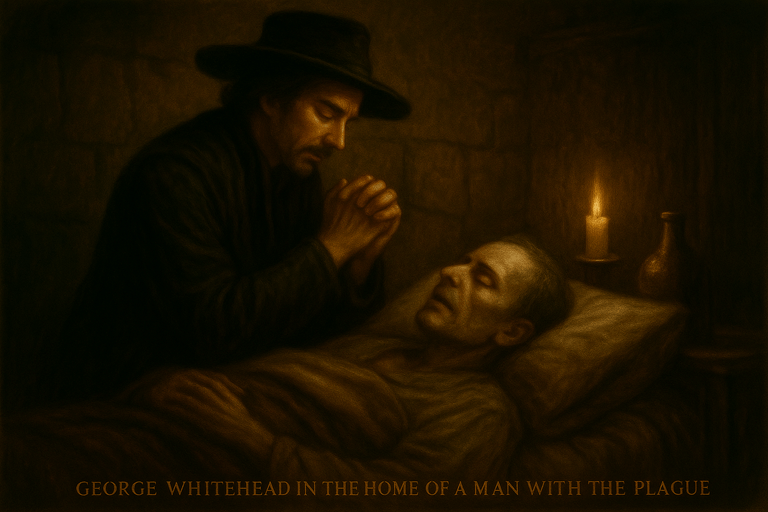
  • In the Time of Plague

    In the Time of Plague

    It’s been a couple weeks since I’ve written a blog post, and a treacherous ten days of deciding whether to feed or starve this cold or flu, whatever it is. And it’s been eight days since I’ve had the presence of mind to compose anything at all.

    As it happens, it is also time to be thinking about The 1665 Plague of London, a sequel to The Great Plague and a perfect driving force to whip up my story arcs and throw a little danger in the mix.

    Not that I need danger, I think as I blow my nose and grab another hand full of tissues, because my Quaker characters are living in a police state at this point, moving in and out of jail, fighting the good fight and so on. What I really need is to make it sound compelling, to put the reader there in the midst of it all.

    I had threatened to quit in my last blog entry, for lack of time to write. Then as our own mini plague set in at the Lawrence residence I had time to write while Eddie was sleeping late, recovering. I was suddenly inspired with the idea to do what I’ve always done as a reader–skip to the end and see how things go. Sure enough, the scene where Thomas Lightfoot escapes certain death while the prison billows into a conflagration around him was just the ticket. Even when he was up and about Eddie was more help than hindrance with his experience as a firefighter and interest in getting the technical aspects of the scene correct.

    I still have to go back and write the scenes of Charles II’s public and private marriage ceremonies, which promises hours of painfully deep research. Oh if it were only true I could get ChatGPT to write it! But then it would be full of anachronisms.

    In time it will get done. And that will be Part II, the goal of 100,000 words met, and my story only 2/3 complete.

    Sigh… I need to go lie down again.

  • The Monster Within

    The Monster Within

    I recently saw on a history program that Frederick Douglass had a “thinking cabin” the family called The Growlery. One can imagine him stomping straight to his cabin at the end of a hard day in politics and growling away at the walls. He was like so many brilliant creators who have been known for their tempers, especially when they needed privacy to create.

    So I was not surprised to hear this, but I was incredibly jealous. A cabin to go to, and people leave you alone.

    Sometimes I want to scream, “LET ME WRITE!” but my daughter keeps bringing these absolutely delightful foster grandchildren to the house and they can’t be denied. As Bluey teaches us, there will always be another time to watch a game…or to do the actually important things Mum and Dad must do. Ok not really a fan of the spoilt children show, but I do see that there is only a short window of time for toddlers and it must be cherished. Though I did admit the other day I chose writing time over Grandma time.

    And I actually feel a bit bad about that choice on that day, because so far, the folks who promise to read my Chapter 1 (I never ask for more–let Chapter 1 do the heavy lifting of enticing readers if it can), never offer any feedback. Except my sister, who decided to start editing it and then got too busy. Which is probably for the best.

    But as I also mentioned in my Writing in Absentia post, I have a whole 17th century universe in my head. It is an accumulation of researched facts that begs to be shared, and a budding love story, a boy in prison, changes in dynasties, and new worlds, and so on! GAH!

    I did have a desk once. As the primary income earner working remotely, there was always an office somewhere as we flipped our way through houses. But then I retired and I gave away my desk. Instead I’m writing from the comfort of my recliner with a lap desk. The cat tries to worm her way in between me and my laptop, but we have developed a deal where she gets her attention at 4pm. Or did.

    And I say these things in past tense because now I have stopped writing. Period. I am attempting to shed myself of my own love story with my book and my characters, and focus instead on the children and on spending my time with my husband (who to be fair just had a scary thing happen with his heart). And let me be clear for your commiseration that spending time with the hubby means endless hours of television or running errands. Frederick Douglass would have gone mad.

    The creators of Bluey are right; I will not end my days wishing I’d written more. Well…unless somebody reads my Chapter 1 and says, “Oh my gosh this is an incredible story–when are you going to finish it?!” Which might be my dream or my nightmare at this point.

    I must tell you, though, that there is a monster within me, and it’s bloody well uptight.

  • Real People

    Real People

    There’s a lot of concern about AI-generated scripts and movies, but consider that the characters have to come from somewhere. As they say, truth is always stranger (and more interesting) than fiction. I can only suppose this is why I’ve found that AI is rather bad at manufacturing all the minute details of a fully-fledged person, even over the space of a brief scene.

    My experience with the admittedly free ChatGPT has been that it might give me a few pretty words but it doesn’t understand or explain humanity and its motivations very well. If you want a scene with any depth, it still requires real people (me, in this case) describing real people.

    And while I admit I sometimes use known actors to populate a given scene as I write, every circumstance and public novelty around me becomes fodder for the pen. And this, the peripheral vision of the people-watchers who write, is something AI can’t obtain even from analyzing every word ever written, from the Icelandic sagas to the vast content on Newspapers.com. It can’t discern the intangible meaning of an unremarkable moment.

    Here is an example. Back in 1981 when I was the local ingénue for a hot minute in our small Oregon town, I enjoyed singing light opera and show tunes wherever I happened to be, even on my solo shift at a place called Stoopid’s Hot Dogs. (Loved that job, and those dogs are the ones, in my opinion, by which all dogs are measured.)

    One day a man, probably in his mid-twenties, came in and sat for awhile in our tiny shop, for which the only furniture was a hard wooden bench set against the wall, not four feet from the counter. No idea whether he ordered anything. I don’t even know if we spoke at all–he just wrote in his notebook and I sang. Obviously it struck me at the time because even though I remember little of that job some 45 years later, I still wonder what that guy wrote. In the same circumstance now I might compare the vocal freedom of the young to the inevitable churning of life that turns us all into sausages for sale.

    You might imagine a future where AI analyzes facial expressions and the collection of circumstances around us, but it will always miss the heart and soul of such a moment. My findings over the course of this project is that it can barely keep up with people’s names, sex, the items they have, among other key details.

    Hollywood being a fickle mistress, perhaps my POV has little meaning and all of our theatrical releases will soon be populated only by manufactured SimOnes. But I’m guessing there will always be an audience for real actors just like there are always audiences for stage plays.

    As far as this author’s most recent human conquest, last month in my heavily-researched Charles II chapter I decided to have him play a period guitar. Enter Lauren of Claythorpe Music and everything I needed to know about period instruments and songs. As a bonus she also discussed Playford’s Dancing Master which I felt compelled to mention in the scene in an appropriately mocking gesture, per the info I got from Lauren.

    Since the king has a guitar in his Council Chamber, he obviously needs a guitar tech. I was happy to name this character Claythorpe and give him several bits of amusing business. The jury’s still out on whether I will make him a her for Lauren’s sake, but in either case I hope she would be pleased.

    Side note: I suppose these days when anyone including a passing Google Street View car can capture your likeness, it’s not such a novel idea that any of us might find ourselves in a meme somewhere, either as image, statement, or passing reference. But if you don’t want to end up in someone’s script or novel, it’s best to avoid writers and their muses altogether, especially on YouTube where we troll for information.

    Like AI, we are greedy for details.

  • The Restoration’s Lash

    The Restoration’s Lash

    November, 1660

    A hard wind blew dry leaves against Whitehall’s towering windows. Inside, beyond the heavy oak doors that guarded the entrance, the long corridor now shone with newly-polished marble columns and flickering sconces. It was no longer the plain, functional passageways of the interregnum, but instead a procession of grandeur restored—walls hung with tapestries depicting the Tudor rose and Stuart lion, gilded frames containing portraits of monarchs past staring down like silent sentinels. Chief among them and most prominent was Van Dyck’s portrait of Charles I with his family, a declaration in itself.

    The floor was laid with a carpet woven in deep reds and blues. A close inspection might reveal places where it was worn thin by decades of shuffling feet; however with a trade war yet raging, now was not the time for such repairs.

    Footsteps echoed ahead; Charles Stuart with sure tread made his way with attendants in tow, passing beneath the portrait of his father. The light was fading, pale through the high windows and throwing long shadows that mingled with the golden candlelight that already burned in heavy brass chandeliers. There was a sense of power still unsettled; haunted by years of exile.

    The group entered a chamber at the far end of the hall; the monarch’s chosen place of meeting, as it had been for those who came before him. The chamber where the Protector once sat in plain buff coat was now half-filled with disused trunks and moth-eaten hangings.

    Two members of His Majesty’s Privy Council had convened to bring news and discuss the unrest still simmering beneath the surface of his restored realm. The door was flung open, revealing a room both sumptuous and commanding.

    Inside, a long table of dark oak stretched between two banks of windows, each pane bordered with lead and diamond-cut glass. Heavy curtains were drawn aside, revealing the Privy Gardens, now reeling from the winds that cruelly tore the leaves from carefully cropped branches. Charles took note as he entered, always the botanist.

    He passed walls hung with rich tapestries, their threads catching the candlelight in a way that made the images shimmer—scenes of English victories and royal triumphs, of kings crowned and realms united. A vast fireplace carved with heraldic lions and dragons dominated an entire wall with a fire that crackled and spat to life. Charles made his way to the windows, remembering again the years he had enjoyed this same view—though it was very different now.

    He watched as the wind came in gusts off the Thames, driving spray against the stone and sending dead leaves swirling across the neat lawns. The trees bent and twisted like supplicants in some ancient ritual. Charles seemed for a moment less a king restored than a gentleman of leisure gauging the temper of the elements.

    A light cough behind him advised that he was expected to take his seat in the grand chair at the head of the table—a throne of carved oak, gilded with gold leaf, the arms terminating in fierce lion heads that seemed to leer at the gathered men. To the right of it Edward Hyde, Lord Chancellor, stood expectantly in heavy robes and powdered wig. He was man whose sharp eyes missed nothing. His voice carried the cool authority of law hardened by years of political survival.

    Opposite him stood with rather more impatience John Maitland, Duke of Lauderdale, a soldier and politician both, his bearing lean and intense, his gaze restless and calculating. He was a man used to command, used to pressing advantage, and well acquainted with those who sought to challenge the status quo.

    The Chancellor leaned slightly. “It is a fine prospect, Your Majesty. But even the neatest garden will not withstand a winter such as this promises to be.”

    “You would be amazed at the strength of such trees,” Charles replied, gesturing toward the embattled yews. “Left alone, they would overrun every wall and path, as with our Roman ruins—still standing after fourteen centuries—our present craft can scarcely match the old strength. The masons of England have chased Roman concrete for generations, yet even now we build with envy.”

    He turned and sat, his voice carrying a hint of amusement. “They tell me Cromwell had the gardeners mending these grounds for months, then locked the gates to all but himself—the old Puritan fox. I mean to open them again—when the treasury can bear the cost. And perhaps a sundial I have in mind that will tell far more than the day’s time,” he added, one brow arched, “to remind our people that the House of Stuart holds a finer command of science than any commonwealth could boast. Cromwell, for all his sums and calculations, was a mere dabbler.”

    The king’s mind, like his forebears’, ran to instruments that marked not just the hour, but the harmony of the heavens themselves. “But that will wait,” he said, “until the kingdom’s debts are stanched and the accounts stop bleeding like a bad wound.” He settled into his chair, and despite the magnificence surrounding him, the king’s posture was cautious, almost tentative, as though the weight of history pressed upon his shoulders more than the soft velvet and ermine could conceal.

    Hyde cleared his throat, breaking the silence with a hint of wryness.

    “Your Majesty, I spoke with Mr. Pepys recently. You recall, the diligent clerk who accompanied your return from exile?”

    Lauderdale grunted. “Pepys says the weather of this century is worth noting in his diary. Records the temperature as though it were a state paper.”

    “Aye,” Charles chuckled, “and I like him for it. Pepys is no sailor, yet we have given him the Navy. He asks what others are too proud to ask—and that may save us from another Dutch humiliation. He tells me he has lately tried a tea from China that was quite extraordinary.”

    This brought a smothered laugh from Lauderdale. “Then he has not travelled as we have. Your interest in Portugal made us well-acquainted with their fetish for this China tea.”

    Hyde added, “One would think his sailors would have told him, for they claim it warms the body against biting winds.”

    Charles’s mind turned. “And what of your meeting? Tell me of the marriage.” His eyes darkened with calculation. “It is our hope this agreement cools the fires of dissent in our midst.”

    The Chancellor inclined his head. “It is all but sealed, sire. The treaty is signed, though the formal ceremonies await the spring. Still, the agreement binds us now. A useful alliance, strengthening our hand against Spain and France alike.

    Maitland added, “She brings not only a dowry but ports—Tangier and Bombay—gifts that expand England’s reach and influence.”

    The Lord Chancellor’s tone shifted, his fingers tightening on the desk. “And yet, Your Majesty, not all fires are quelled by marriage. If we are ready for our next business?” As both nodded, Hyde continued, “We have petitions from the ‘Georges.’”

    His majesty groaned. “These Quakers! Queen Elizabeth would have swept them from the realm before they’d learned to call a meeting.”

    Again, the unfortunate Chancellor coughed, and the duke nearly asked if he was suffering from cold. But Hyde continued, “There is another petition, quite similar, from Lady Fell. Both speak of change with quiet but firm conviction.”

    Maitland’s gaze hardened. “They may say they seek peace ‘quietly,’ but their refusal to bend threatens the order we are charged to preserve. As for this woman, she is a known trouble-maker. Entertains the heretics at Swarthmoor all the more now her husband is dead.”

    Charles shook his head. “Has her son no spine to bring his house into order?”

    “Thomas Fell left the house and grounds to her, to prevent marriage with one of these dissenters. It was to preserve the family, though an ill choice to my mind.”

    At this the king turned fully, unfolding the petitions deliberately. “Then let us give our answer speedily, for I fear she will gather all the women of the gentry to her bosom lest we act with authority for the realm’s peace, and for the Crown’s future. We hardly need another dissenter to overtake these grounds.”

    The wind gave a sharp knock at the windows, as if to punctuate the thought, and the king looked at his two advisors expectantly.

    Hyde was first to reply, his voice a rasp like dry parchment, “Sire, the chief difficulty is that these petitions are brought for as in humility, yet the very words strike at the root of our Church and Crown, threatening the very order that holds this realm together. You are correct; to permit such dissent unchecked invites even greater chaos than the last reign’s failings.”

    Lauderdale nodded sharply, eyes hard. “They refuse oaths, spurn the militia, reject lawful authority. Their meetings disrupt the peace. This faith is but sedition in disguise.”

    Charles sighed impatiently. “Yes, yes, all are agreed. What is your counsel?”

    With a gaze sharpened with resolve, Hyde set forth the plan he had been crafting since Cromwell’s death. “The Corporation Act, Your Majesty. Soon to be presented to Parliament. It will secure municipal offices for those loyal to Church and Crown, requiring oaths that exclude these recusants. Constables under the old regime held sway, but many proved timid or corrupt. This law ensures municipal authority remains steadfast and uncompromised. Their influence will be curtailed; their gatherings suppressed by law.”

    Lauderdale’s eyes darkened. “The militia must be ready to quell disturbances swiftly and decisively. Constables alone cannot withstand the uproar—those howling sectaries, disrupting worship and irritating ministers and magistrates. Nor even the ministers and magistrates inciting mobs against these Quakers. Let us be clear–loyalty is not a matter of convenience but an unyielding allegiance to King and Church alike. But above all we keep the peace.”

    The king considered his council, voice steady and firm. “Let the law bind all subjects equally. None may claim conscience as a shield from obedience. Disorder will find no refuge in these realms.”

    The chamber quieted, the candle flames flickering like watchful eyes as the weight of the decision settled. Outside, the wind whispered through bare branches, carrying rumors of unrest that would soon swell into storm.