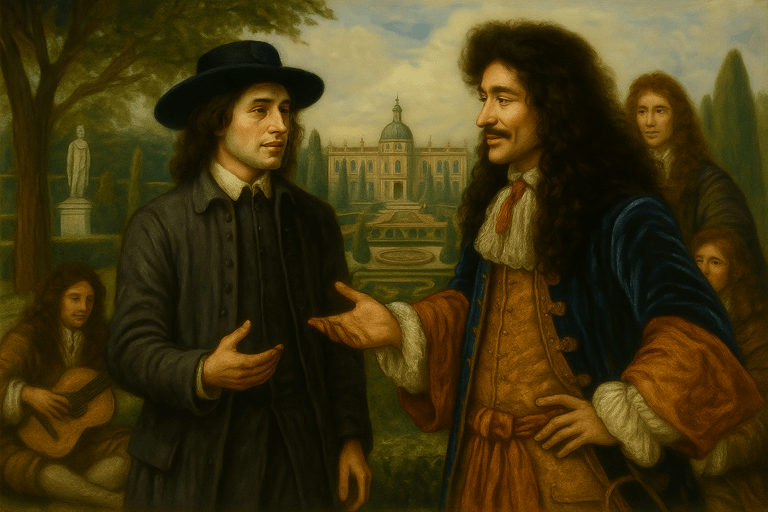
As my time with Charles II stretches on toward a month together, I feel as though God is staying my hand from finishing the scene where he calls down fury upon the Quakers. And rightly so, because every day some new fact arises that educates me further on this pivotal moment in history. Especially on the point of who was to blame for making life intolerable for our Spirit-filled Friends.
Recently, while Eddie and I were fishing around YouTube for something interesting to watch (Time Team is a favorite and has informed a surprising amount of this work), we stumbled across a video about John Bunyan, the author of The Pilgrim’s Progress. Even if you’ve never read it, you may be aware of the book as I am from its use in Little Women by Louisa May Alcott. The book is not just mentioned, but was used by Alcott as a framework for the entire story.
Well as it happens, Bunyan was arrested in November 1660—the exact date of my scene. Now he needs a mention.
Bunyan, Whitehead, and Charles II
Thanks to the wit of our Quaker George Whitehead (and the King’s appreciation of wit), he met several times with Charles II even though he was considered by many to be a troublemaker. Meanwhile the Baptist John Bunyan, who would go on to write his international best seller from prison, was distinctly disliked by the King. Why is that, if both Dissenters were religious malefactors?
Perhaps Bunyan was a poor conversationalist or worse yet, too free with his judgement of Charlie’s lascivious lifestyle. Though I’m sure George arched a disapproving eyebrow as well. Who can explain why we vibe with one person and not another?
The Case for Tolerance
The fact is, the King was a closet Catholic and could have used some religious tolerance for himself and his soon-to-be bride from heavily Catholic Portugal. Moreover, the Lord Chancellor and Charles’ closest advisor Edward Hyde, 1st Earl of Clarendon, was a staunch Anglican/Episcopalian. While he was free to be Anglican again at this point, he had been forced to keep a low profile during Charles’ exile in Scotland. Both men had every reason to lobby for at least some level of religious tolerance as the country moved forward.
The Clarendon Code and Its Reach
This brought me to Clarendon’s proposed “Quaker laws.” At first intended to keep order, they became crueler when Parliament took them up and shaped them into what would be called the Clarendon Code, parts of which remained in effect for more than 150 years.
One part banned religious meetings of more than five people. In practice, that meant a pair of plain-dressed Friends speaking quietly in the street could be seen as conspirators. Enforcement relied on constables and informers—paid for turning in offenders. This created an atmosphere some historians liken to a police state.
The Presbyterians were also swept up in this. As a result of the Code, ministers who had served in parishes in the past century since the Reformation were suddenly required to take communion from the Church of England. More than 2,000 ministers refused, losing their pulpits and their livelihoods. No wonder so many Presbyterians, alongside Quakers, later found their way to Pennsylvania.
My Writing Crossroads
So, back to Charles II and Clarendon. Did they simply say, “Send all the Quakers to jail!”? No. They actually tried to shield Presbyterians from the worst of the laws, even though their patience with radical dissent was thin. Charles still disliked Bunyan. Clarendon still wanted order.
Oh and lest I forget, there is also Lady Margaret Fell’s petition to account for—she was bold enough to proselytize across the peerage and lobby for women’s rights, which became intrinsic to the Quaker movement. So you have the Crown caught between Fell’s influence from above, Bunyan’s in the streets, and the restless clergy in their pulpits. It’s no wonder the King and his advisor felt pressed to act.
My task now is to imagine how Charles and Clarendon could sit together, weighing these voices, and convince themselves that laws restricting worship were not persecution but peacekeeping. To prevent mob violence, to steady a kingdom still raw from civil war, and another unfortunate necessity—to continue the flow of tithes to the Church of England, which supported not just churches but libraries, universities, and hospitals.
That’s where my pen hovers today. I’d love to hear your thoughts. Comment below.
Our story from the beginning: Prologue
 Friends of Freedom