Tag: religion

  • A Tip of the Scales of Justice

    A Tip of the Scales of Justice

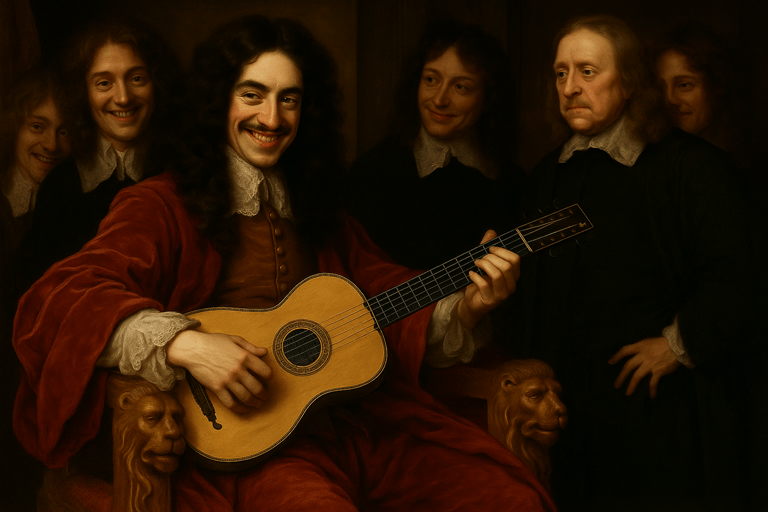
    Having finished with my introduction of Charles II and his courtiers, I have moved on to another research-heavy chapter: how the punishments for Quakers were ramped up by the House of Lords in spite of the King’s desire for tolerance.

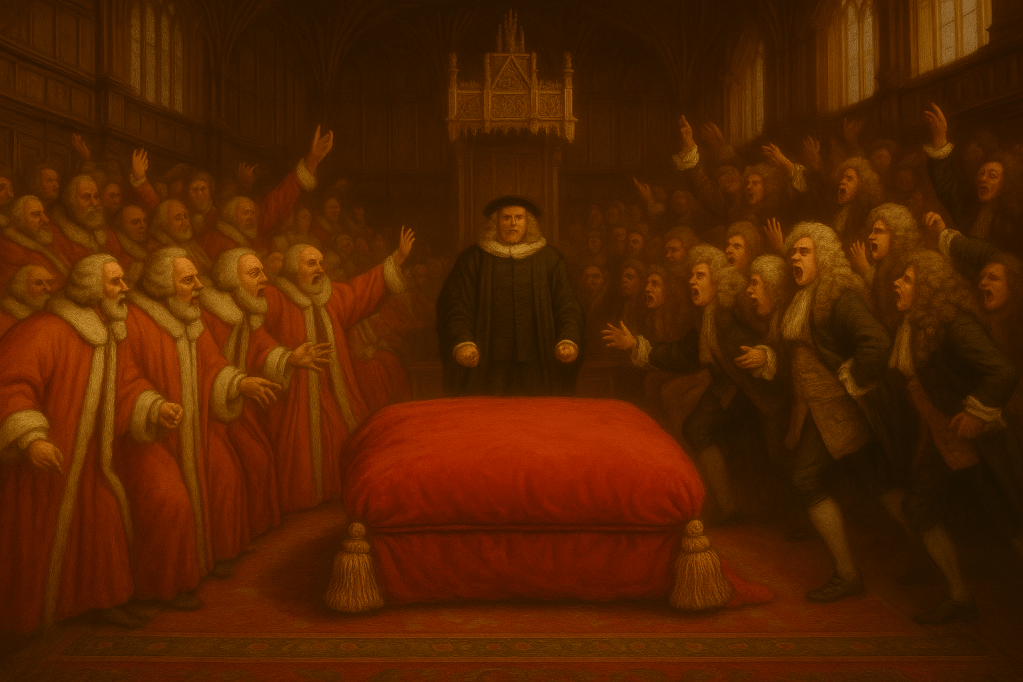
    It has taken many hours of inquiry in the form of discussions with both Google and ChatGPT-5 about what the chamber looked like at the time, and the characters involved on both sides of the aisle, and of course a lot of writing and rewriting to get from the starting point of the King’s request to the ending legislation that created what amounted to a police state throughout England. The Quaker Act punished severely any perceived religious meeting of five or more people, and suddenly any thief or drunkard could lessen their fines by turning someone in.

    It helped that Eddie happened to watch a meeting of the House of Lords recently. I was shocked at the yelling back and forth and how it appeared to me like an undisciplined high school debate, sprinkled with calls of “Here-here!” and a great deal of booing and even the stomping of feet. So that had to be worked in as well.

    All of which brings to mind, as does every chapter and sometimes individual paragraphs, the similarities between those times and these. Turbulence. The will of the people, however divided they may be. The will of lawmakers. The will of the heads of state. How can there be peace on earth when there is a continual sense of dissatisfaction with the status quo and a desire to improve juxtaposed against the wealthy protecting their funds?

    As Christians, we are taught by the Bible to continually seek to be more like Jesus. To forgive seventy times seven, to love the unlovable including ourselves, to refrain from even calling anyone an idiot because in doing so we destroy them as a person. But there is also a desire within humanity for better, for more, for improvement of our personal circumstances. All of that is the individual stuff. Layer over that the call to improve our church body. And over that the desire of the clergy should they oppose us.

    And then this is where my eyes cross, because as a free person in a free country, I have always had the ability to just leave if I wanted. Imagine if your church was assigned, and the clerics above you were assigned, and you could not “wipe the dust from your feet” if you disagreed with them. I have said before that money was the issue and if you follow the money it pretty much stinks to see how the wealthy bishops used it. And this week I discovered how the bishops were squandering the hard-earned tithes of the people, by doling out livings to any who would support them in their careers.

    As a result of their legislation, there was a period when Quakers who threatened this way of existence were exiled to plantations in the American Colonies or the Indies.

    Once I complete my work on this chapter, the next one examines this police state and how even the mercy of the King could not save his subjects. And how some people cheered and others felt justice had been done. Sound like anything happening in our world today?

    I grew up with a generation of elders who had witnessed the worst in people, and who were proud to say that we, the people of the United States, had helped put an end to hatred and antisemitism. Imagine my horror to find that my generation should actually bear witness to its return. And that Christians of all kinds could have targets upon our heads.

    I’m not so sure this book is about Quakers or even about Spirit-filled youth. As God leads me through the story, it seems to be about how a society can be divided against itself and one citizen can turn against another, both believing they are in the right. And let us not forget the money that stokes the divisions.

    Thoughts on the matter? Leave a comment.
  • John Bunyan, Quakers, and the King in a Tight Spot

    John Bunyan, Quakers, and the King in a Tight Spot

    As my time with Charles II stretches on toward a month together, I feel as though God is staying my hand from finishing the scene where he calls down fury upon the Quakers. And rightly so, because every day some new fact arises that educates me further on this pivotal moment in history. Especially on the point of who was to blame for making life intolerable for our Spirit-filled Friends.

    Recently, while Eddie and I were fishing around YouTube for something interesting to watch (Time Team is a favorite and has informed a surprising amount of this work), we stumbled across a video about John Bunyan, the author of The Pilgrim’s Progress. Even if you’ve never read it, you may be aware of the book as I am from its use in Little Women by Louisa May Alcott. The book is not just mentioned, but was used by Alcott as a framework for the entire story.

    Well as it happens, Bunyan was arrested in November 1660—the exact date of my scene. Now he needs a mention.


    Bunyan, Whitehead, and Charles II

    Thanks to the wit of our Quaker George Whitehead (and the King’s appreciation of wit), he met several times with Charles II even though he was considered by many to be a troublemaker. Meanwhile the Baptist John Bunyan, who would go on to write his international best seller from prison, was distinctly disliked by the King. Why is that, if both Dissenters were religious malefactors?

    Perhaps Bunyan was a poor conversationalist or worse yet, too free with his judgement of Charlie’s lascivious lifestyle. Though I’m sure George arched a disapproving eyebrow as well. Who can explain why we vibe with one person and not another?


    The Case for Tolerance

    The fact is, the King was a closet Catholic and could have used some religious tolerance for himself and his soon-to-be bride from heavily Catholic Portugal. Moreover, the Lord Chancellor and Charles’ closest advisor Edward Hyde, 1st Earl of Clarendon, was a staunch Anglican/Episcopalian. While he was free to be Anglican again at this point, he had been forced to keep a low profile during Charles’ exile in Scotland. Both men had every reason to lobby for at least some level of religious tolerance as the country moved forward.


    The Clarendon Code and Its Reach

    This brought me to Clarendon’s proposed “Quaker laws.” At first intended to keep order, they became crueler when Parliament took them up and shaped them into what would be called the Clarendon Code, parts of which remained in effect for more than 150 years.

    One part banned religious meetings of more than five people. In practice, that meant a pair of plain-dressed Friends speaking quietly in the street could be seen as conspirators. Enforcement relied on constables and informers—paid for turning in offenders. This created an atmosphere some historians liken to a police state.

    The Presbyterians were also swept up in this. As a result of the Code, ministers who had served in parishes in the past century since the Reformation were suddenly required to take communion from the Church of England. More than 2,000 ministers refused, losing their pulpits and their livelihoods. No wonder so many Presbyterians, alongside Quakers, later found their way to Pennsylvania.


    My Writing Crossroads

    So, back to Charles II and Clarendon. Did they simply say, “Send all the Quakers to jail!”? No. They actually tried to shield Presbyterians from the worst of the laws, even though their patience with radical dissent was thin. Charles still disliked Bunyan. Clarendon still wanted order.

    Oh and lest I forget, there is also Lady Margaret Fell’s petition to account for—she was bold enough to proselytize across the peerage and lobby for women’s rights, which became intrinsic to the Quaker movement. So you have the Crown caught between Fell’s influence from above, Bunyan’s in the streets, and the restless clergy in their pulpits. It’s no wonder the King and his advisor felt pressed to act.

    My task now is to imagine how Charles and Clarendon could sit together, weighing these voices, and convince themselves that laws restricting worship were not persecution but peacekeeping. To prevent mob violence, to steady a kingdom still raw from civil war, and another unfortunate necessity—to continue the flow of tithes to the Church of England, which supported not just churches but libraries, universities, and hospitals.

    That’s where my pen hovers today. I’d love to hear your thoughts. Comment below.

    Our story from the beginning: Prologue

  • Party Hearty Charlie!

    Party Hearty Charlie!

    I’m now two and a half weeks into the life of Charles II. The info keeps coming, like a firehose. There are so many complexities to his character, and ChatGPT tells me that while he is not the main emphasis of the story, he is a “hinge point” that must be addressed. Google tells me, “a hinge point in a story is a pivotal moment or event that causes a significant, often irreversible, change in the direction of the plot or a character’s journey.” So Charlie gets all the attention for now, until I can get past him.

    What a card this guy was, and what a departure from the austerity of Oliver Cromwell. I find myself wondering just how much I need to go into his rather sordid life; especially as I see this book becoming an important read for teenagers who are trying to understand what they believe, as I learned this week from a Kirk Cameron video. (Seriously, he learned on-camera that his kid became an agnostic for awhile.) So now I want to provide

    All of these questions about the personal faith of teenagers leads us carefully away from the man who *ahem* fathered many children but not one in wedlock who could be an heir. However, he had a soft side. He refused to divorce his barren wife (kind of the whole reason the Church of England was created, amIright?). He also remembered generously those who helped him escape to exile–even those who were Quakers.

    The reason it was under Charles’ rule that the Quakers suffered most is in fact because he was so lackadaisical he allowed his closest advisor to run things on the Quaker front. Was this guy just evil in his hatred of the Friends? Evidently no. Google tells me the First Earl of Clarendon wanted to be more lenient in what would be called the “Clarendon Code” but the new Parliament, called the Cavalier Parliament, went a more ruthless route. So now I have to decide how to cover all that in a way that is both informative and compelling.

    GPT-5 tells me that what George Whitehead takes from all this is that government is mercurial. What I know is that God is faithful. Kind of what young David learned when his pal King Saul went on the occasional murderous rampage.

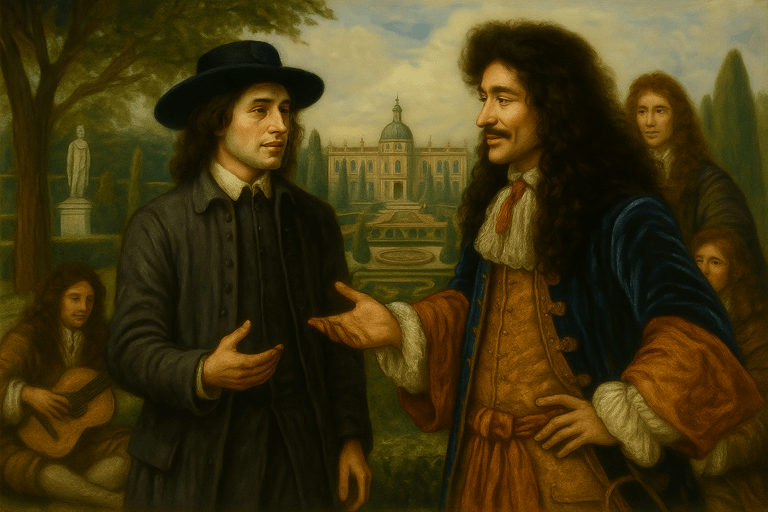
    So while I go back to my writing struggles, here’s a highly entertaining Charles II video from the Horrible History crew. This is why I’m portraying him like a modern celebrity with his posse on the sidelines!

  • GPT5 and Now What?

    GPT5 and Now What?

    I can’t believe I gained followers because I mistakenly pasted a section of my latest chapter into a post. Like our little Quaker Tom, I am thankful for a prayer answered in a strange way, because I really have been asking for encouragement, and your follows have indeed encouraged me.

    That being said, I’m not so sure about posting chapters independently going forward because it seems like it would be hard to follow. Anyone with thoughts on the matter please comment.

    Meanwhile, I am facing a challenge that will surprise nobody—GPT5 is far less helpful than its predecessor. As I discuss in this video, ChatGPT was amazingly helpful when I started this endeavor and I was even a little concerned it deserved credit for doing a chunk of the work. But as I developed more content I realized that AI is still just a big encyclopedia compiling and spewing back the information that is already out there (inaccuracies and all). Even if it does so in the style of Isaac Asimov.

    At the same time, this is not like writing alongside a sane person. In my video I compared it to writing with a brilliant college Freshman, but one that is really not paying attention to what you’re trying to do. It doesn’t get humans at all.

    I have come to see AI as the tool that it is, like upgrading from a horse and plow to a tractor. The farmer doesn’t worry that he’s not giving enough credit to the tractor for his increased yield. Rather, he does the work of figuring out the tractor and reaps a fine harvest for his investment. But that was version 4. To carry on my analogy, it’s now as if I had a very serviceable tractor and someone took it away and replaced it with Jeremy Clarkson’s Lamborghini tractor. Which is maddening. [If you don’t get the reference, watch Clarkson’s Farm. Know the plight of the British farmer.]

    So now I am halfway through my book, and AI has helped me infuse my story with a glorious depth of Asmovian detail. Maybe too much at times, but if you want to be steeped in 17th century England, you’ll need to wade through some descriptive paragraphs.

    Although this may only be true for the first 50,000 pages, because my cohort is suddenly stupid, and not in a brilliant way. Or perhaps it’s now designed to be very unhelpful for authoring novels.

    Let me be specific. Whereas before I could ignore its last prompt to rewrite the prior passage with even more detail (and wiping away some really good prose in the process), and instead move on to another question about period or character development, the new version answers my every question by, yes, rewriting the last scene in a novel way. I can’t get it to move on. I am now on my third novel-related session because the first one can’t finish the graphic I requested, and the second one is stuck on the scene rewrites.

    Full disclosure…I am writing all of this without paying $20 for a month of the personal plan, so I suppose my next step is to pony up the cash and see if it helps. Although my hopes are not high because I’ve seen a number of complaints about 5 on X and Substack.

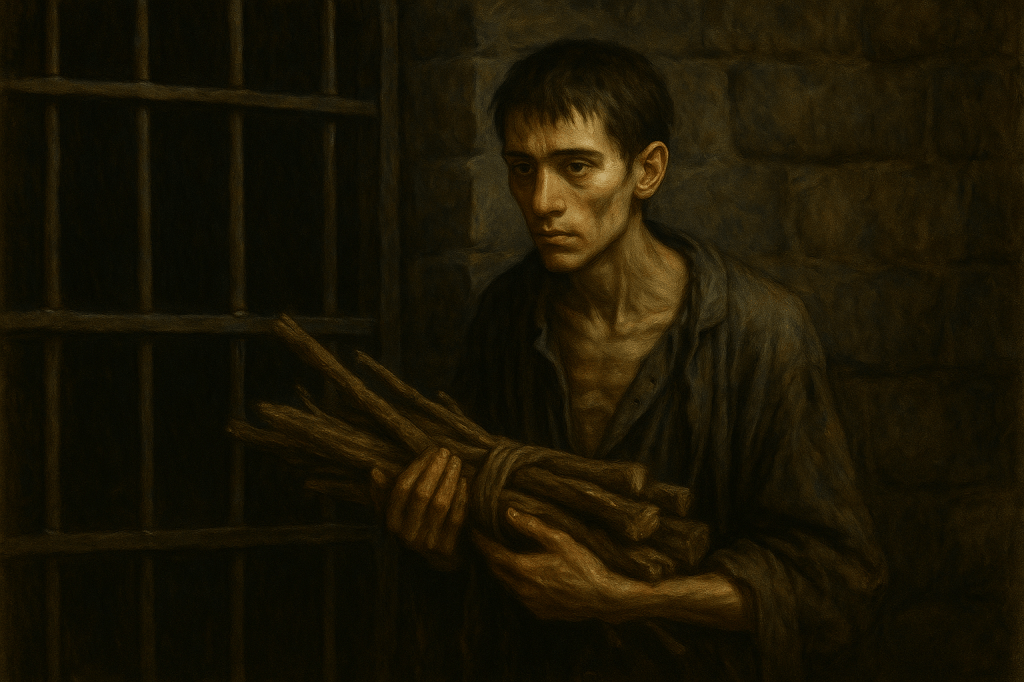
    Ok enough complaining. For those who are following along, my most recent work fills the gap between the two scenes in Under the Shadow of Persecution where I bring a now-sober Duffy back into the picture. This section also develops Tom’s religious character, as we bring him more in line with the Quaker-famous Thomas Lightfoot who emigrated to Pennsylvania in 1712. Let me know your thoughts!

    [Picture by Sora, which admittedly builds far better graphics than the ones created in the chatbot]