When I started this journey, I was able to take advantage of a 9-week stay of marital execution. By which I jokingly mean, my husband was in England with his family and new grandson for a couple months and I was free to favor the execution of my work as a writer over my duties as a wife.
As a result, Part I of this work flew by like a breeze, just me and ChatGPT-4 whistling while we worked.
Back then, I would turn off the TV at 9am and write sometimes for the next 12 or 14 hours. At one point I completely forgot to attend a potluck until two hours after it ended. Fortunately I had put my ice cream cake in the church freezer the day before.
Today, four weeks after Eddie’s return, my work has slowed to a crawl. Not all his fault. I have posted about my difficulties with Charles II and all the intricacies of his court, as well as the need to press the pause button earlier this week as I sought additional information.
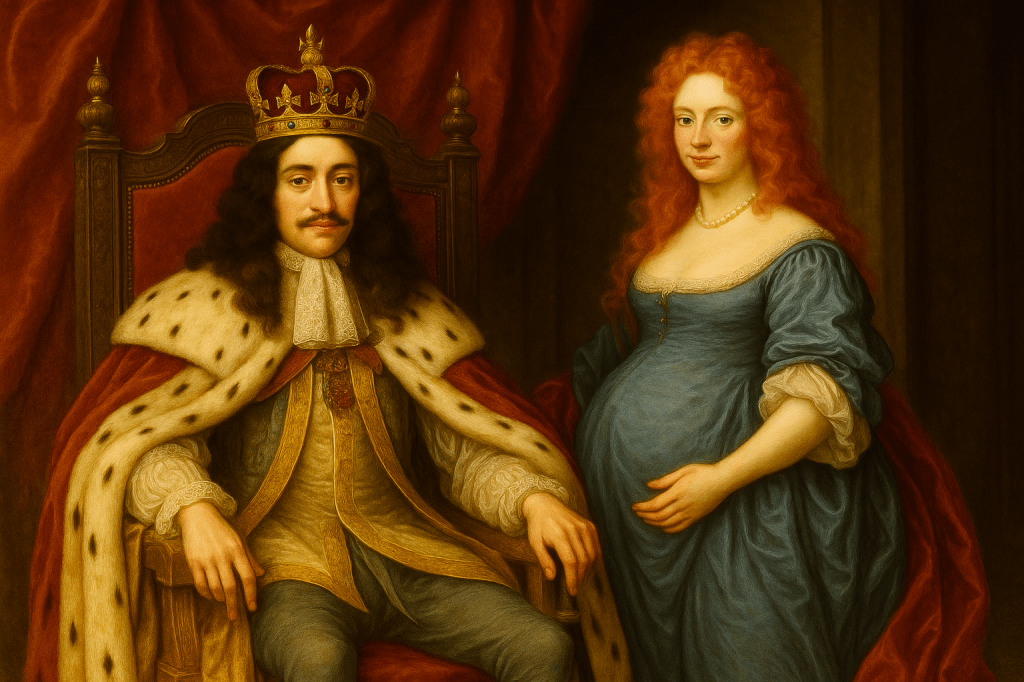
I believe what I was supposed to pause for was this: I had begun my written portrait of Charles II by having him followed into the great council room by a band of hangers-on, like a Leonardo DiCaprio posse. But as I watched hours of historic videos about Charlie 2, I realized the premise I have been following–that George Whitehead had an impact because his intelligence appealed to the king–would have been true of everyone the king surrounded himself with.
That means, if this king had a posse, the least of these had better have some good witticisms to share. And more to the point, as I realized in the middle of the night recently, his mistresses would not have been air-heads either. So off I went to Google the next morning and yes, Barbara Villiers was a very bright woman who ran the palace (even with Queen Catharine there) for a decade. She was instrumental in the decision to sell the French port of Dunkirk back to France, mainly to support her lavish lifestyle.
Even more influential was his next dalliance with the French noblewoman Louise de Kérouaille, who had a foot firmly in the household as a lady in waiting to the Queen. Louise acted as a French spy, influenced Charles in ways that would be advantageous to her country, and blatantly sold access to him. It reminds me of those stories you hear about pop stars whose lives are run by someone who gets close to them. I’m sure you can think of modern examples.
So my task in the last couple days has been to understand those who were not in positions of authority, but who had access to King Charles II, and then to reimagine a scene where an intelligent woman inserts herself even in the Privy Council. The only problem is…I’m back to being half of a partnership. One in which we are flipping properties in an attempt to gain a foothold in an ever more inaccessible housing market. We’ve managed to purchase a property with a trashed-out mobile home an hour outside Raleigh.
That means long drives to submit permits and arrange utilities. Luckily I didn’t have to be there to watch the destruction of the trailer and subsequent brush clearing. Although as a good wife I did have to watch the videos and respond with encouragement.
After errands today I managed to get back to my story just before 2pm. An hour later Eddie asked if I wanted to go spend time with the kids. Not to be a bad grandma, but honestly, there is an entire universe in my brain. One with a boy starved and starving himself in prison, our young hero George Whitehead arguing compassion and human rights in the middle of a century that was tussling over the direction the Protestant Revolution should take humanity, and a wild and crazy king who was leaning toward religious freedom for his own secret reasons.
So my response was…no.
I asked Google for a good writer’s joke. Here’s what I got: “If you need me, I’ll be in another world for the next few hours. Don’t worry, I know the way back…mostly.”

 Friends of Freedom